TEKS Math 2.8.E
The Standard
decompose two-dimensional shapes such as cutting out a square from a rectangle, dividing a shape in half, or partitioning a rectangle into identical triangles and identify the resulting geometric parts
Texas Essential Knowledge and Skills for Mathematics
Teacher's field guide
What This Standard Means
What Students Need to Do
- Students split squares, rectangles, and other flat shapes by cutting or drawing lines. They name the smaller shapes created and decide whether the parts are identical or equal halves.
What Mastery Looks Like
- Students can cut or draw lines to break a shape into named parts. They can identify each resulting shape and tell whether the parts are identical or form equal halves.
Common Misconceptions
- Students may think the smaller pieces become different shapes just because they came from a larger shape. They may call pieces identical when the pieces have different sizes or shapes, or assume any line divides a shape in half.
How to Assess It
- Give students a paper rectangle and ask them to draw one line that makes two identical triangles. Have them name the original shape and the two resulting parts.
Lesson moves
Ways to Teach It
Give students paper squares and rectangles to cut into halves, smaller rectangles, squares, or identical triangles, then label every resulting piece.
Show two different ways to divide a rectangle and ask, “Which partition makes identical parts, and how do you know?”
Play Shape Split Match by pairing cards showing whole shapes with cards showing the same shapes partitioned into geometric parts.
Use a paper sandwich or cracker outline and ask students to divide it fairly between two people, then name the pieces.
Free download
Printable 2.8.E Worksheet
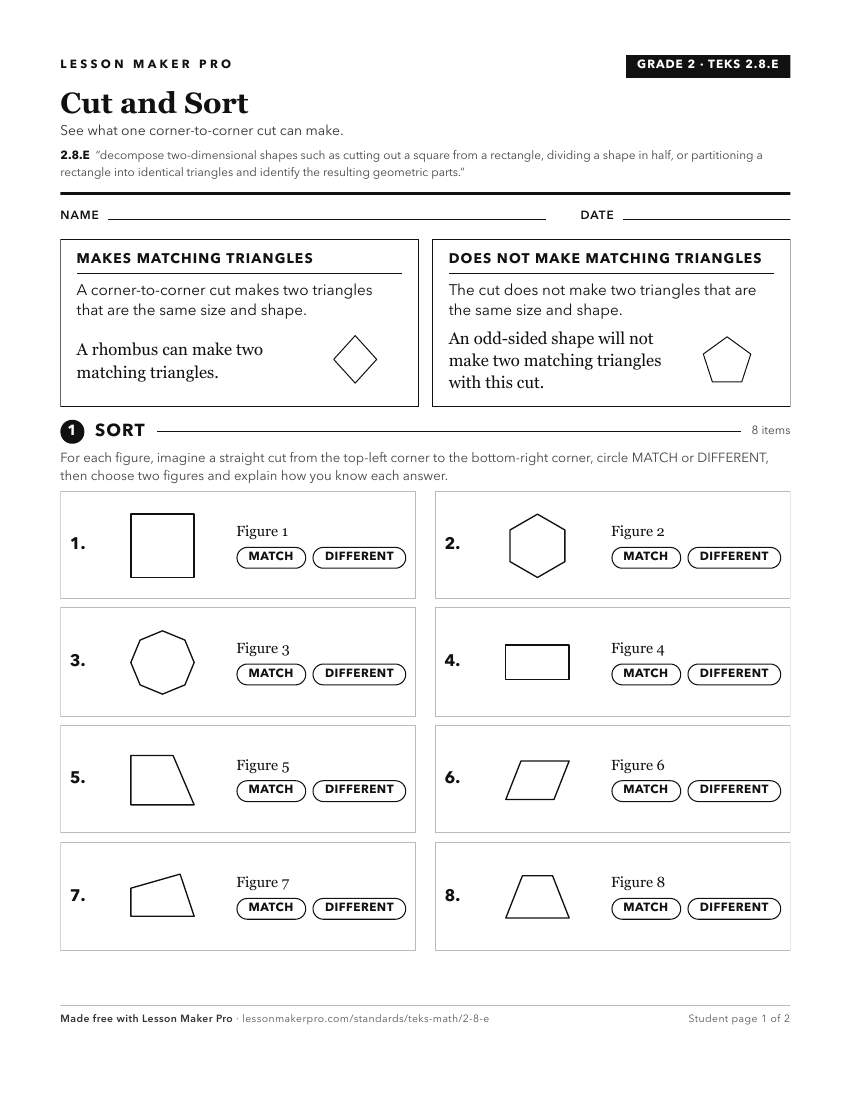
A ready-to-print activity worksheet aligned to 2.8.E, with an answer key for the teacher on its own page. No account needed.
PDF, US Letter, prints cleanly in black and white.
Download the worksheetKeep exploring
Related Standards
- 1.6.F
compose two-dimensional shapes by joining two, three, or four figures to produce a target shape in more than one way if possible
- 1.6.G
partition two-dimensional figures into two and four fair shares or equal parts and describe the parts using words
- 1.6.D
identify two-dimensional shapes, including circles, triangles, rectangles, and squares, as special rectangles, rhombuses, and hexagons and describe their attrib...
- 3.6.E
decompose two congruent two-dimensional figures into parts with equal areas and express the area of each part as a unit fraction of the whole and recognize that...
Turn this exact standard into a lesson
Grade, subject, topic, and the complete standard are prefilled. Create one free, no account needed.
Also for this standard:Make a WorksheetMake a QuizMake a Sub Lesson