TEKS Math 6.5.C
The Standard
use equivalent fractions, decimals, and percents to show equal parts of the same whole
Texas Essential Knowledge and Skills for Mathematics
Teacher's field guide
What This Standard Means
What Students Need to Do
- Students represent one amount in three forms, such as 3/4, 0.75, and 75%. They explain why each form names the same part of one whole.
What Mastery Looks Like
- A student can correctly rename a fraction as a decimal and percent, and work backward from either form. They can use a model or calculation to prove the values are equal.
Common Misconceptions
- Students may treat the numerator and denominator as separate whole numbers instead of dividing. They may write 0.4 as 4%, or scale only one part of a fraction.
How to Assess It
- Exit ticket: Write 3/8 as a decimal and percent, then place all three forms at the same point on a 0-to-1 number line.
Lesson moves
Ways to Teach It
Give pairs fraction strips and 10-by-10 grids to model amounts such as 1/2, 1/4, 3/5, and 3/4 in three forms.
Ask students to explain why 0.25 and 25% name the same amount, using a picture and one complete sentence.
Run a card sort where teams match fraction, decimal, percent, and shaded-model cards, then check each set with division.
Use store sale tags marked 10%, 25%, 40%, and 50%, and have students write each discount as a fraction and decimal.
Free download
Printable 6.5.C Worksheet
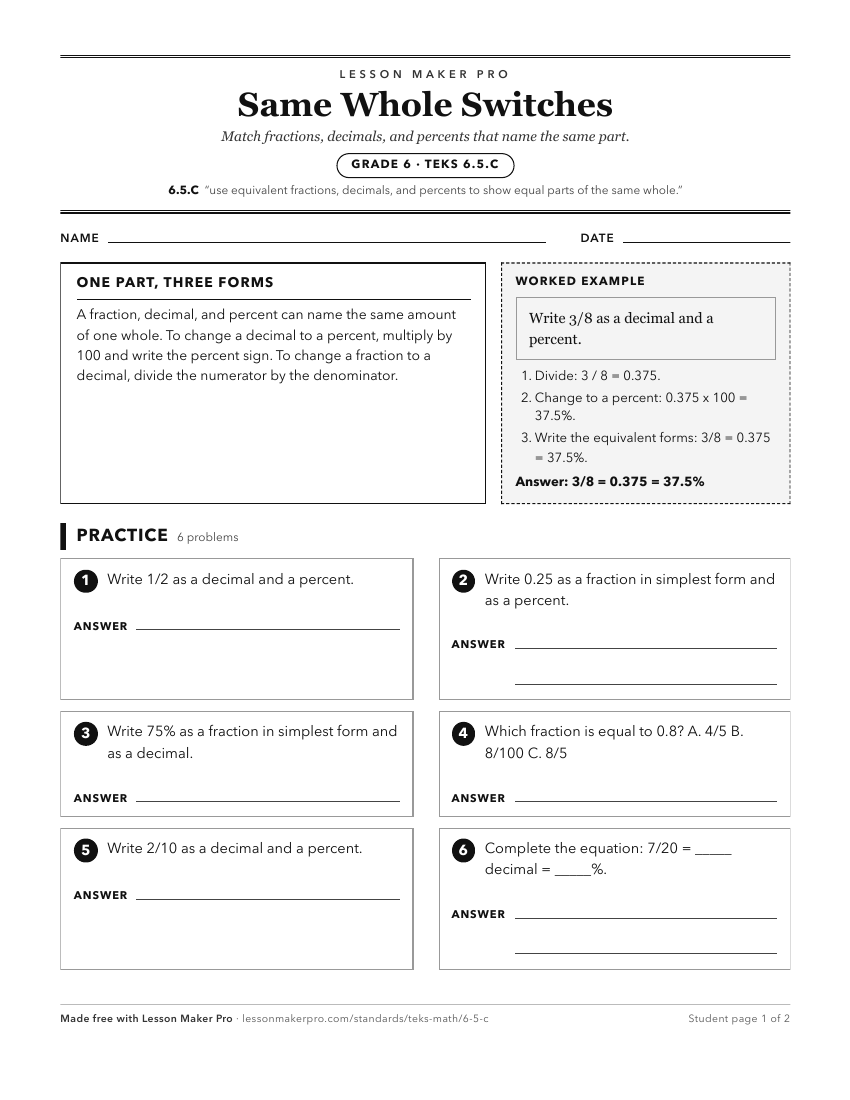
A ready-to-print activity worksheet aligned to 6.5.C, with an answer key for the teacher on its own page. No account needed.
PDF, US Letter, prints cleanly in black and white.
Download the worksheetKeep exploring
Related Standards
- 3.3.F
represent equivalent fractions with denominators of 2, 3, 4, 6, and 8 using a variety of objects and pictorial models, including number lines
- 2.3.C
use concrete models to count fractional parts beyond one whole using words and recognize how many parts it takes to equal one whole
- 6.4.E
represent ratios and percents with concrete models, fractions, and decimals
- 6.4.G
generate equivalent forms of fractions, decimals, and percents using real-world problems, including problems that involve money
Turn this exact standard into a lesson
Grade, subject, topic, and the complete standard are prefilled. Create one free, no account needed.
Also for this standard:Make a WorksheetMake a QuizMake a Sub Lesson