TEKS Math 2.3.C
The Standard
use concrete models to count fractional parts beyond one whole using words and recognize how many parts it takes to equal one whole
Texas Essential Knowledge and Skills for Mathematics
Teacher's field guide
What This Standard Means
What Students Need to Do
- Students build and count equal-size fraction pieces across more than one whole. They name amounts such as five fourths and explain that four fourths combine to make one whole.
What Mastery Looks Like
- A student can arrange equal pieces to show an amount greater than one whole. They can name the total pieces and explain how many pieces combine to make each whole.
Common Misconceptions
- Students may count wholes instead of individual pieces. They may think a larger denominator means a larger piece, or count unequal pieces as fractions of one whole.
How to Assess It
- Give each student eight paper fourths. Ask them to build six fourths, then write how many fourths make one whole and describe their model.
Lesson moves
Ways to Teach It
Give pairs paper circles and fourth-circle pieces, then ask them to build five fourths, six fourths, and seven fourths.
Show six half-circle pieces and ask, “How many wholes can you make, and how do you know?”
Play Fraction Build: students draw a card, collect that many equal fraction pieces, and announce the amount using fraction words.
Use paper pizza slices to model sharing three pizzas cut into fourths, then count all slices as fourths.
Free download
Printable 2.3.C Worksheet
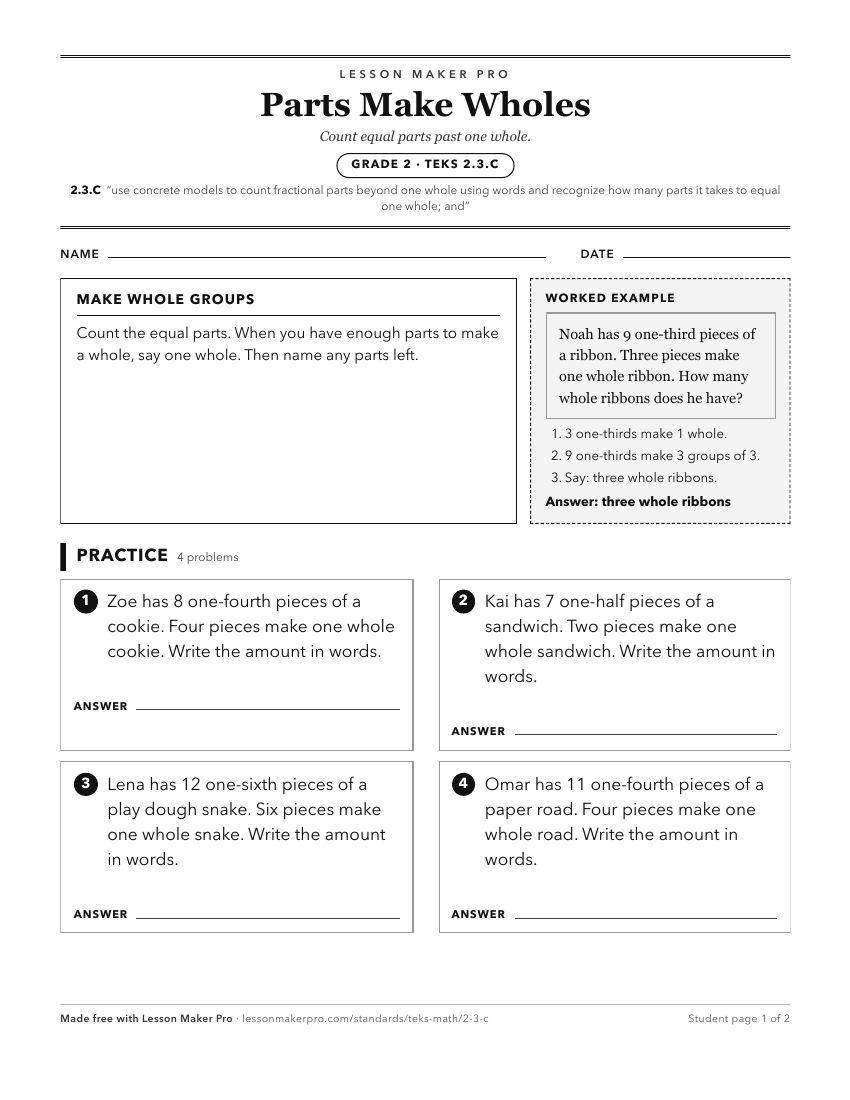
A ready-to-print activity worksheet aligned to 2.3.C, with an answer key for the teacher on its own page. No account needed.
PDF, US Letter, prints cleanly in black and white.
Download the worksheetKeep exploring
Related Standards
- 4.3.B
decompose a fraction in more than one way into a sum of fractions with the same denominator using concrete and pictorial models and recording results with symbo...
- 1.2.B
use concrete and pictorial models to compose and decompose numbers up to 120 in more than one way as so many hundreds, so many tens, and so many ones
- 3.3.A
represent fractions greater than zero and less than or equal to one with denominators of 2, 3, 4, 6, and 8 using concrete objects and pictorial models, includin...
- 2.2.A
use concrete and pictorial models to compose and decompose numbers up to 1,200 in more than one way as a sum of so many thousands, hundreds, tens, and ones
Turn this exact standard into a lesson
Grade, subject, topic, and the complete standard are prefilled. Create one free, no account needed.
Also for this standard:Make a WorksheetMake a QuizMake a Sub Lesson