TEKS Math 4.3.D
The Standard
compare two fractions with different numerators and different denominators and represent the comparison using the symbols >, =, or <
Texas Essential Knowledge and Skills for Mathematics
Teacher's field guide
What This Standard Means
What Students Need to Do
- Students decide which fraction is greater or whether the fractions are equal. They use models, benchmarks, or equivalent fractions, then record the relationship with >, <, or =.
What Mastery Looks Like
- A student selects >, <, or = correctly for each pair. The student can justify the choice with fraction strips, a number line, benchmarks, or equivalent fractions.
Common Misconceptions
- Students may think the fraction with the larger denominator is always greater. They may compare only numerators or use fraction models with wholes of different sizes.
How to Assess It
- Give this exit ticket: Complete 3/4 __ 5/8, 2/3 __ 4/6, and 3/10 __ 2/5. Justify one answer with a drawing or benchmark.
Lesson moves
Ways to Teach It
Give pairs fraction strips, such as 3/4 and 5/8, and have students align them, compare lengths, and record the correct symbol.
Ask, "Which is greater, 5/6 or 7/9?" and have students defend an answer using a benchmark or equivalent fractions.
Play Fraction War with fraction cards, requiring partners to place >, <, or = between cards before claiming each round.
Show recipe cards using 2/3 cup and 3/4 cup of milk, then ask which recipe uses more and how students know.
Free download
Printable 4.3.D Worksheet
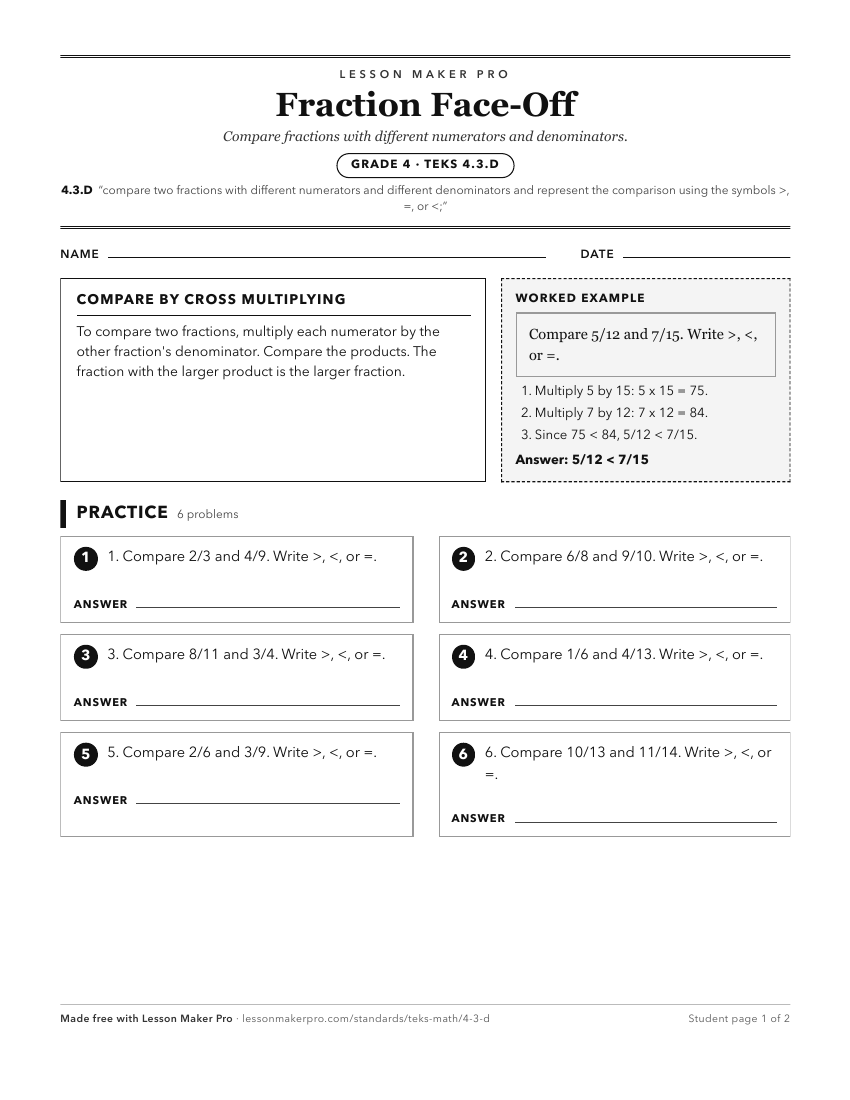
A ready-to-print activity worksheet aligned to 4.3.D, with an answer key for the teacher on its own page. No account needed.
PDF, US Letter, prints cleanly in black and white.
Download the worksheetKeep exploring
Related Standards
- 1.2.G
represent the comparison of two numbers to 100 using the symbols >, <, or =
- 3.2.D
compare and order whole numbers up to 100,000 and represent comparisons using the symbols >, <, or =
- 5.2.B
compare and order two decimals to thousandths and represent comparisons using the symbols >, <, or =
- 3.3.H
compare two fractions having the same numerator or denominator in problems by reasoning about their sizes and justifying the conclusion using symbols, words, ob...
Turn this exact standard into a lesson
Grade, subject, topic, and the complete standard are prefilled. Create one free, no account needed.
Also for this standard:Make a WorksheetMake a QuizMake a Sub Lesson