TEKS Math 5.2.B
The Standard
compare and order two decimals to thousandths and represent comparisons using the symbols >, <, or =
Texas Essential Knowledge and Skills for Mathematics
Teacher's field guide
What This Standard Means
What Students Need to Do
- Students use place value to decide which of two decimals is greater, less, or equal. They arrange several decimals in order and record each comparison with the correct symbol.
What Mastery Looks Like
- A student can compare decimals such as 0.6 and 0.599 by aligning place values or writing 0.600. The student can order a mixed set accurately and explain the first place where values differ.
Common Misconceptions
- Students may think the decimal with more digits is always greater, so they choose 0.425 over 0.7. They may compare digits without aligning place values, ignore trailing zeros, or reverse < and >.
How to Assess It
- Exit ticket: Insert >, <, or = in 0.506 __ 0.56, then order 1.009, 1.09, and 1.099 from least to greatest. Circle the first place value that proves each decision.
Lesson moves
Ways to Teach It
Give pairs decimal cards and place-value mats, then have them build, compare, and physically arrange five decimals from least to greatest.
Post the prompt: Which is greater, 0.8 or 0.799, and how do you know? Students write a two-sentence place-value explanation.
Play Decimal War: partners flip decimal cards, name the greater value, and keep both cards after stating the comparison aloud.
Compare prices or race times recorded to three decimal places, then rank the values and explain what greater means in that context.
Free download
Printable 5.2.B Worksheet
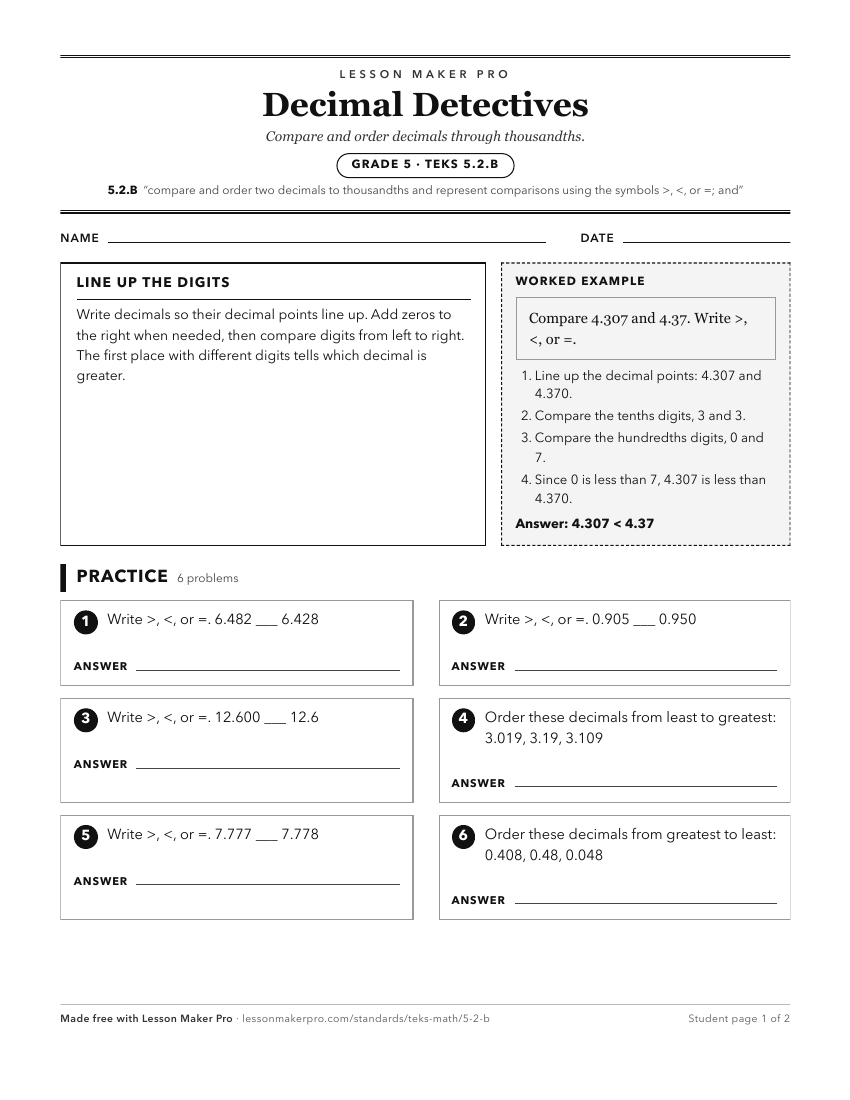
A ready-to-print activity worksheet aligned to 5.2.B, with an answer key for the teacher on its own page. No account needed.
PDF, US Letter, prints cleanly in black and white.
Download the worksheetKeep exploring
Related Standards
- 4.2.C
compare and order whole numbers to 1,000,000,000 and represent comparisons using the symbols >, <, or =
- 1.2.G
represent the comparison of two numbers to 100 using the symbols >, <, or =
- 3.2.D
compare and order whole numbers up to 100,000 and represent comparisons using the symbols >, <, or =
- 4.3.D
compare two fractions with different numerators and different denominators and represent the comparison using the symbols >, =, or <
Turn this exact standard into a lesson
Grade, subject, topic, and the complete standard are prefilled. Create one free, no account needed.
Also for this standard:Make a WorksheetMake a QuizMake a Sub Lesson