TEKS Math 4.3.F
The Standard
evaluate the reasonableness of sums and differences of fractions using benchmark fractions 0, 1/4, 1/2, 3/4, and 1, referring to the same whole
Texas Essential Knowledge and Skills for Mathematics
Teacher's field guide
What This Standard Means
What Students Need to Do
- Students place each fraction near a familiar reference value. They use those reference values to estimate a sum or difference, then decide whether a given answer makes sense. All comparisons must use equal-sized wholes.
What Mastery Looks Like
- A student matches each fraction to a nearby benchmark and uses those values to estimate the result. The student can accept or reject a proposed answer and explain the decision using equal-sized wholes.
Common Misconceptions
- Students may add denominators or judge size from the denominator alone. They may compare fractions drawn from different-sized wholes or assume every fraction sum must be less than 1.
How to Assess It
- Exit ticket: Mia says 5/8 + 7/10 is about 3/4. Decide whether her estimate is reasonable and support your answer with benchmarks.
Lesson moves
Ways to Teach It
Use equal-sized fraction strips to match fraction cards to benchmarks, then estimate the sum or difference for each card pair.
Discuss: Without calculating exactly, should 7/8 minus 2/5 be closer to 0, 1/2, or 1? Explain.
Play Benchmark Sort by having pairs place fraction expressions under result cards labeled 0, 1/4, 1/2, 3/4, 1, or greater than 1.
Compare two recipe amounts measured with the same one-cup scoop, then estimate how much more or less one recipe uses.
Free download
Printable 4.3.F Worksheet
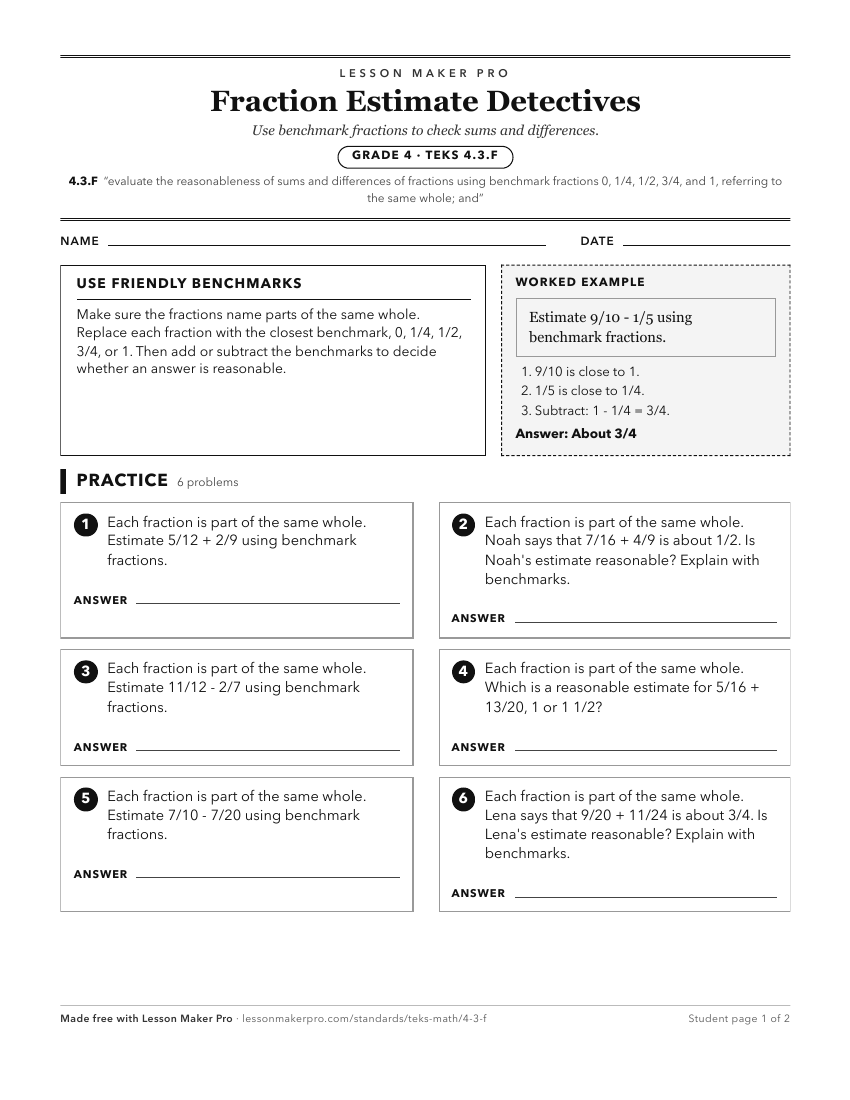
A ready-to-print activity worksheet aligned to 4.3.F, with an answer key for the teacher on its own page. No account needed.
PDF, US Letter, prints cleanly in black and white.
Download the worksheetKeep exploring
Related Standards
- 3.3.A
represent fractions greater than zero and less than or equal to one with denominators of 2, 3, 4, 6, and 8 using concrete objects and pictorial models, includin...
- 6.5.C
use equivalent fractions, decimals, and percents to show equal parts of the same whole
- 6.4.F
represent benchmark fractions and percents such as 1%, 10%, 25%, 33 1/3%, and multiples of these values using 10 by 10 grids, strip diagrams, number lines, and ...
- 3.3.H
compare two fractions having the same numerator or denominator in problems by reasoning about their sizes and justifying the conclusion using symbols, words, ob...
Turn this exact standard into a lesson
Grade, subject, topic, and the complete standard are prefilled. Create one free, no account needed.
Also for this standard:Make a WorksheetMake a QuizMake a Sub Lesson