TEKS Math 1.3.C
The Standard
compose 10 with two or more addends with and without concrete objects
Texas Essential Knowledge and Skills for Mathematics
Teacher's field guide
What This Standard Means
What Students Need to Do
- Students join two or more parts to make a total of 10. They use counters or other objects, then represent the same thinking with numbers and addition equations.
What Mastery Looks Like
- Students can make 10 with two, three, or more addends and write accurate equations, such as 4 + 3 + 3 = 10. They can do this with objects and with numerals alone.
Common Misconceptions
- Students may stop after finding two addends and miss combinations with three or more parts. They may miscount objects, omit an addend, or think changing the addend order changes the total.
How to Assess It
- Give students counters and ask, “Show 10 with three groups, then write a different three-addend equation for 10 without counters.”
Lesson moves
Ways to Teach It
Give students ten counters to split among three cups, then have them draw the groups and write the matching equation.
Ask, “How are 2 + 5 + 3 and 5 + 3 + 2 alike and different?”
Students draw number cards and keep any set of two or more cards that totals 10, then record the equation.
Have students plan a fruit cup with 10 pieces using two or more fruits, then write an equation for their choices.
Free download
Printable 1.3.C Worksheet
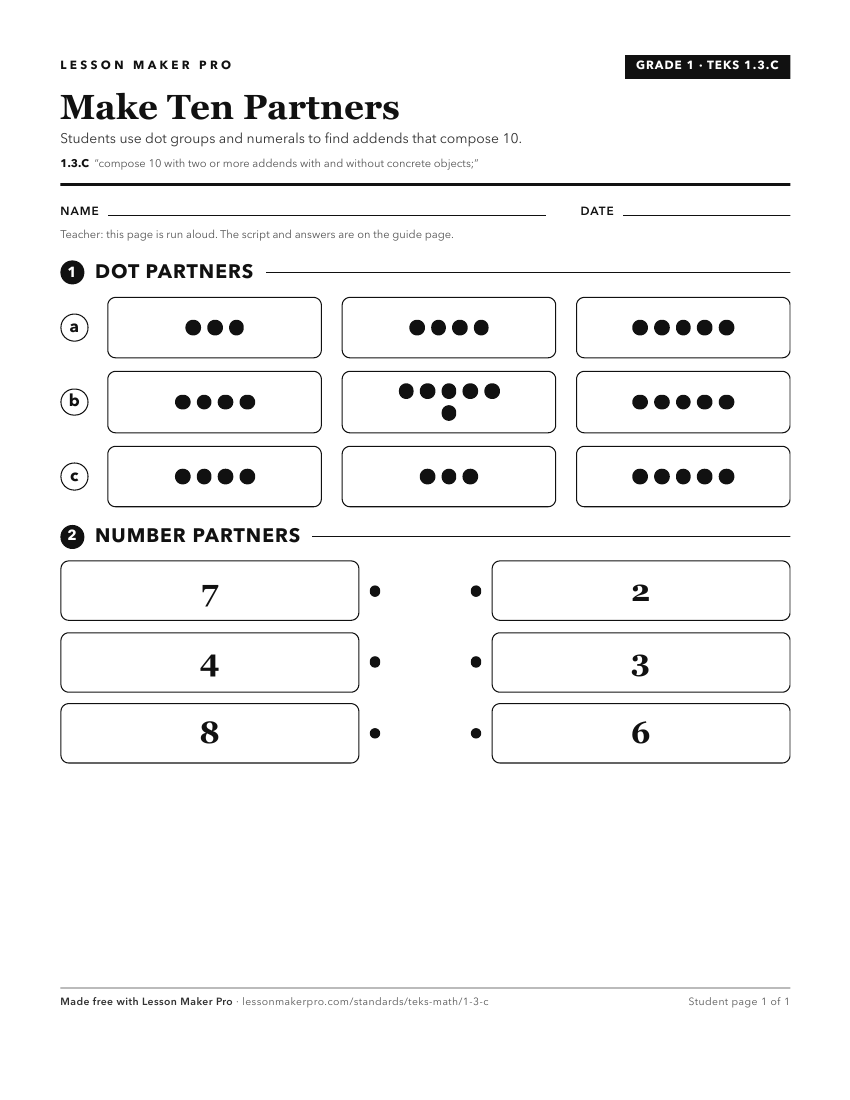
A ready-to-print activity worksheet aligned to 1.3.C, with an answer key for the teacher on its own page. No account needed.
PDF, US Letter, prints cleanly in black and white.
Download the worksheetKeep exploring
Related Standards
- 3.2.A
compose and decompose numbers up to 100,000 as a sum of so many ten thousands, so many thousands, so many hundreds, so many tens, and so many ones using objects...
- K.3.B
solve word problems using objects and drawings to find sums up to 10 and differences within 10
- K.2.I
compose and decompose numbers up to 10 with objects and pictures
- 2.2.A
use concrete and pictorial models to compose and decompose numbers up to 1,200 in more than one way as a sum of so many thousands, hundreds, tens, and ones
Turn this exact standard into a lesson
Grade, subject, topic, and the complete standard are prefilled. Create one free, no account needed.
Also for this standard:Make a WorksheetMake a QuizMake a Sub Lesson