TEKS Math 3.2.A
The Standard
compose and decompose numbers up to 100,000 as a sum of so many ten thousands, so many thousands, so many hundreds, so many tens, and so many ones using objects, pictorial models, and numbers, including expanded notation as appropriate
Texas Essential Knowledge and Skills for Mathematics
Teacher's field guide
What This Standard Means
What Students Need to Do
- Students build and break apart whole numbers through 100,000 by place value. They show the same number with manipulatives, place-value drawings, standard numerals, and addition expressions. They explain the value represented by each digit.
What Mastery Looks Like
- A student can show 62,407 as 6 ten thousands, 2 thousands, 4 hundreds, 0 tens, and 7 ones. The student can write 60,000 + 2,000 + 400 + 7 and trade one thousand for ten hundreds without changing the total.
Common Misconceptions
- Students may treat each digit as its face value, writing 43,205 as 4 + 3 + 2 + 5. They may skip zero places or shift digits, such as writing 60,304 as 6,304.
How to Assess It
- Exit ticket: Show 70,305 with a labeled place-value drawing, then write it as an addition expression. Circle the value represented by the digit 3.
Lesson moves
Ways to Teach It
Give pairs place-value disks and mats to build 38,416, then trade disks to show a second decomposition with the same value.
Ask students to explain why 50,000 + 700 + 9 still needs zero placeholders when written as one numeral.
Play Match Three with cards showing a numeral, a place-value picture, and an expanded expression for the same number.
Use a posted town population, such as 27,845, and have students label how many people each digit represents.
Free download
Printable 3.2.A Worksheet
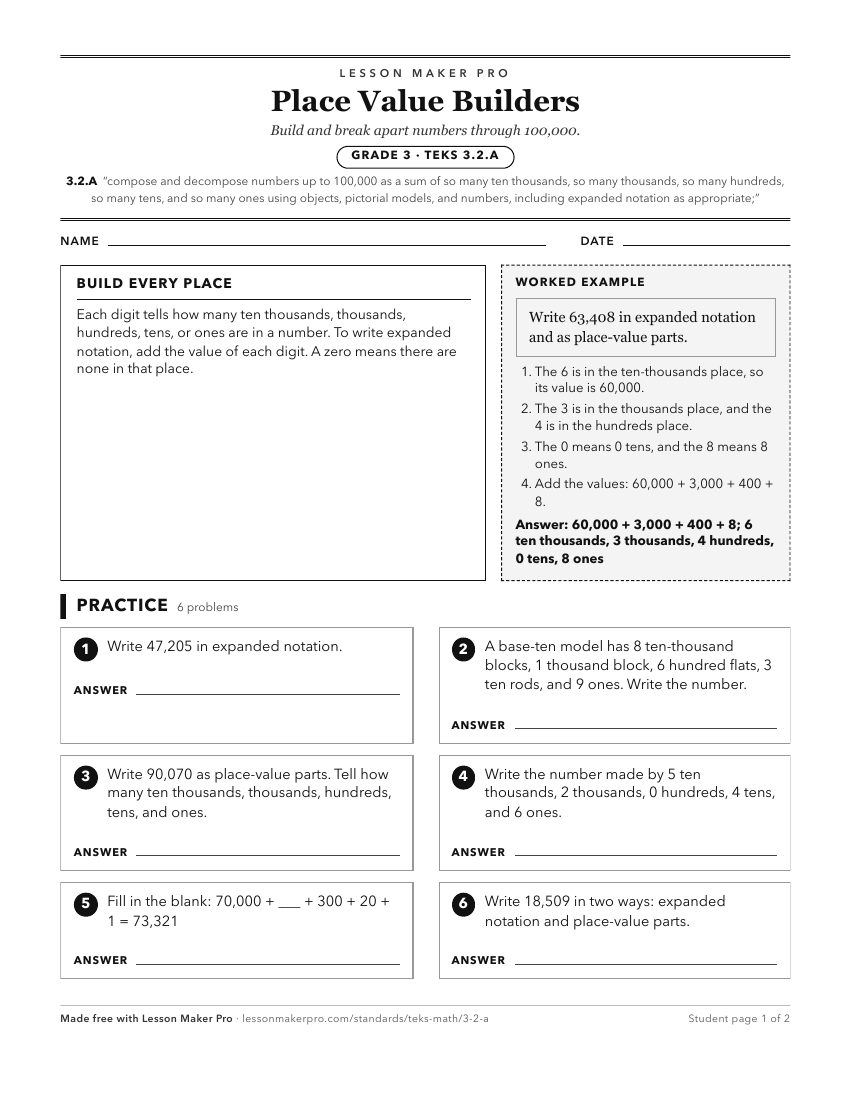
A ready-to-print activity worksheet aligned to 3.2.A, with an answer key for the teacher on its own page. No account needed.
PDF, US Letter, prints cleanly in black and white.
Download the worksheetKeep exploring
Related Standards
- 1.3.A
use concrete and pictorial models to determine the sum of a multiple of 10 and a one-digit number in problems up to 99
- 1.2.B
use concrete and pictorial models to compose and decompose numbers up to 120 in more than one way as so many hundreds, so many tens, and so many ones
- K.2.I
compose and decompose numbers up to 10 with objects and pictures
- 2.2.A
use concrete and pictorial models to compose and decompose numbers up to 1,200 in more than one way as a sum of so many thousands, hundreds, tens, and ones
Turn this exact standard into a lesson
Grade, subject, topic, and the complete standard are prefilled. Create one free, no account needed.
Also for this standard:Make a WorksheetMake a QuizMake a Sub Lesson