TEKS Math 1.3.A
The Standard
use concrete and pictorial models to determine the sum of a multiple of 10 and a one-digit number in problems up to 99
Texas Essential Knowledge and Skills for Mathematics
Teacher's field guide
What This Standard Means
What Students Need to Do
- Students build or draw a number made of full tens, then add up to nine ones. They connect the model to an equation and find the total without regrouping.
What Mastery Looks Like
- A student can build or draw full tens and add separate ones. The student writes the correct equation and explains that the number of tens stays the same.
Common Misconceptions
- Students may add the digit to the number of tens, saying 40 + 3 equals 70. They may also count ten-rods as single ones or reverse the tens and ones when writing the total.
How to Assess It
- Give students the prompt: “Solve 60 + 7. Draw a model, write the total, and label the tens and ones.”
Lesson moves
Ways to Teach It
Give students ten-rods and unit cubes to build 40 + 6, then draw the model and write 46.
Ask, “Mia says 70 + 5 equals 75. How could a drawing prove her answer?”
Partners draw one tens card and one digit card, build the sum, and record the equation on a whiteboard.
Bundle straws into groups of ten, add loose straws, and count the total as classroom supplies.
Free download
Printable 1.3.A Worksheet
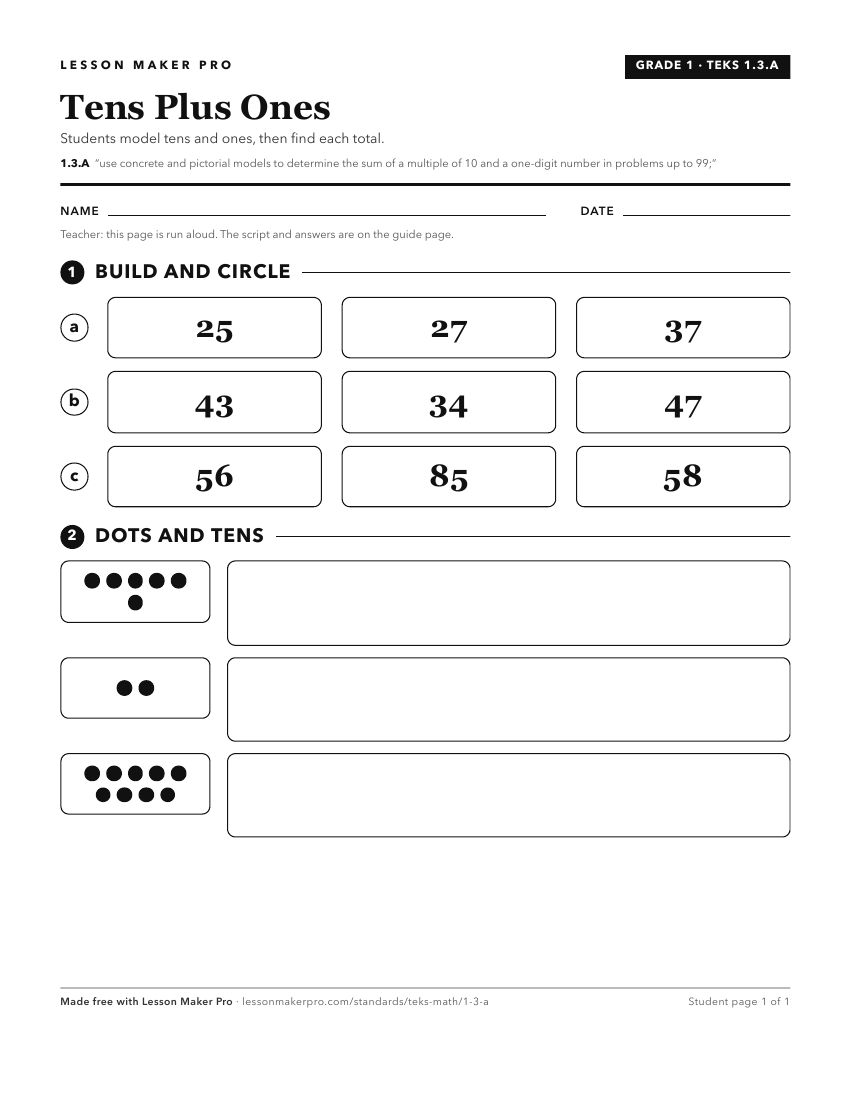
A ready-to-print activity worksheet aligned to 1.3.A, with an answer key for the teacher on its own page. No account needed.
PDF, US Letter, prints cleanly in black and white.
Download the worksheetKeep exploring
Related Standards
- 1.2.B
use concrete and pictorial models to compose and decompose numbers up to 120 in more than one way as so many hundreds, so many tens, and so many ones
- K.2.E
generate a set using concrete and pictorial models that represents a number that is more than, less than, and equal to a given number up to 20
- 3.5.A
represent one- and two-step problems involving addition and subtraction of whole numbers to 1,000 using pictorial models, number lines, and equations
- 2.2.A
use concrete and pictorial models to compose and decompose numbers up to 1,200 in more than one way as a sum of so many thousands, hundreds, tens, and ones
Turn this exact standard into a lesson
Grade, subject, topic, and the complete standard are prefilled. Create one free, no account needed.
Also for this standard:Make a WorksheetMake a QuizMake a Sub Lesson