TEKS Math 1.3.B
The Standard
use objects and pictorial models to solve word problems involving joining, separating, and comparing sets within 20 and unknowns as any one of the terms in the problem such as 2 + 4 = [ ]; 3 + [ ] = 7; and 5 = [ ] - 3
Texas Essential Knowledge and Skills for Mathematics
Teacher's field guide
What This Standard Means
What Students Need to Do
- Students use counters or drawings to model addition and subtraction stories with numbers to 20. They find a missing start, change, result, or comparison amount and write a matching equation.
What Mastery Looks Like
- A student chooses addition or subtraction to match a joining, separating, or comparing story. The student finds the unknown in any position and explains how the model matches the equation.
Common Misconceptions
- Students may always add when they hear “more” or subtract when they hear “left.” They may also think the unknown must come after the equals sign or reverse the quantities in a comparison.
How to Assess It
- Give this exit ticket: “Noah had some marbles. He gave away 3 and has 5 left. How many did he start with?” Require a drawing or counters and an equation.
Lesson moves
Ways to Teach It
Give pairs counters and story cards; students build each story, cover the unknown group with a cup, then solve.
Ask students to draw and explain two different stories that match 8 = 5 + 3.
Play an equation match game where students pair picture cards, story cards, and equations with unknowns in different positions.
Use classroom pencils to act out getting more, giving some away, and comparing two students’ amounts.
Free download
Printable 1.3.B Worksheet
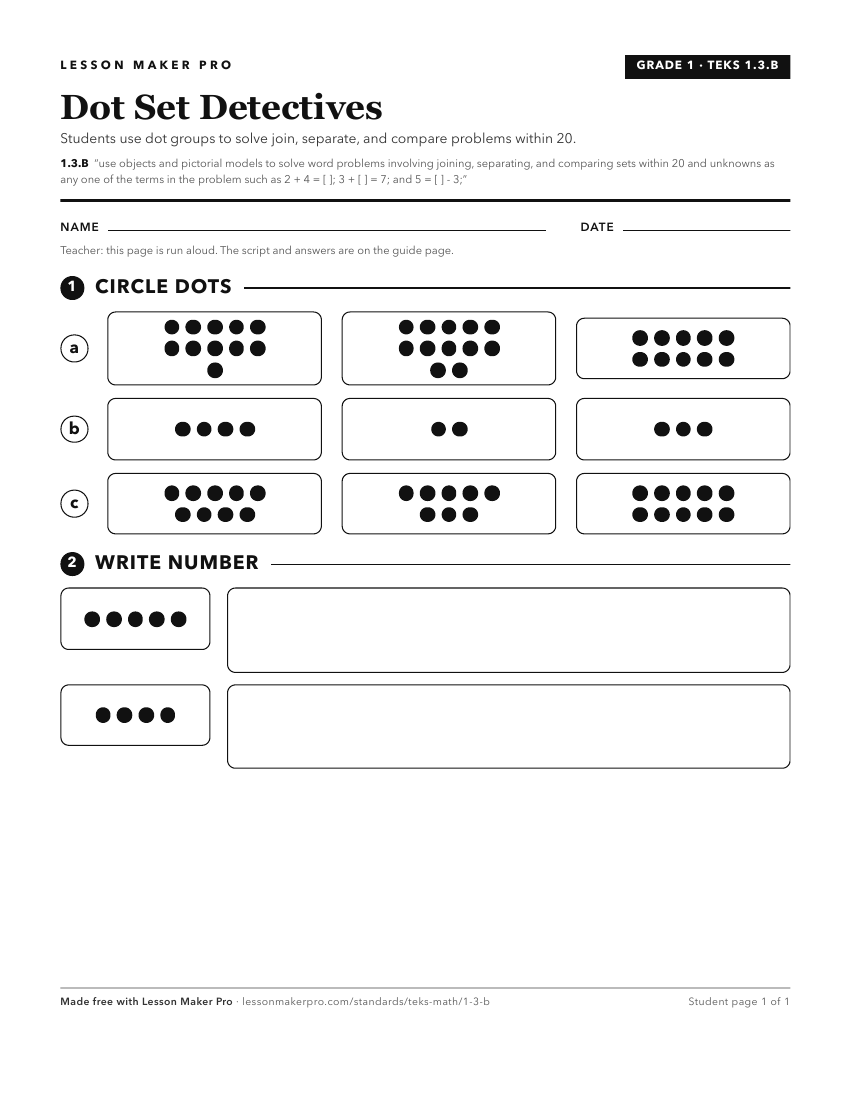
A ready-to-print activity worksheet aligned to 1.3.B, with an answer key for the teacher on its own page. No account needed.
PDF, US Letter, prints cleanly in black and white.
Download the worksheetKeep exploring
Related Standards
- 3.4.K
solve one-step and two-step problems involving multiplication and division within 100 using strategies based on objects; pictorial models, including arrays, are...
- 1.3.E
explain strategies used to solve addition and subtraction problems up to 20 using spoken words, objects, pictorial models, and number sentences
- K.3.B
solve word problems using objects and drawings to find sums up to 10 and differences within 10
- 1.5.D
represent word problems involving addition and subtraction of whole numbers up to 20 using concrete and pictorial models and number sentences
Turn this exact standard into a lesson
Grade, subject, topic, and the complete standard are prefilled. Create one free, no account needed.
Also for this standard:Make a WorksheetMake a QuizMake a Sub Lesson