TEKS Math 4.4.C
The Standard
represent the product of 2 two-digit numbers using arrays, area models, or equations, including perfect squares through 15 by 15
Texas Essential Knowledge and Skills for Mathematics
Teacher's field guide
What This Standard Means
What Students Need to Do
- Students break each factor into tens and ones, then show the multiplication with a partitioned array or rectangle. They connect each section to a partial product and combine the parts in an equation.
What Mastery Looks Like
- A student can model 23 × 14 by partitioning both factors into tens and ones. The student labels each region, finds every partial product, and shows that their sum equals 322.
Common Misconceptions
- Students may treat tens as single units, so 20 × 10 becomes 2 instead of 200. They may skip a partial product, mislabel side lengths, or add the four parts incorrectly.
How to Assess It
- Give this exit ticket: Draw and label an area model for 13 × 12, then write an equation showing all partial products and the total.
Lesson moves
Ways to Teach It
Build 14 × 12 with base-ten blocks, arrange the pieces as a rectangle, and record the four partial products.
Ask students to explain in writing why a 15 × 15 area model can be split into 10s and 5s.
Have pairs draw two number cards, create a labeled area model on grid paper, and check each other’s product.
Plan a 24-by-18-foot garden, then use an area model to find the total square feet needed.
Free download
Printable 4.4.C Worksheet
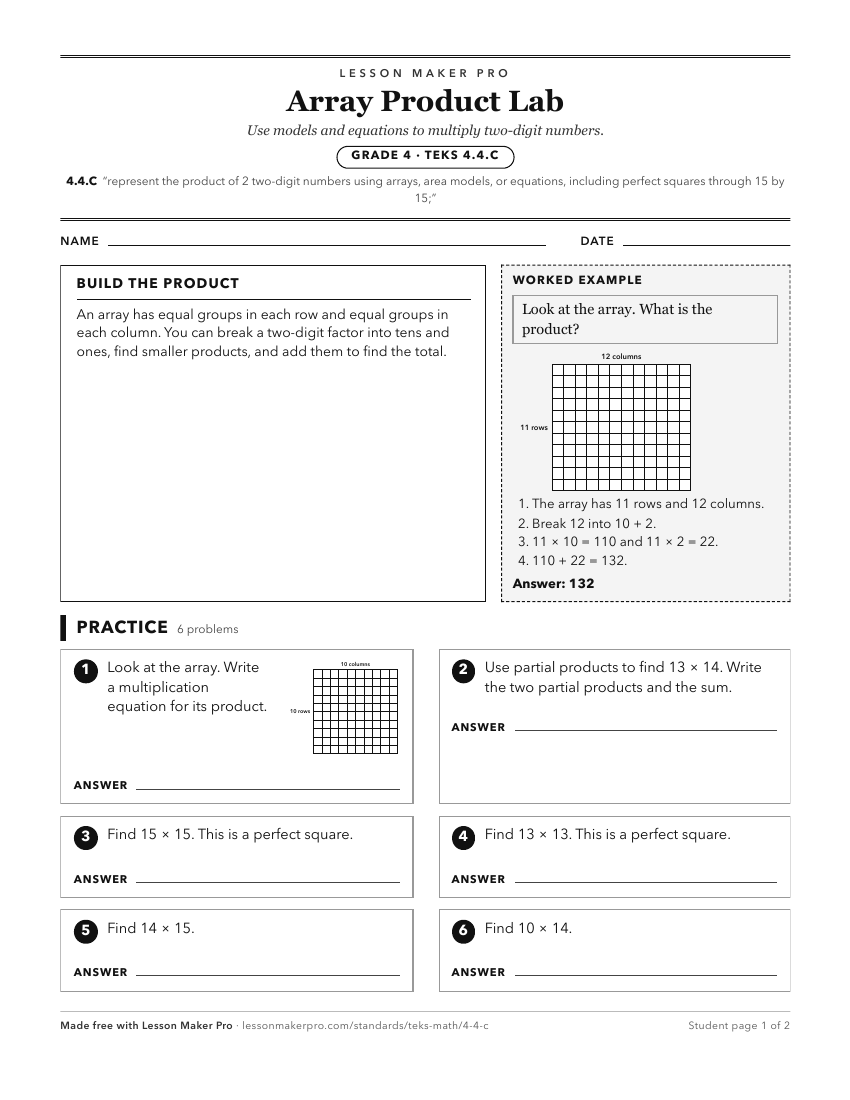
A ready-to-print activity worksheet aligned to 4.4.C, with an answer key for the teacher on its own page. No account needed.
PDF, US Letter, prints cleanly in black and white.
Download the worksheetKeep exploring
Related Standards
- 3.4.G
use strategies and algorithms, including the standard algorithm, to multiply a two-digit number by a one-digit number. Strategies may include mental math, parti...
- 3.5.B
represent and solve one- and two-step multiplication and division problems within 100 using arrays, strip diagrams, and equations
- 5.3.D
represent multiplication of decimals with products to the hundredths using objects and pictorial models, including area models
- 4.4.E
represent the quotient of up to a four-digit whole number divided by a one-digit whole number using arrays, area models, or equations
Turn this exact standard into a lesson
Grade, subject, topic, and the complete standard are prefilled. Create one free, no account needed.
Also for this standard:Make a WorksheetMake a QuizMake a Sub Lesson