TEKS Math 4.4.G
The Standard
round to the nearest 10, 100, or 1,000 or use compatible numbers to estimate solutions involving whole numbers
Texas Essential Knowledge and Skills for Mathematics
Teacher's field guide
What This Standard Means
What Students Need to Do
- Students estimate answers to whole-number calculations by rounding numbers to tens, hundreds, or thousands. They also replace numbers with nearby, easy-to-use values and choose an approach that gives a sensible estimate.
What Mastery Looks Like
- A student rounds whole numbers correctly to tens, hundreds, and thousands. The student uses compatible numbers to estimate sums, differences, products, and quotients, then checks whether each estimate makes sense.
Common Misconceptions
- Students may look at the wrong digit, always round up, or change digits to the left of the rounding place. They may treat an estimate as exact or choose compatible numbers that are easy to use but too far from the originals.
How to Assess It
- Exit ticket: estimate 4,782 + 2,149 by rounding to the nearest hundred, then estimate 1,196 ÷ 6 with compatible numbers. Show the changed numbers and explain why each estimate is reasonable.
Lesson moves
Ways to Teach It
Place number cards on a floor number line, then move each card to the nearest 10, 100, or 1,000.
Compare estimates for 3,187 + 2,746 using hundreds, thousands, and compatible numbers, then defend which estimate best fits the problem.
Play Estimate Match by pairing expression cards with estimate cards and explaining each rounding or compatible-number choice.
Use a grocery flyer to estimate the total cost of several quantities, choosing a rounding place that fits the question.
Free download
Printable 4.4.G Worksheet
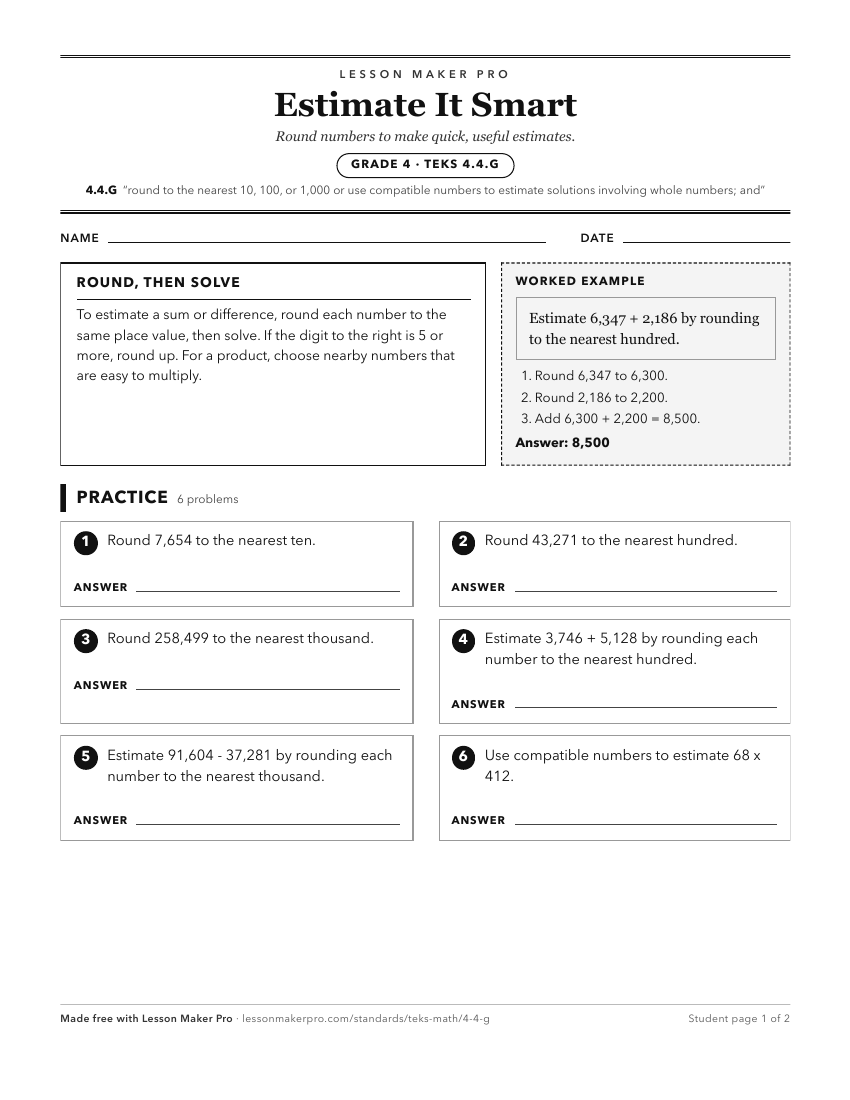
A ready-to-print activity worksheet aligned to 4.4.G, with an answer key for the teacher on its own page. No account needed.
PDF, US Letter, prints cleanly in black and white.
Download the worksheetKeep exploring
Related Standards
- 4.2.D
round whole numbers to a given place value through the hundred thousands place
- 3.2.C
represent a number on a number line as being between two consecutive multiples of 10; 100; 1,000; or 10,000 and use words to describe relative size of numbers i...
- 5.2.C
round decimals to tenths or hundredths
- 3.4.B
round to the nearest 10 or 100 or use compatible numbers to estimate solutions to addition and subtraction problems
Turn this exact standard into a lesson
Grade, subject, topic, and the complete standard are prefilled. Create one free, no account needed.
Also for this standard:Make a WorksheetMake a QuizMake a Sub Lesson