TEKS Math 3.4.B
The Standard
round to the nearest 10 or 100 or use compatible numbers to estimate solutions to addition and subtraction problems
Texas Essential Knowledge and Skills for Mathematics
Teacher's field guide
What This Standard Means
What Students Need to Do
- Students round numbers to the nearest 10 or 100, then use the rounded values to estimate sums and differences. They also choose nearby compatible numbers that make mental calculation easier.
What Mastery Looks Like
- A student can round 346 to 350 or 300, depending on the place named. The student chooses nearby compatible numbers, calculates mentally, and explains why the estimate is reasonable.
Common Misconceptions
- Students may check the tens digit when rounding to the nearest 10, instead of checking the ones digit. They may report an estimate as an exact answer. Some choose compatible numbers that are easy to calculate but not close to the original numbers.
How to Assess It
- Use this exit ticket: Estimate 287 + 416 by rounding to the nearest hundred, then estimate 603 − 298 using compatible numbers. Explain each choice.
Lesson moves
Ways to Teach It
Students place number cards on open number lines, mark the nearest tens and hundreds, then use those values to estimate sums and differences.
Ask, “Which gives a more useful estimate for 368 + 247, rounding to tens or hundreds, and why?”
Play Estimate Match by having students pair addition and subtraction cards with matching rounded or compatible-number estimates.
Give students a school store price list and ask them to estimate purchase totals and change before finding exact amounts.
Free download
Printable 3.4.B Worksheet
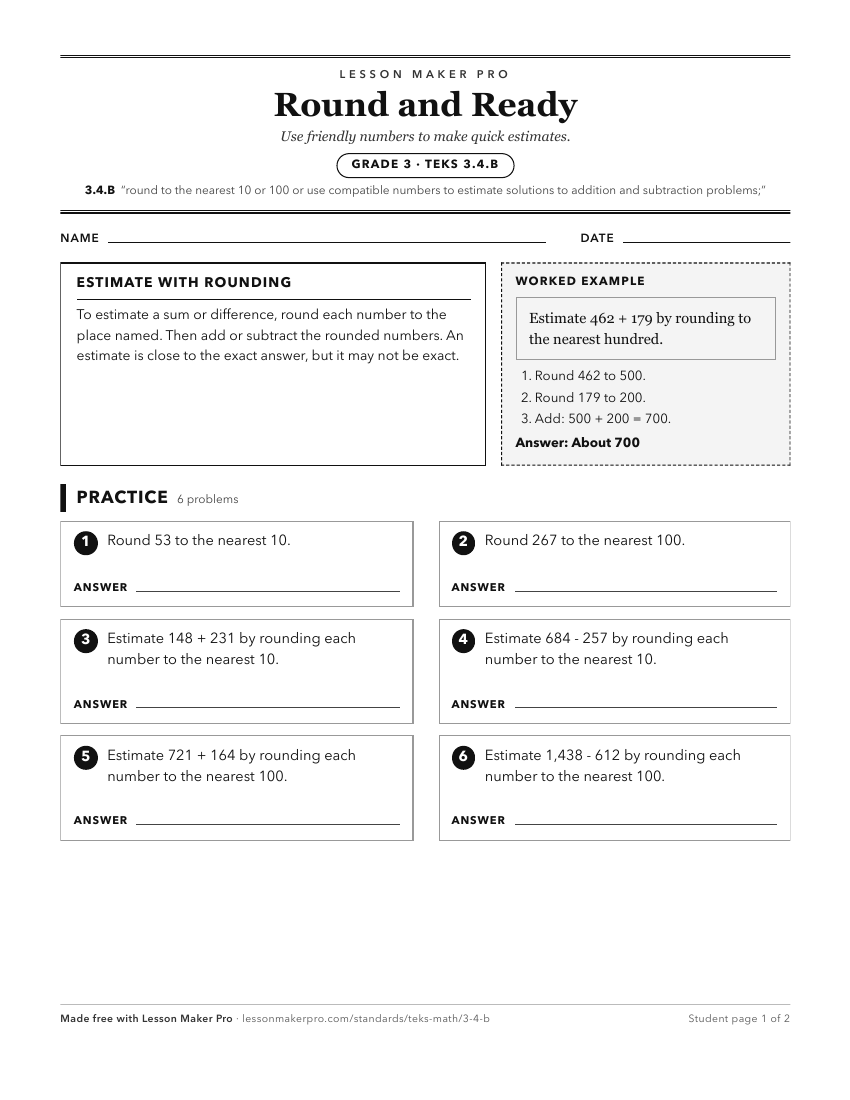
A ready-to-print activity worksheet aligned to 3.4.B, with an answer key for the teacher on its own page. No account needed.
PDF, US Letter, prints cleanly in black and white.
Download the worksheetKeep exploring
Related Standards
- 4.4.G
round to the nearest 10, 100, or 1,000 or use compatible numbers to estimate solutions involving whole numbers
- 2.4.D
generate and solve problem situations for a given mathematical number sentence involving addition and subtraction of whole numbers within 1,000
- 3.2.C
represent a number on a number line as being between two consecutive multiples of 10; 100; 1,000; or 10,000 and use words to describe relative size of numbers i...
- 1.3.A
use concrete and pictorial models to determine the sum of a multiple of 10 and a one-digit number in problems up to 99
Turn this exact standard into a lesson
Grade, subject, topic, and the complete standard are prefilled. Create one free, no account needed.
Also for this standard:Make a WorksheetMake a QuizMake a Sub Lesson