TEKS Math 3.2.C
The Standard
represent a number on a number line as being between two consecutive multiples of 10; 100; 1,000; or 10,000 and use words to describe relative size of numbers in order to round whole numbers
Texas Essential Knowledge and Skills for Mathematics
Teacher's field guide
What This Standard Means
What Students Need to Do
- Students place a whole number between the correct neighboring multiples of 10, 100, 1,000, or 10,000. They decide which endpoint is closer and use that comparison to round.
What Mastery Looks Like
- Students correctly name the two bounding multiples for a given number and place the number between them. They identify the closer multiple and round accurately to tens, hundreds, thousands, or ten-thousands. They explain their choice using distance or relative size.
Common Misconceptions
- Students may look only at the last digit instead of the digit directly to the right of the rounding place. They may choose incorrect bounding multiples or treat number line intervals as unequal. Some round midpoint numbers down instead of up.
How to Assess It
- Exit ticket: For 36,482, write the surrounding multiples of 10, 100, 1,000, and 10,000, then round at each place. Explain one answer using closer to.
Lesson moves
Ways to Teach It
Build floor number lines with masking tape, place number cards between labeled multiples, then stand by the closer endpoint.
Ask students to write: Which multiple of 1,000 is 7,620 closer to, and how does the number line prove it?
Play Rounding Match: students match a number card, its two bounding multiples, and its rounded value.
Use town population cards and have students round each population to the nearest 10, 100, 1,000, or 10,000 for a news report.
Free download
Printable 3.2.C Worksheet
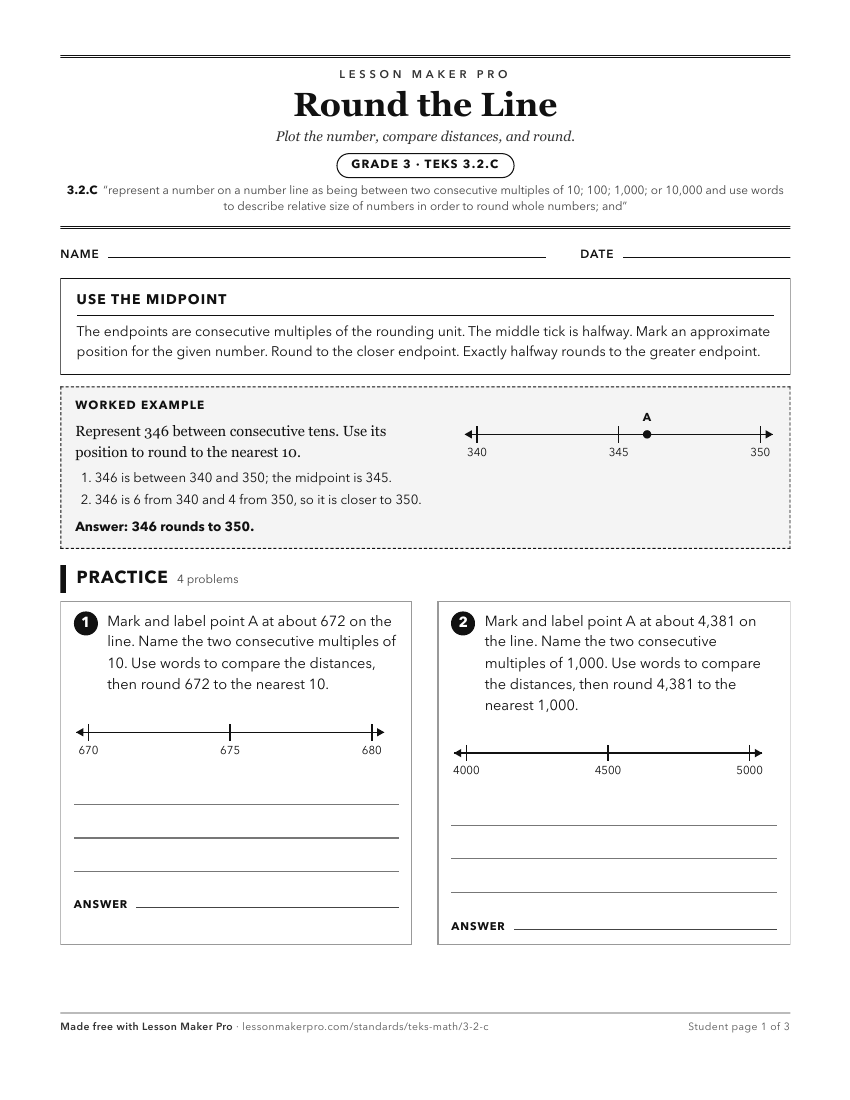
A ready-to-print activity worksheet aligned to 3.2.C, with an answer key for the teacher on its own page. No account needed.
PDF, US Letter, prints cleanly in black and white.
Download the worksheetKeep exploring
Related Standards
- 4.4.G
round to the nearest 10, 100, or 1,000 or use compatible numbers to estimate solutions involving whole numbers
- 2.9.C
represent whole numbers as distances from any given location on a number line
- 3.4.B
round to the nearest 10 or 100 or use compatible numbers to estimate solutions to addition and subtraction problems
- 2.2.D
use place value to compare and order whole numbers up to 1,200 using comparative language, numbers, and symbols (>, <, or =)
Turn this exact standard into a lesson
Grade, subject, topic, and the complete standard are prefilled. Create one free, no account needed.
Also for this standard:Make a WorksheetMake a QuizMake a Sub Lesson