TEKS Math 2.9.C
The Standard
represent whole numbers as distances from any given location on a number line
Texas Essential Knowledge and Skills for Mathematics
Teacher's field guide
What This Standard Means
What Students Need to Do
- Students use equal spaces on a number line to show a whole-number distance from a marked starting point. They count intervals, not tick marks.
What Mastery Looks Like
- A student can begin at a marked value and count equal intervals to show a given distance. The student can name the distance between two points without counting the starting point.
Common Misconceptions
- Students count tick marks instead of the spaces between them. They may treat the ending label as the distance or assume every number line must begin at zero.
How to Assess It
- Give students a number line labeled 3 through 10. Ask them to start at 4, mark a point 5 units to the right, and label the distance traveled.
Lesson moves
Ways to Teach It
Make a floor number line with tape, have students stand on 6, then move four equal spaces and name their ending point.
Ask students to explain why the distance from 4 to 9 is 5 units, not 9 units.
Play Number Line Partner Calls, where one student names a start and distance, and the other marks the endpoint.
Use a bus route map with numbered stops, and have students find how many stops separate two locations.
Free download
Printable 2.9.C Worksheet
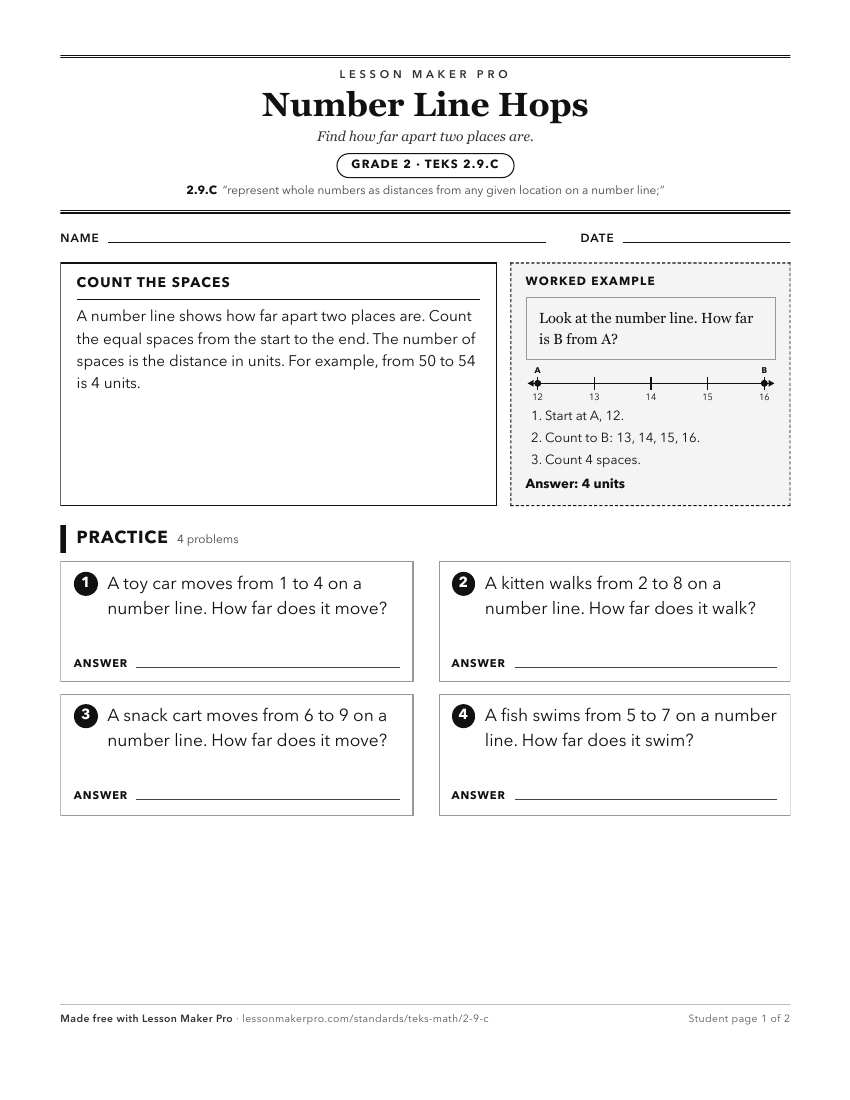
A ready-to-print activity worksheet aligned to 2.9.C, with an answer key for the teacher on its own page. No account needed.
PDF, US Letter, prints cleanly in black and white.
Download the worksheetKeep exploring
Related Standards
- 2.2.F
name the whole number that corresponds to a specific point on a number line
- 3.2.C
represent a number on a number line as being between two consecutive multiples of 10; 100; 1,000; or 10,000 and use words to describe relative size of numbers i...
- 3.7.A
represent fractions of halves, fourths, and eighths as distances from zero on a number line
- 4.3.G
represent fractions and decimals to the tenths or hundredths as distances from zero on a number line
Turn this exact standard into a lesson
Grade, subject, topic, and the complete standard are prefilled. Create one free, no account needed.
Also for this standard:Make a WorksheetMake a QuizMake a Sub Lesson