TEKS Math 4.3.G
The Standard
represent fractions and decimals to the tenths or hundredths as distances from zero on a number line
Texas Essential Knowledge and Skills for Mathematics
Teacher's field guide
What This Standard Means
What Students Need to Do
- Students locate tenths and hundredths by measuring each value’s distance from zero. They read the line’s scale and place equivalent fractions and decimals at the same point.
What Mastery Looks Like
- Students accurately plot values such as 3/10, 0.3, 47/100, and 0.47. They use the scale correctly and recognize when a fraction and decimal belong at the same point.
Common Misconceptions
- Students often count tick marks instead of spaces. They may treat every tick as one tenth, even when the interval is split into hundredths, or place points from the left edge instead of zero.
How to Assess It
- Give students a 0 to 1 line marked in tenths and a zoomed section from 0.3 to 0.4. Ask them to plot 0.6 and 37/100, then explain each location.
Lesson moves
Ways to Teach It
Use a meter strip as one whole, then have students place clips at 3/10, 0.45, and 72/100 of the length.
Ask, “Which is farther from zero, 0.6 or 58/100?” Students write a claim and support it with a number line.
Give pairs fraction cards, decimal cards, and number-line point cards to match, then check each set with a partner.
Mark tenths and hundredths on a one-meter paper race track, then locate each toy car’s recorded distance from the start.
Free download
Printable 4.3.G Worksheet
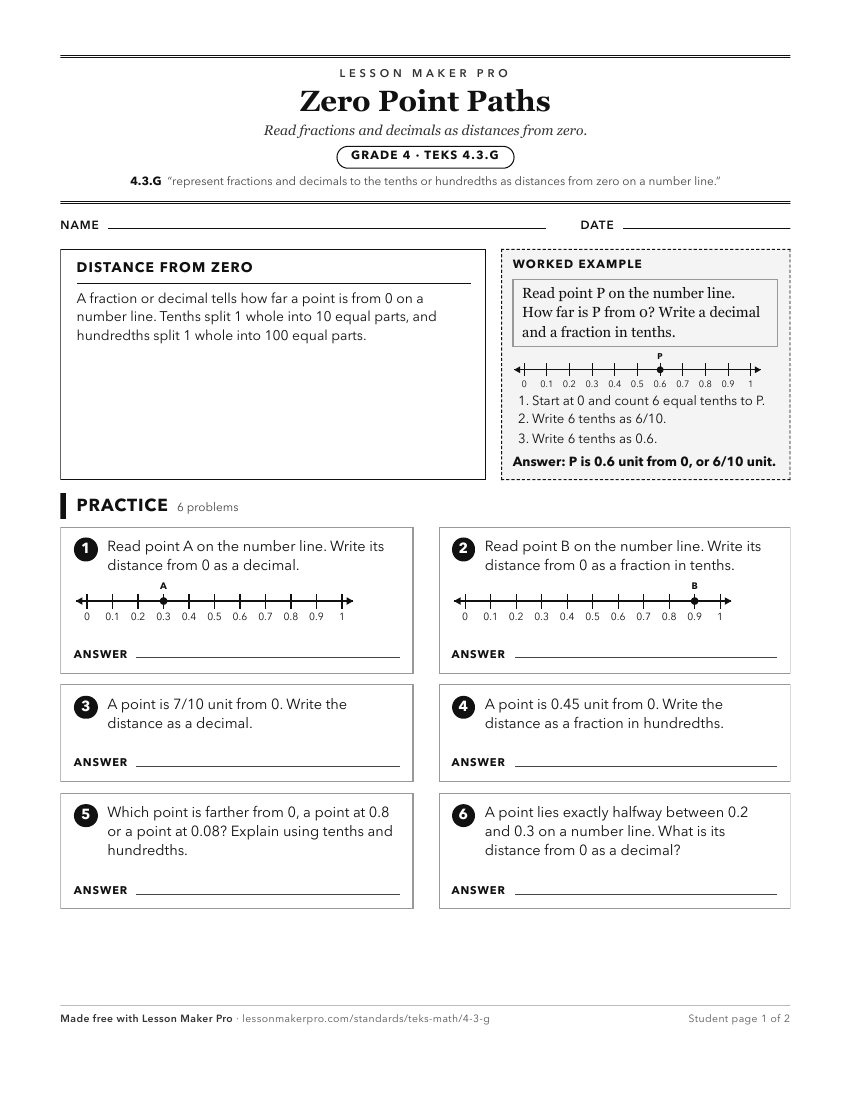
A ready-to-print activity worksheet aligned to 4.3.G, with an answer key for the teacher on its own page. No account needed.
PDF, US Letter, prints cleanly in black and white.
Download the worksheetKeep exploring
Related Standards
- 5.2.C
round decimals to tenths or hundredths
- 3.7.A
represent fractions of halves, fourths, and eighths as distances from zero on a number line
- 4.2.G
relate decimals to fractions that name tenths and hundredths
- 4.2.H
determine the corresponding decimal to the tenths or hundredths place of a specified point on a number line
Turn this exact standard into a lesson
Grade, subject, topic, and the complete standard are prefilled. Create one free, no account needed.
Also for this standard:Make a WorksheetMake a QuizMake a Sub Lesson