TEKS Math 5.2.C
The Standard
round decimals to tenths or hundredths
Texas Essential Knowledge and Skills for Mathematics
Teacher's field guide
What This Standard Means
What Students Need to Do
- Students locate the requested decimal place and inspect the digit immediately to its right. They decide whether to keep or increase the target digit, then remove later digits.
What Mastery Looks Like
- A student can find both requested place values and use the correct deciding digit. The student can handle cases such as 4.96 and explain the result with a number line or place-value reasoning.
Common Misconceptions
- Students may inspect the target digit instead of the digit to its right. Some simply cut off extra digits or forget to regroup when the target digit is 9.
How to Assess It
- Exit ticket: Find the nearest tenth and nearest hundredth for 6.347. Circle the digit that decides each answer and explain one choice.
Lesson moves
Ways to Teach It
Place 3.46 on a floor number line from 3.4 to 3.5, then walk to the nearer tenth.
Write: Why does 7.25 become 7.3 to the nearest tenth but remain 7.25 to the nearest hundredth?
Play rounding bingo using decimal cards, with students covering the matching tenth or hundredth on their boards.
Use grocery prices to estimate each item to the nearest tenth of a dollar, then compare the estimated and exact totals.
Free download
Printable 5.2.C Worksheet
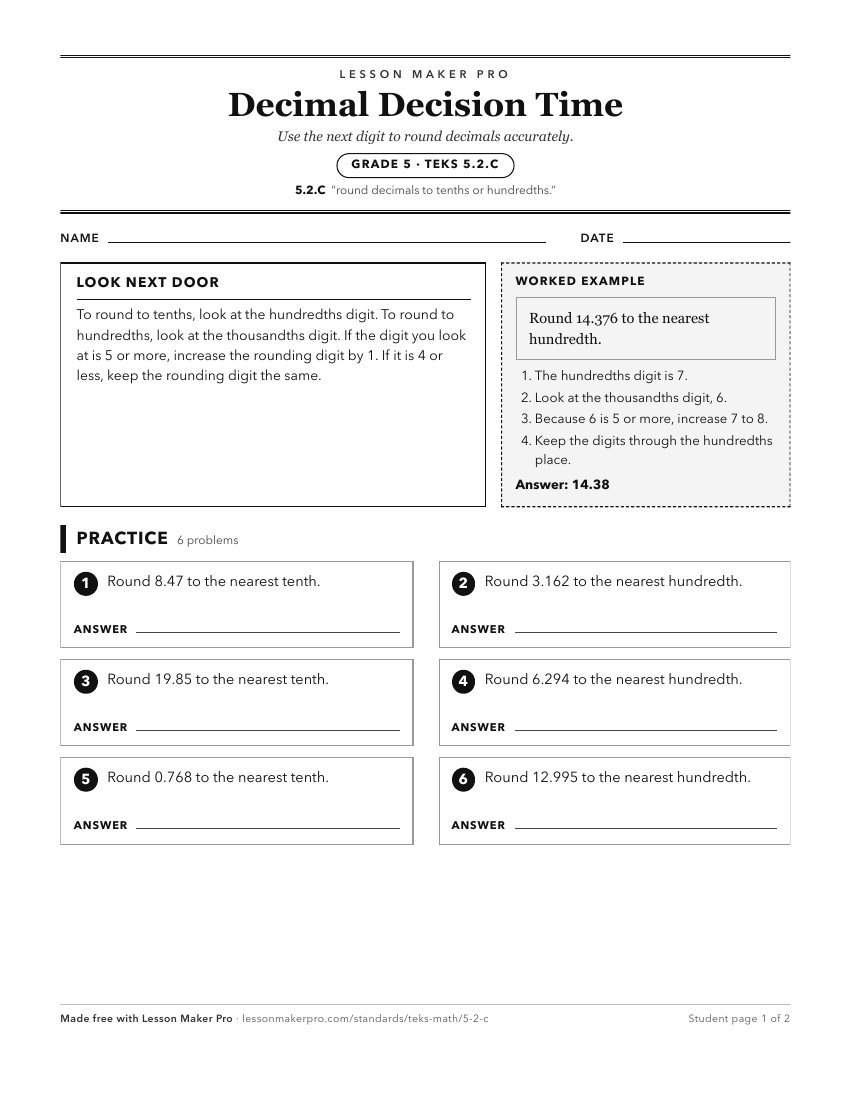
A ready-to-print activity worksheet aligned to 5.2.C, with an answer key for the teacher on its own page. No account needed.
PDF, US Letter, prints cleanly in black and white.
Download the worksheetKeep exploring
Related Standards
- 4.4.G
round to the nearest 10, 100, or 1,000 or use compatible numbers to estimate solutions involving whole numbers
- 4.2.G
relate decimals to fractions that name tenths and hundredths
- 4.3.G
represent fractions and decimals to the tenths or hundredths as distances from zero on a number line
- 4.2.H
determine the corresponding decimal to the tenths or hundredths place of a specified point on a number line
Turn this exact standard into a lesson
Grade, subject, topic, and the complete standard are prefilled. Create one free, no account needed.
Also for this standard:Make a WorksheetMake a QuizMake a Sub Lesson