TEKS Math 5.3.A
The Standard
estimate to determine solutions to mathematical and real-world problems involving addition, subtraction, multiplication, or division
Texas Essential Knowledge and Skills for Mathematics
Teacher's field guide
What This Standard Means
What Students Need to Do
- Students estimate answers to addition, subtraction, multiplication, and division problems. They choose useful rounded or compatible numbers and use the estimate to judge whether an answer makes sense.
What Mastery Looks Like
- Students choose rounding or compatible numbers that fit the problem. They compute mentally, label the answer as an estimate, and explain why it is reasonable.
Common Misconceptions
- Students may round every number to the same place even when that gives a poor estimate. They may choose the wrong operation, report an estimate as exact, or use numbers that are not easy to compute mentally.
How to Assess It
- Give this exit ticket: “A school orders 47 boxes with 198 pencils in each box. Estimate the total and explain your number choices.”
Lesson moves
Ways to Teach It
Give pairs number cards and operation cards, then have them build a problem and replace each number with a useful rounded or compatible number.
Ask, “Which is a better estimate for 398 ÷ 19, 20 or 200?” Students defend their choice in two sentences.
Play Estimate Match by having students pair exact-expression cards with estimate cards, then explain one match to a partner.
Use a grocery flyer to estimate the cost of several quantities, such as six cereal boxes or three pounds of apples.
Free download
Printable 5.3.A Worksheet
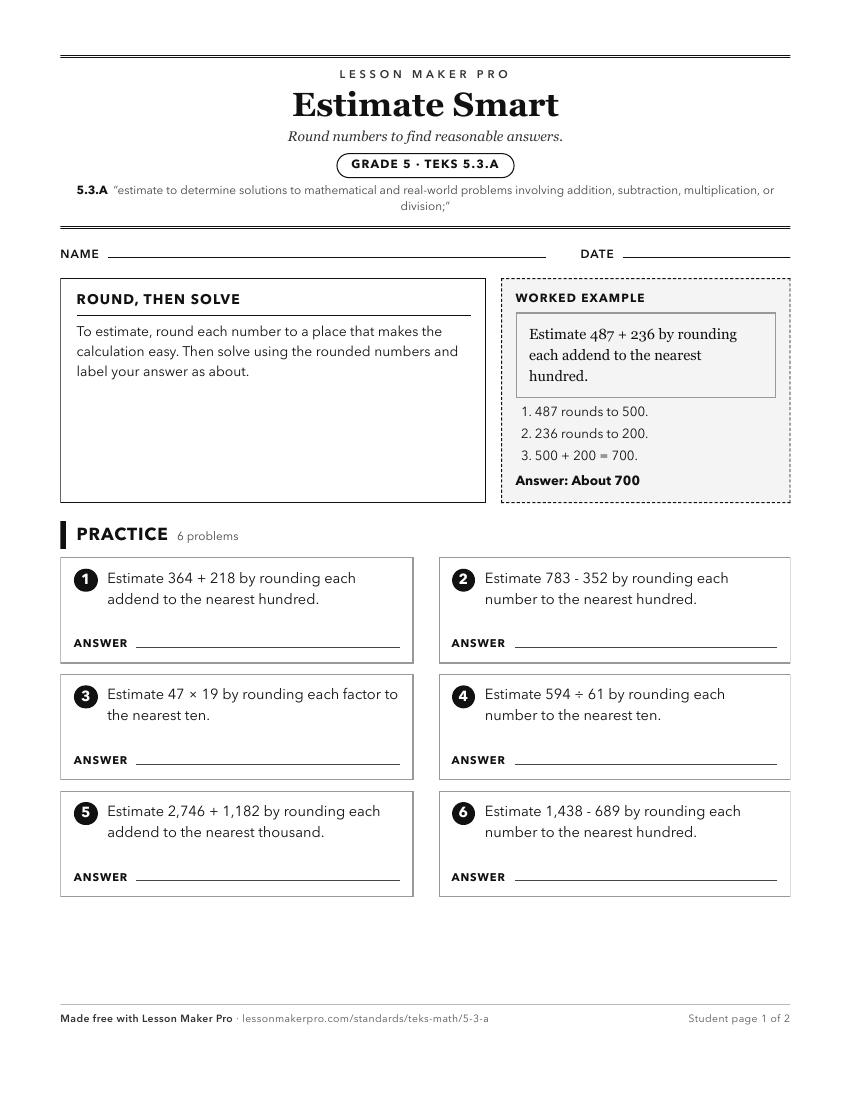
A ready-to-print activity worksheet aligned to 5.3.A, with an answer key for the teacher on its own page. No account needed.
PDF, US Letter, prints cleanly in black and white.
Download the worksheetKeep exploring
Related Standards
- 3.4.B
round to the nearest 10 or 100 or use compatible numbers to estimate solutions to addition and subtraction problems
- 4.8.C
solve problems that deal with measurements of length, intervals of time, liquid volumes, mass, and money using addition, subtraction, multiplication, or divisio...
- 6.3
The student applies mathematical process standards to represent addition, subtraction, multiplication, and division while solving problems and justifying soluti...
- 7.3.B
apply and extend previous understandings of operations to solve problems using addition, subtraction, multiplication, and division of rational numbers
Turn this exact standard into a lesson
Grade, subject, topic, and the complete standard are prefilled. Create one free, no account needed.
Also for this standard:Make a WorksheetMake a QuizMake a Sub Lesson