TEKS ELAR 4.2
Knowledge and Skills Statement (Standard Cluster)
The student develops word structure knowledge through phonological awareness, print concepts, phonics, and morphology to communicate, decode, and spell.
Texas Essential Knowledge and Skills for English Language Arts and Reading
Cluster contents
Student Expectations in This Statement
4.2 is a knowledge and skills statement. These are the student expectations under it.
- 4.2.A.i
decoding words with specific orthographic patterns and rules, including regular and irregular plurals
- 4.2.A.ii
decoding multisyllabic words with closed syllables; open syllables; VCe syllables; vowel teams, including digraphs and diphthongs; r-controlled syllables; and f...
- 4.2.A.iii
decoding words using advanced knowledge of syllable division patterns such as VV
- 4.2.A.iv
decoding words using knowledge of prefixes
- 4.2.A.v
decoding words using knowledge of suffixes, including how they can change base words such as dropping e, changing y to i, and doubling final consonants
- 4.2.A.vi
identifying and reading high-frequency words from a research-based list
- 4.2.B.i
spelling multisyllabic words with closed syllables; open syllables; VCe syllables; vowel teams, including digraphs and diphthongs; r-controlled syllables; and f...
- 4.2.B.ii
spelling homophones
- 4.2.B.iii
spelling multisyllabic words with multiple sound-spelling patterns
- 4.2.B.iv
spelling words using advanced knowledge of syllable division patterns
- 4.2.B.v
spelling words using knowledge of prefixes
- 4.2.B.vi
spelling words using knowledge of suffixes, including how they can change base words such as dropping e, changing y to i, and doubling final consonants
- 4.2.C
write legibly in cursive to complete assignments.
Teacher's field guide
What This Cluster Means
What Students Need to Do
- Students break unfamiliar multisyllabic words into syllables and use vowel patterns, affixes, and spelling rules to read and spell them. They recognize irregular plurals, homophones, and common high-frequency words. They also write assignments in readable cursive.
What Mastery Looks Like
- A student can mark syllable breaks, identify useful patterns, and read a new word accurately. The student spells related words correctly when adding prefixes or suffixes and chooses the right homophone from context. Cursive is consistent, spaced, and easy to read.
Common Misconceptions
- Students often divide words by letters rather than vowel sounds, or treat every vowel pair the same. They may keep the final e, leave y unchanged, or forget to double a final consonant when adding a suffix. They also confuse homophones and assume all plurals end in s.
How to Assess It
- Give students this exit ticket: divide and read hopeful and musician, then spell making, carried, and running. Have them choose there or their in a sentence and copy the completed sentence in cursive.
Lesson moves
Ways to Teach It
Use letter tiles and syllable cards to build reptile, rainbow, corner, table, and music, then sort each word by syllable type.
Ask students to explain in writing why hope becomes hoping, happy becomes happier, and run becomes running.
Play Syllable Scoop: teams draw word cards, mark syllable breaks, read the word, and earn a point for a correct spelling.
Have students edit a mock class newsletter for homophones, plurals, and suffix errors, then rewrite one corrected sentence in cursive.
Free download
Printable 4.2 Worksheet
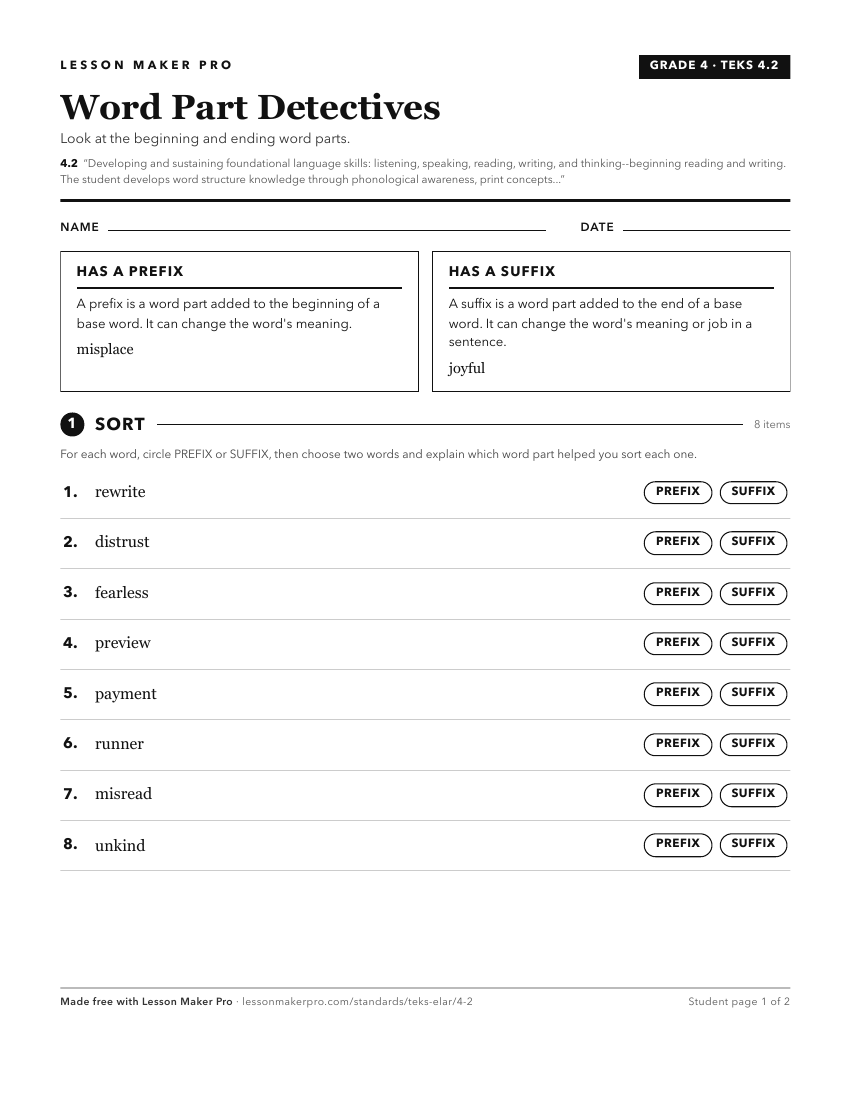
A ready-to-print activity worksheet aligned to 4.2, with an answer key for the teacher on its own page. No account needed.
PDF, US Letter, prints cleanly in black and white.
Download the worksheetKeep exploring
Related Standards
Turn this cluster into a lesson
Grade, subject, topic, and the complete cluster are prefilled. Create one free, no account needed.
Also for this cluster:Make a WorksheetMake a QuizMake a Sub Lesson