TEKS ELAR 4.2.B.v
The Standard
spelling words using knowledge of prefixes
Texas Essential Knowledge and Skills for English Language Arts and Reading · The student develops word structure knowledge through phonological awareness, print concepts, phonics, and morphology to communicate, decode, and spell.
Teacher's field guide
What This Standard Means
What Students Need to Do
- Students use known prefixes and base words to spell longer words correctly. They identify where the prefix ends and keep the base word’s spelling when joining the parts.
What Mastery Looks Like
- Students correctly spell words such as disagree, preview, misplace, and uncertain. They can separate each word into its prefix and base word and check both parts.
Common Misconceptions
- Students may spell the whole word by sound instead of separating the prefix and base word. They may drop repeated letters, writing “mispell” for “misspell,” or confuse prefixes such as in-, im-, and un-.
How to Assess It
- Give this exit ticket: “Add dis- to agree, re- to appear, and un- to certain. Write each new word and circle its prefix.”
Lesson moves
Ways to Teach It
Give pairs prefix cards and base-word cards to combine, read, and record, including reappear, misspell, preview, and uncertain.
Ask students to explain in writing how finding the base word helps them spell “disagree” and “misunderstand.”
Play Prefix Match, where students race to pair a spoken word with its written prefix and base-word cards.
Have students find five prefixed words in classroom notices or school emails, copy them, and mark each prefix and base word.
Free download
Printable 4.2.B.v Worksheet
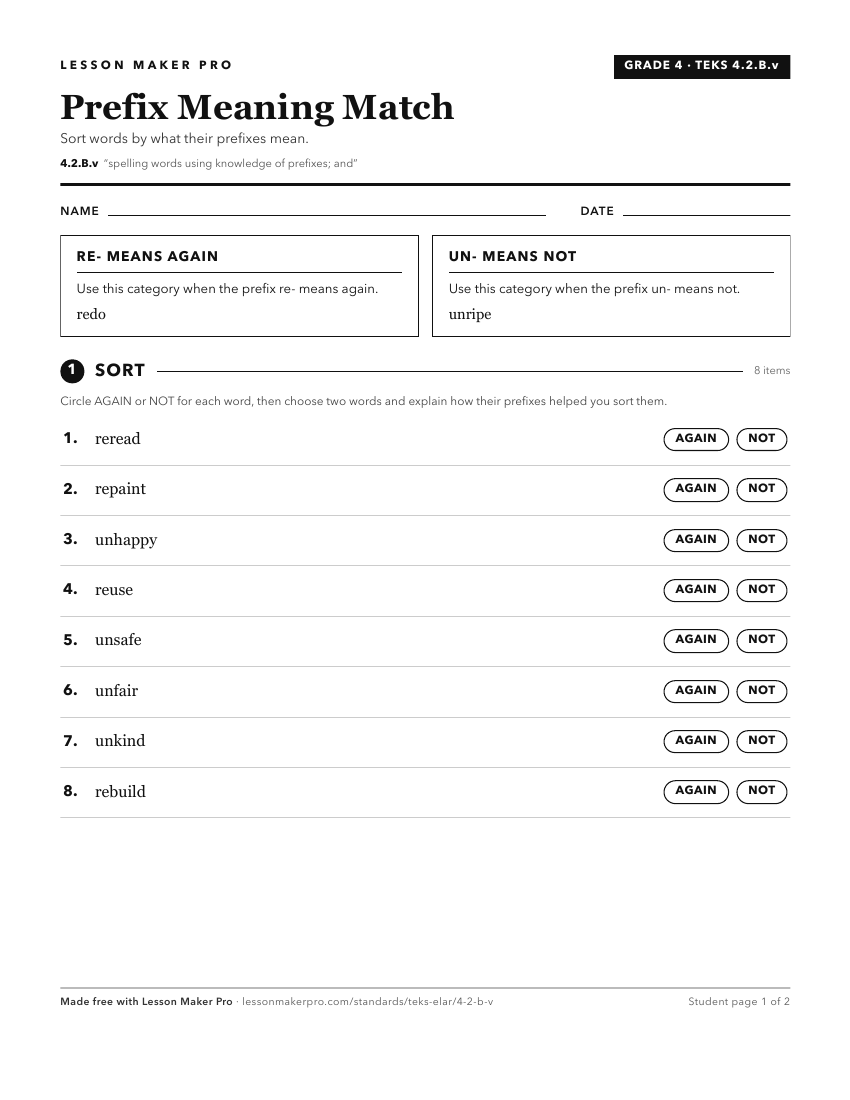
A ready-to-print activity worksheet aligned to 4.2.B.v, with an answer key for the teacher on its own page. No account needed.
PDF, US Letter, prints cleanly in black and white.
Download the worksheetKeep exploring
Related Standards
Turn this exact standard into a lesson
Grade, subject, topic, and the complete standard are prefilled. Create one free, no account needed.
Also for this standard:Make a WorksheetMake a QuizMake a Sub Lesson