TEKS ELAR 4.2.A.i
The Standard
decoding words with specific orthographic patterns and rules, including regular and irregular plurals
Texas Essential Knowledge and Skills for English Language Arts and Reading · The student develops word structure knowledge through phonological awareness, print concepts, phonics, and morphology to communicate, decode, and spell.
Teacher's field guide
What This Standard Means
What Students Need to Do
- Students read nouns that name more than one person, place, thing, or idea. They use endings, spelling changes, and known irregular forms to decode each word accurately.
What Mastery Looks Like
- Students accurately read familiar and unfamiliar plural nouns in lists and sentences. They connect each plural to its singular form and recognize whether it adds an ending, changes spelling, or stays unchanged.
Common Misconceptions
- Students may add s to every noun, producing forms such as childs, mouses, or sheeps. They may misread endings such as -es, confuse plural forms with possessives, or miss changes in words such as babies and knives.
How to Assess It
- Give students this exit ticket: Read boxes, wishes, babies, knives, children, geese, mice, and sheep aloud, then write each singular form.
Lesson moves
Ways to Teach It
Give pairs singular and plural word cards to match, then sort them under -s, -es, spelling change, irregular, and unchanged headings.
Ask students to explain in writing why boxes, babies, knives, children, and sheep do not form plurals the same way.
Play Plural Bingo by calling singular nouns; students cover the correctly written plural and read it aloud before claiming the square.
Use a grocery ad to find plural product names, identify each singular form, and label the plural pattern used.
Free download
Printable 4.2.A.i Worksheet
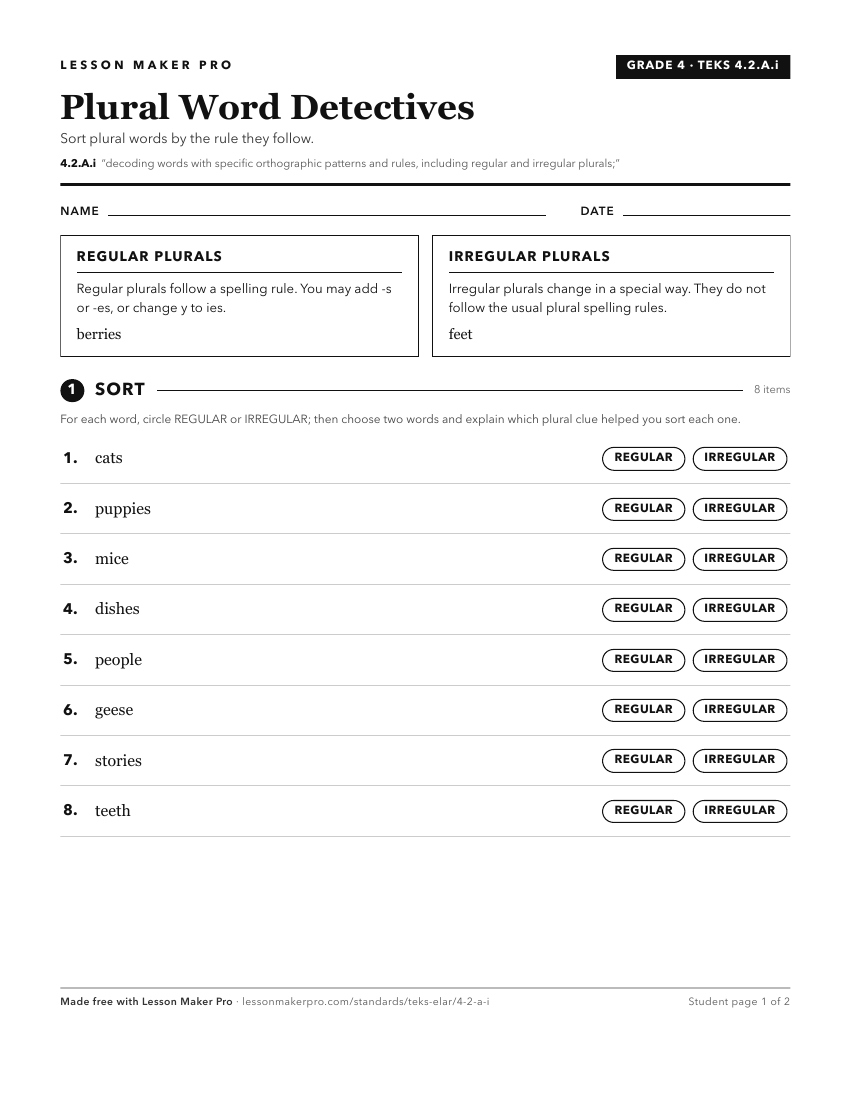
A ready-to-print activity worksheet aligned to 4.2.A.i, with an answer key for the teacher on its own page. No account needed.
PDF, US Letter, prints cleanly in black and white.
Download the worksheetKeep exploring
Related Standards
- 5.11.D.xi
correct spelling of words with grade-appropriate orthographic patterns and rules and high-frequency words; and
- K.10.D.ix
correct spelling of words with grade-appropriate orthographic patterns and rules and high-frequency words; and
- 1.2.B.v
decoding words with inflectional endings, including -ed, -s, and -es; and
- 5.2.A.iii
decoding words using advanced knowledge of syllable division patterns;
Turn this exact standard into a lesson
Grade, subject, topic, and the complete standard are prefilled. Create one free, no account needed.
Also for this standard:Make a WorksheetMake a QuizMake a Sub Lesson