TEKS ELAR 4.2.B.vi
The Standard
spelling words using knowledge of suffixes, including how they can change base words such as dropping e, changing y to i, and doubling final consonants
Texas Essential Knowledge and Skills for English Language Arts and Reading · The student develops word structure knowledge through phonological awareness, print concepts, phonics, and morphology to communicate, decode, and spell.
Teacher's field guide
What This Standard Means
What Students Need to Do
- Students add endings such as -ed, -ing, -er, and -est to base words. They decide whether the base word needs a spelling change before adding the ending.
What Mastery Looks Like
- Students correctly spell words such as hoping, carried, running, and played. They can name the base word and explain why its spelling stayed the same or changed.
Common Misconceptions
- Students may remove every final e, even when it should stay. They may change y to i after a vowel, or double the last consonant in words like rain or open. They may also write makeing, tryed, or stoped.
How to Assess It
- Give students hope + ing, carry + ed, run + ing, and play + ed. Have them write each new word and explain each spelling choice.
Lesson moves
Ways to Teach It
Use letter tiles to build hope, carry, and run, then add ending tiles and physically remove, replace, or double letters.
Ask students to explain why hoping, carried, and running change differently, using the base word and ending in each explanation.
Play a card sort with base words and suffixes, awarding points for a correct spelling and a spoken rule.
Proofread a mock class newsletter containing misspelled words like makeing, tryed, and stoped, then publish corrected versions.
Free download
Printable 4.2.B.vi Worksheet
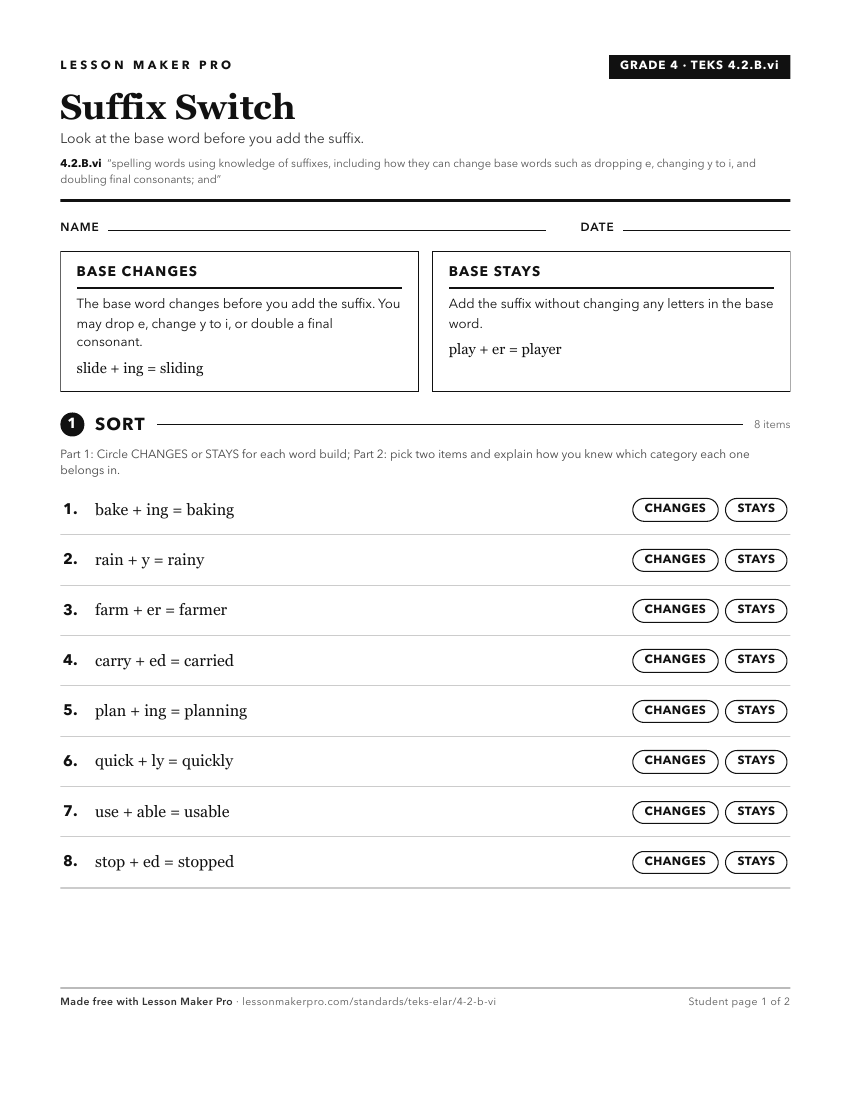
A ready-to-print activity worksheet aligned to 4.2.B.vi, with an answer key for the teacher on its own page. No account needed.
PDF, US Letter, prints cleanly in black and white.
Download the worksheetKeep exploring
Related Standards
- 4.2.A.v
decoding words using knowledge of suffixes, including how they can change base words such as dropping e, changing y to i, and doubling final consonants; and
- 3.2.B.vii
spelling words using knowledge of suffixes, including how they can change base words such as dropping e, changing y to i, and doubling final consonants;
- 3.2.A.vi
decoding words using knowledge of suffixes, including how they can change base words such as dropping e, changing y to i, and doubling final consonants; and
- 5.2.B.vi
The 5th Grade version of this standard.
Turn this exact standard into a lesson
Grade, subject, topic, and the complete standard are prefilled. Create one free, no account needed.
Also for this standard:Make a WorksheetMake a QuizMake a Sub Lesson