Georgia 5.L.GC.1
Georgia Standard (Expectation Cluster)
Grammar, Usage, & Mechanics Learn and apply conventions of Standard English grammar, usage, and mechanics to aid the comprehension and analysis of texts and to communicate clearly and precisely in written and spoken language.
Georgia's K-12 English Language Arts Standards · Language (L)
Cluster contents
Expectations in This Standard
5.L.GC.1 is a Georgia English Language Arts standard. These are the expectations under it.
- 5.L.GC.1.38
"Grammar: Use indefinite pronouns, ensuring correct agreement. (Master)
- 5.L.GC.1.39
Grammar: Use subordinating conjunctions to join clauses. (Master)
- 5.L.GC.1.40
Mechanics: Use commas after introductory phrases or clauses. (Master)
- 5.L.GC.1.41
Mechanics: Use conventional capitalization and underlining, quotation marks, or italics to indicate titles of works. (Master)
- 5.L.GC.1.42
Grammar: Use intensive pronouns. (Master)
- 5.L.GC.1.43
Grammar: Form and use the progressive, perfect, and perfect progressive verb aspects. (Continue)
- 5.L.GC.1.44
Grammar: Form and use participles. (Continue)
- 5.L.GC.1.45
Usage: Recognize and correct vague pronoun references. (Continue)
- 5.L.GC.1.46
Grammar: Use correlative conjunctions to join words, phrases, or clauses. (Introduce)
- 5.L.GC.1.47
Mechanics: Use conventional capitalization, quotation marks, commas, end punctuation, and attributions to indicate exact words and lines of dialogue. (Introduce...
- 5.L.GC.1.48
Mechanics: Use semicolons to separate items in a series or list when at least one of the items already contains commas. (Introduce)
- 5.L.GC.1.54
Mechanics: Use conventional capitalization, quotation marks, commas, end punctuation, and parentheses (citations) when incorporating textual evidence. (Introduc...
Teacher's field guide
What This Cluster Means
What Students Need to Do
- Students apply standard grammar, usage, capitalization, punctuation, and spelling when speaking and writing. They revise sentences so readers can follow the meaning without confusion.
What Mastery Looks Like
- Students write complete, clear sentences with consistent verb tense, correct agreement, clear pronouns, and accurate mechanics. They can edit a draft and explain how a correction improves meaning.
Common Misconceptions
- Students may assume a sentence is correct if it sounds natural when spoken. They may miss fragments, run-ons, agreement errors, unclear pronouns, and punctuation that changes meaning.
How to Assess It
- Give students a short paragraph with five grammar, usage, capitalization, or punctuation errors. Ask them to correct each error and explain one change.
Lesson moves
Ways to Teach It
Give pairs sentence strips with fragments, run-ons, and complete sentences, then have them sort and revise the incorrect examples.
Ask students to compare two punctuated versions of the same sentence and write which meaning each version communicates.
Play an editing relay where teams correct one marked sentence at a time for grammar, usage, capitalization, spelling, or punctuation.
Have students edit a sample email to the principal so its sentences, tone, capitalization, and punctuation communicate the request clearly.
Free download
Printable 5.L.GC.1 Worksheet
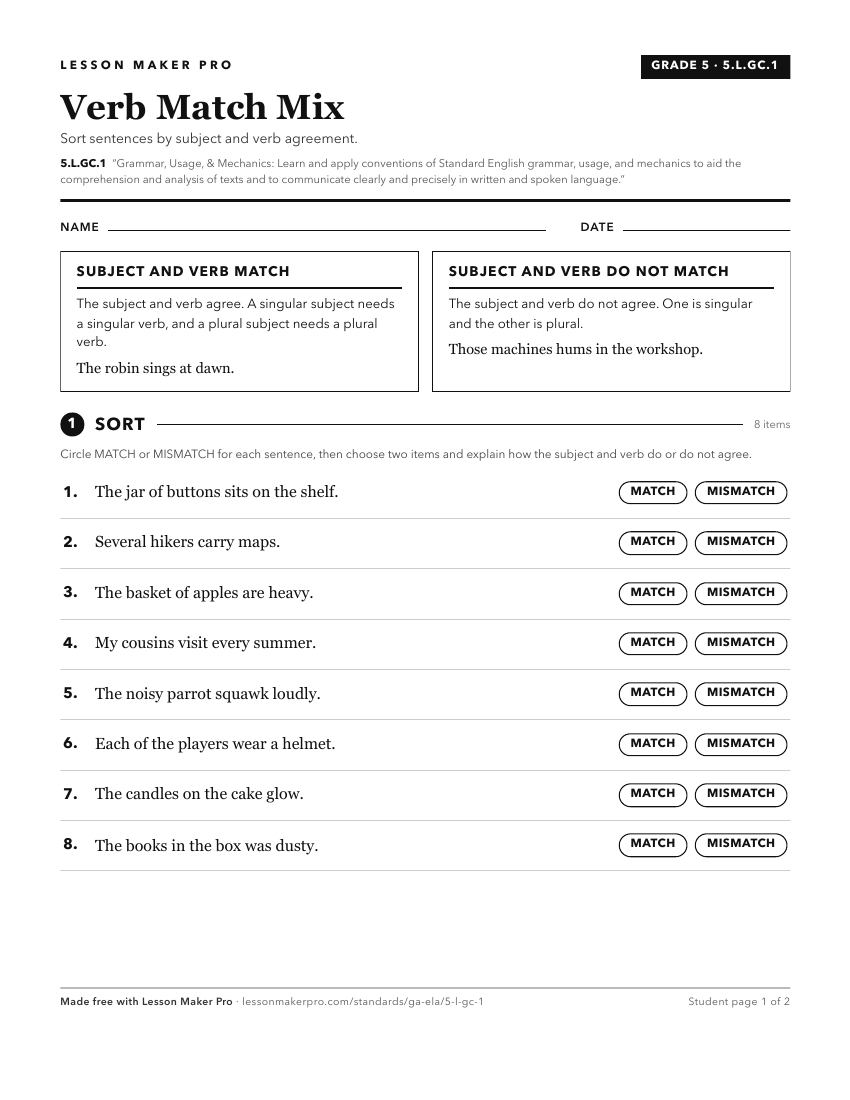
A ready-to-print activity worksheet aligned to 5.L.GC.1, with an answer key for the teacher on its own page. No account needed.
PDF, US Letter, prints cleanly in black and white.
Download the worksheetKeep exploring
Related Standards
- 1.L.GC.1
Grammar, Usage, & Mechanics Learn and apply conventions of Standard English grammar, usage, and mechanics to aid the comprehension of texts and to communicate c...
- 4.L.GC.1
The 4th Grade version of this standard.
- 3.L.GC.1
The 3rd Grade version of this standard.
- 2.L.GC.1
Grammar, Usage, & Mechanics Learn and apply conventions of Standard English grammar, usage, and mechanics to aid the comprehension of texts and to communicate c...
Turn this cluster into a lesson
Grade, subject, topic, and the complete cluster are prefilled. Create one free, no account needed.
Also for this cluster:Make a WorksheetMake a QuizMake a Sub Lesson