Georgia 5.L.GC.1.45
The Standard
Usage: Recognize and correct vague pronoun references. (Continue)
Georgia's K-12 English Language Arts Standards · Language (L) · Grammar Conventions
Teacher's field guide
What This Standard Means
What Students Need to Do
- Students identify which noun each pronoun refers to in a sentence. They rewrite sentences when the intended person, place, thing, or idea is unclear.
What Mastery Looks Like
- Students can point to the exact noun a pronoun replaces. When a sentence has two possible antecedents or no clear antecedent, they can revise it without changing the intended meaning.
Common Misconceptions
- Students may assume the nearest noun is always the pronoun's antecedent. They may also replace an unclear pronoun with another pronoun instead of naming the intended person or thing.
How to Assess It
- Give this exit ticket: “Jordan told Marcus that he had won the contest.” Students explain the ambiguity and write two clear revisions with different meanings.
Lesson moves
Ways to Teach It
Give pairs noun and pronoun cards, then have students build sentences and swap any card that creates an unclear reference.
Discuss the prompt, “When Elena called Mia, she sounded worried,” then write two revisions showing the possible meanings.
Play Pronoun Detective with sentence cards, earning a point for identifying ambiguity and another for making a clear correction.
Edit vague pronouns in a mock school announcement, email, or set of directions so every reader knows who or what is meant.
Free download
Printable 5.L.GC.1.45 Worksheet
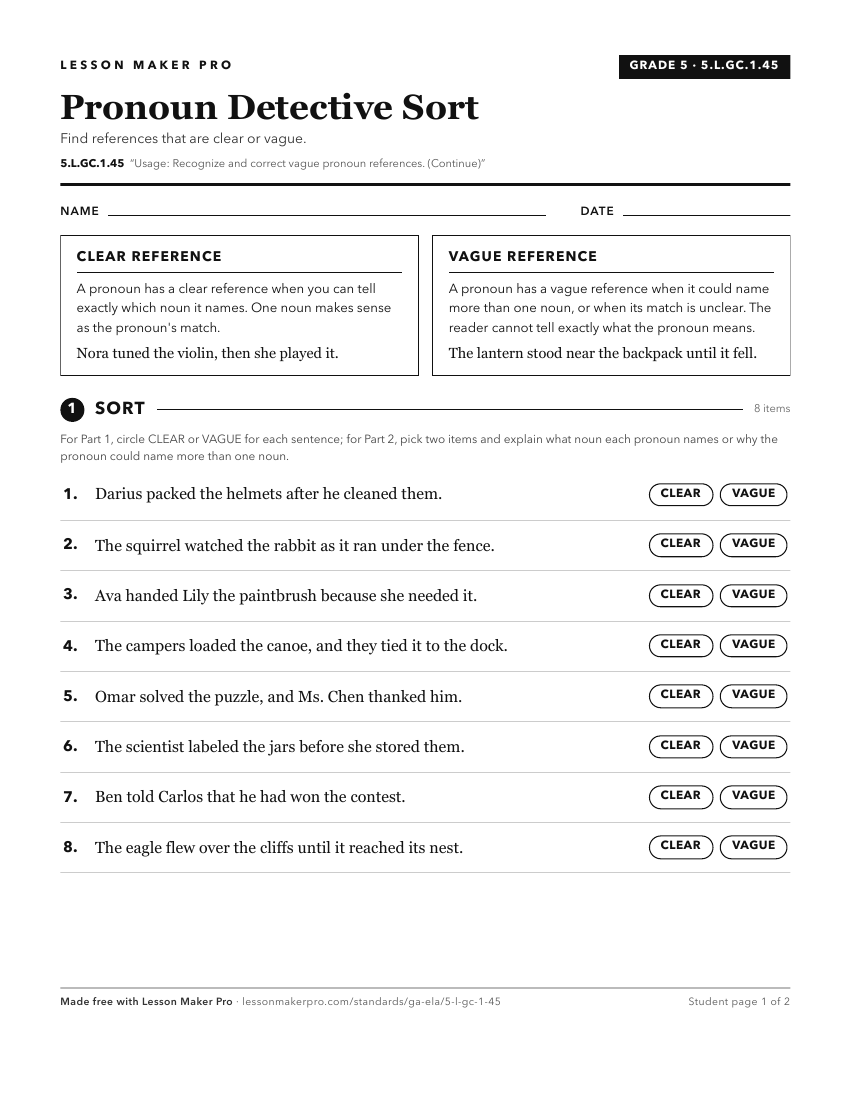
A ready-to-print activity worksheet aligned to 5.L.GC.1.45, with an answer key for the teacher on its own page. No account needed.
PDF, US Letter, prints cleanly in black and white.
Download the worksheetKeep exploring
Related Standards
Turn this exact standard into a lesson
Grade, subject, topic, and the complete standard are prefilled. Create one free, no account needed.
Also for this standard:Make a WorksheetMake a QuizMake a Sub Lesson