Virginia SOL K.PS.1
SOL Standard (Knowledge and Skills Cluster)
The student will apply the data cycle (pose questions; collect or acquire data; organize and represent data; and analyze data and communicate results) with a focus on object graphs and picture graphs.
Virginia Standards of Learning for Mathematics
Cluster contents
Knowledge and Skills in This Standard
K.PS.1 is a Standards of Learning standard. These are the knowledge and skills expectations under it.
- K.PS.1.a
Sort and classify concrete objects into appropriate subsets (categories) based on one attribute (e.g., size, shape, color, thickness).
- K.PS.1.b
Describe and label attributes (e.g., size, color, shape) of a set of objects (e.g., coins, counters, buttons) that has been sorted.
- K.PS.1.c
Pose questions, given a predetermined context, that require the collection of data (limited to 25 or fewer data points for no more than four categories).
- K.PS.1.d
Determine the data needed to answer a posed question, and collect the data using various methods (e.g., counting objects, drawing pictures).
- K.PS.1.e
Organize and represent a data set (vertically or horizontally) by sorting concrete objects into organized groups to form a simple object graph.
- K.PS.1.f
Organize and represent a data set (vertically or horizontally) using pictures to form a simple picture graph.
- K.PS.1.g.i
ask and answer questions about the data represented in object graphs and picture graphs (e.g., how many in each category, which categories have the greatest, le...
- K.PS.1.g.ii
draw conclusions about the data and make predictions based on the data.
Teacher's field guide
What This Cluster Means
What Students Need to Do
- Students sort objects using one feature, such as color, shape, or size, and name the groups. They ask a simple question, gather answers or objects, and show the results in an object graph or picture graph. They count, compare categories, state what the graph shows, and make a prediction.
What Mastery Looks Like
- A student can sort objects by one named feature and explain the sorting rule. The student can make a neat, labeled object or picture graph and accurately count and compare its categories. The student uses the graph to answer a question and make a reasonable prediction.
Common Misconceptions
- Students may switch sorting rules midway, such as sorting some buttons by color and others by size. They may leave uneven spaces in a graph or count pictures instead of matching each picture to one response. They may confuse greatest and least or overlook categories with equal amounts.
How to Assess It
- Give students a picture graph showing 4 red choices, 2 blue choices, and 4 green choices. Ask them to label each category, tell which has the least, and name two categories with equal amounts.
Lesson moves
Ways to Teach It
Give each pair 15 mixed buttons, attribute cards, and a mat; students choose one card, sort, label groups, and build an object graph.
Display a picture graph of favorite fruits and ask, “What do you notice, and which graph counts prove it?”
Partners draw ten shape cards from a bag, place matching counters on a graph mat, then compare greatest, least, and equal groups.
Survey up to 25 classmates about getting to school, use four labeled picture categories, then predict which answer another class might choose.
Free download
Printable K.PS.1 Worksheet
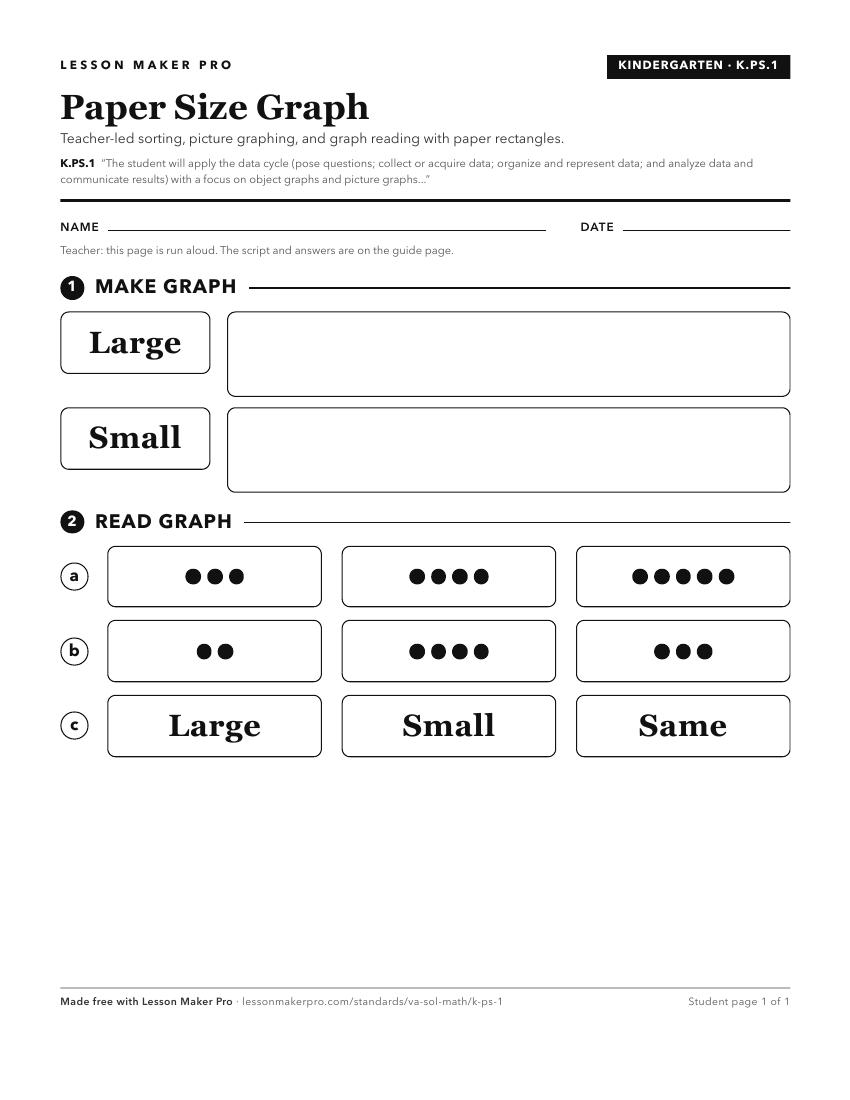
A ready-to-print activity worksheet aligned to K.PS.1, with an answer key for the teacher on its own page. No account needed.
PDF, US Letter, prints cleanly in black and white.
Download the worksheetKeep exploring
Related Standards
- 1.PS.1
The student will apply the data cycle (pose questions; collect or acquire data; organize and represent data; and analyze data and communicate results) with a fo...
- 3.PS.1
The student will apply the data cycle (formulate questions; collect or acquire data; organize and represent data; and analyze data and communicate results) with...
- 6.PS.1
The student will apply the data cycle (formulate questions; collect or acquire data; organize and represent data; and analyze data and communicate results) with...
- 2.PS.1
The student will apply the data cycle (pose questions; collect or acquire data; organize and represent data; and analyze data and communicate results) with a fo...
Turn this cluster into a lesson
Grade, subject, topic, and the complete cluster are prefilled. Create one free, no account needed.
Also for this cluster:Make a WorksheetMake a QuizMake a Sub Lesson