Virginia SOL K.PS.1.b
The Standard
Describe and label attributes (e.g., size, color, shape) of a set of objects (e.g., coins, counters, buttons) that has been sorted.
Virginia Standards of Learning for Mathematics · The student will apply the data cycle (pose questions; collect or acquire data; organize and represent data; and analyze data and communicate results) with a focus on object graphs and picture graphs.
Teacher's field guide
What This Standard Means
What Students Need to Do
- Students look at objects that have already been sorted and identify the attribute used. They describe and label each group by color, size, shape, or another visible feature.
What Mastery Looks Like
- A student identifies the attribute used to sort a set, such as color, size, or shape. The student gives each group a clear label that matches the same attribute.
Common Misconceptions
- Students may name the objects instead of the attribute used to sort them. They may also label groups inconsistently, such as calling one group red and another group circles.
How to Assess It
- Show three groups of buttons sorted by size. Ask, “How were these buttons sorted, and what label belongs on each group?”
Lesson moves
Ways to Teach It
Give pairs mixed buttons to sort into paper plates, then have them place a word or picture label on each plate.
Show a sorted set of counters and ask, “What is the sorting rule, and how would you label each group?”
Play Mystery Sort by arranging blocks secretly while students guess the attribute and name labels for each group.
Sort classroom supplies by type, color, or size, then label the groups with sticky notes.
Free download
Printable K.PS.1.b Worksheet
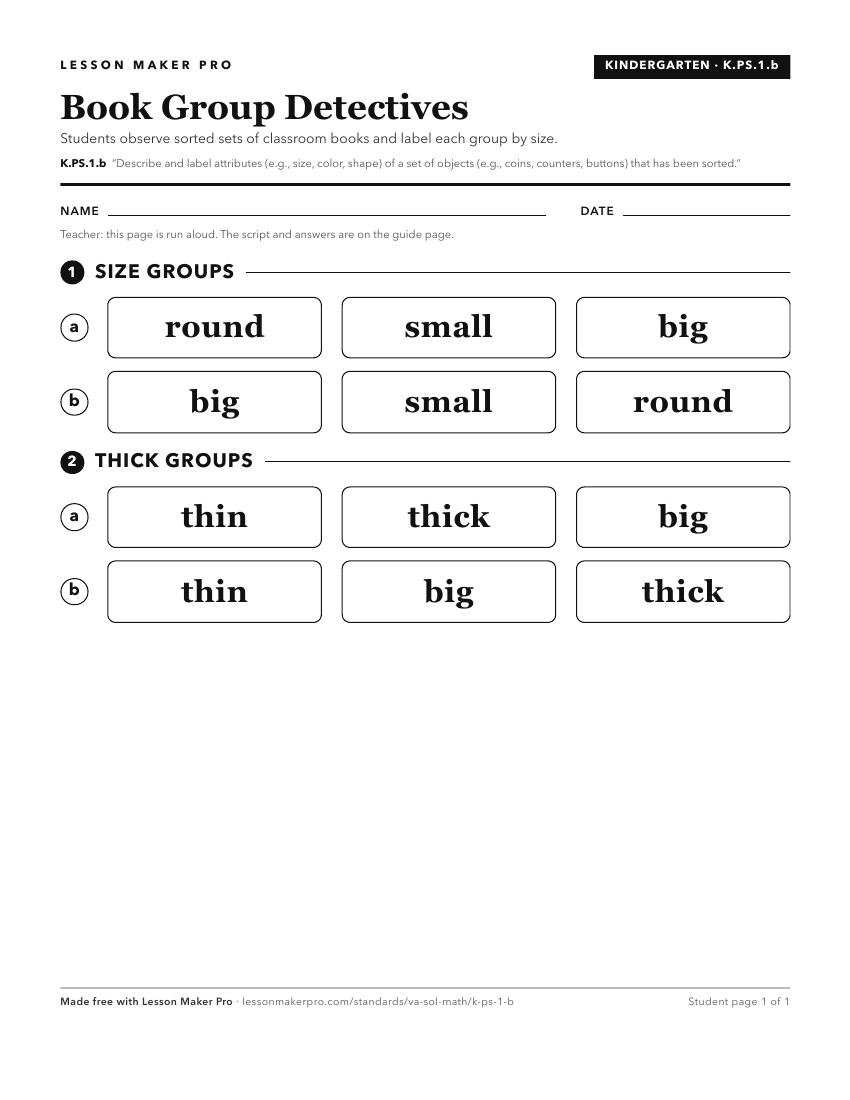
A ready-to-print activity worksheet aligned to K.PS.1.b, with an answer key for the teacher on its own page. No account needed.
PDF, US Letter, prints cleanly in black and white.
Download the worksheetKeep exploring
Related Standards
- 1.PS.1.b
Describe and label attributes of a set of objects that has been sorted.
- 1.PS.1.a
Sort and classify concrete objects into appropriate subsets (categories) based on one or two attributes, such as size, shape, color, and/or thickness (e.g., sor...
- K.NS.1.j
Group a collection of up to 100 objects (e.g., counters, pennies, cubes) into sets of ten and count by tens to determine the total (e.g., there are 3 groups of ...
- K.PS.1.a
Sort and classify concrete objects into appropriate subsets (categories) based on one attribute (e.g., size, shape, color, thickness).
Turn this exact standard into a lesson
Grade, subject, topic, and the complete standard are prefilled. Create one free, no account needed.
Also for this standard:Make a WorksheetMake a QuizMake a Sub Lesson