Virginia SOL CE.14
SOL Standard (Skills Cluster)
The student will apply history and social science skills to explain career opportunities and understand the fundamentals of personal finance by identifying the talents, interests, and aspirations that can influence career choice; identifying the attitudes and behaviors that strengthen individual work ethic and promote career success; identifying human capital, abilities, intellectual and physical skills, work habits, and education, and the changing supply and demand in the economy; examining the effect of technological change and globalization on career opportunities; describing the importance of education to one’s intellectual life, lifelong learning, and personal goals; analyzing the role of financial responsibility in good citizenship including, but not limited to evaluating common forms of credit, savings, and investments; describing the importance of equal opportunities for access to education and training; and researching jobs and careers in the public and private sector and understanding the pathways to various careers.
Virginia Standards of Learning for History and Social Science
Cluster contents
Skills in This Standard
CE.14 is a Standards of Learning history and social science standard. These are the skills expectations under it.
- CE.14.a
identifying the talents, interests, and aspirations that can influence career choice
- CE.14.b
identifying the attitudes and behaviors that strengthen individual work ethic and promote career success
- CE.14.c
identifying human capital, abilities, intellectual and physical skills, work habits, and education, and the changing supply and demand in the economy
- CE.14.d
examining the effect of technological change and globalization on career opportunities
- CE.14.e
describing the importance of education to one’s intellectual life, lifelong learning, and personal goals
- CE.14.f
analyzing the role of financial responsibility in good citizenship including, but not limited to evaluating common forms of credit, savings, and investments
- CE.14.g
describing the importance of equal opportunities for access to education and training
- CE.14.h
researching jobs and careers in the public and private sector and understanding the pathways to various careers.
Teacher's field guide
What This Cluster Means
What Students Need to Do
- Students connect their talents, interests, and goals to realistic career paths. They explain how education, work habits, technology, globalization, and labor demand affect opportunities. They compare credit, saving, and investing choices and recognize barriers to training.
What Mastery Looks Like
- Given a career, students can name required skills, training, work habits, sector, and a realistic pathway. They can explain how technology or labor demand may change that job. Given a money scenario, they can choose a responsible option and defend it.
Common Misconceptions
- Students may assume interests alone determine career fit, or that college is the only route to a good job. They often confuse debit with credit and overlook differences in risk among savings and investments. They may think technology only removes jobs and overlook unequal access to training.
How to Assess It
- Exit ticket: Maya wants to become a cybersecurity analyst and needs $400 for certification next year. Name one skill, one training step, one labor market influence, one access barrier, and whether she should use credit, savings, or an investment.
Lesson moves
Ways to Teach It
Give groups career cards, skill cards, education cards, and sector cards; have them build four matched pathways and explain each match.
Prompt: Which matters more for career success, talent, training, or work habits? Use one career example and address equal access.
Run a budget game where teams choose saving, credit, or investing for six goals, then score costs, risks, and timing.
Compare two local job postings, one public and one private, and list required skills, pay, training, and technology changes.
Free download
Printable CE.14 Worksheet
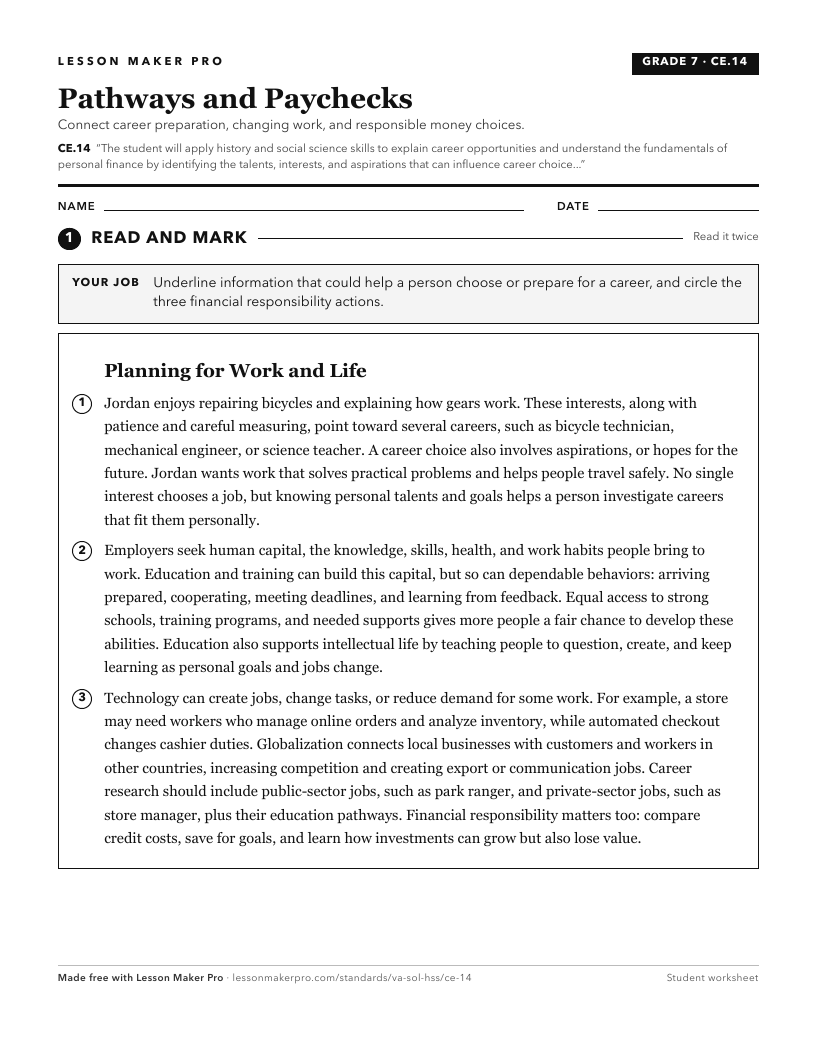
A ready-to-print activity worksheet aligned to CE.14, with an answer key for the teacher on its own page. No account needed.
PDF, US Letter, prints cleanly in black and white.
Download the worksheetKeep exploring
Related Standards
- 3.10
The student will apply history and social science skills to explain basic economic principles by
- 1.8
The student will apply history and social science skills to explain how individuals make economic choices to meet their basic needs by
- K.8
The student will apply history and social science skills to demonstrate an understanding of primary economic principles by
- 2.13
The student will apply history and social science skills to understand basic economic principles by
Turn this cluster into a lesson
Grade, subject, topic, and the complete cluster are prefilled. Create one free, no account needed.
Also for this cluster:Make a WorksheetMake a QuizMake a Sub Lesson