Virginia SOL 1.8
SOL Standard (Skills Cluster)
The student will apply history and social science skills to explain how individuals make economic choices to meet their basic needs by identifying the difference between goods and services; describing how people can be both consumers and producers; describing ways people work to earn and save money to purchase goods and services; describing goods produced and services provided in Virginia; and describing why people must make choices, prioritizing needs over wants.
Virginia Standards of Learning for History and Social Science
Cluster contents
Skills in This Standard
1.8 is a Standards of Learning history and social science standard. These are the skills expectations under it.
- 1.8.a
identifying the difference between goods and services
- 1.8.b
describing how people can be both consumers and producers
- 1.8.c
describing ways people work to earn and save money to purchase goods and services
- 1.8.d
describing goods produced and services provided in Virginia
- 1.8.e
describing why people must make choices, prioritizing needs over wants
Teacher's field guide
What This Cluster Means
What Students Need to Do
- Students sort purchases into goods and services. They explain how people earn and save money, and how one person can both make or provide something and buy something. They name Virginia examples and choose needs before wants when money is limited.
What Mastery Looks Like
- A student labels an apple as a good and a haircut as a service. Given $5 and several choices, the student buys a needed item and explains how work or saving can pay for it. The student names a Virginia good and service, then identifies the producer and consumer.
Common Misconceptions
- Students may call every purchase a good, including a haircut or bus ride. They may think producers only work in factories, or that people are always either producers or consumers. They may treat every want as a need or think saving creates extra money.
How to Assess It
- Give a four-part exit ticket: circle the good, identify the service worker, name who produces and consumes Virginia apples, and choose lunch or a toy with $5. Have students draw one way to earn or save the $5.
Lesson moves
Ways to Teach It
Set up a class store with picture cards and play money. Students act as workers, buyers, and savers while choosing needs before wants.
Ask, “How can the same person be a producer at work and a consumer after work?” Students draw and explain one example.
Play Goods or Services corners. Read examples such as shoes, haircuts, milk, and bus rides, then have students move and justify.
Study photos of Virginia apple orchards, peanut farms, restaurants, and clinics. Students name the goods or services and workers shown.
Free download
Printable 1.8 Worksheet
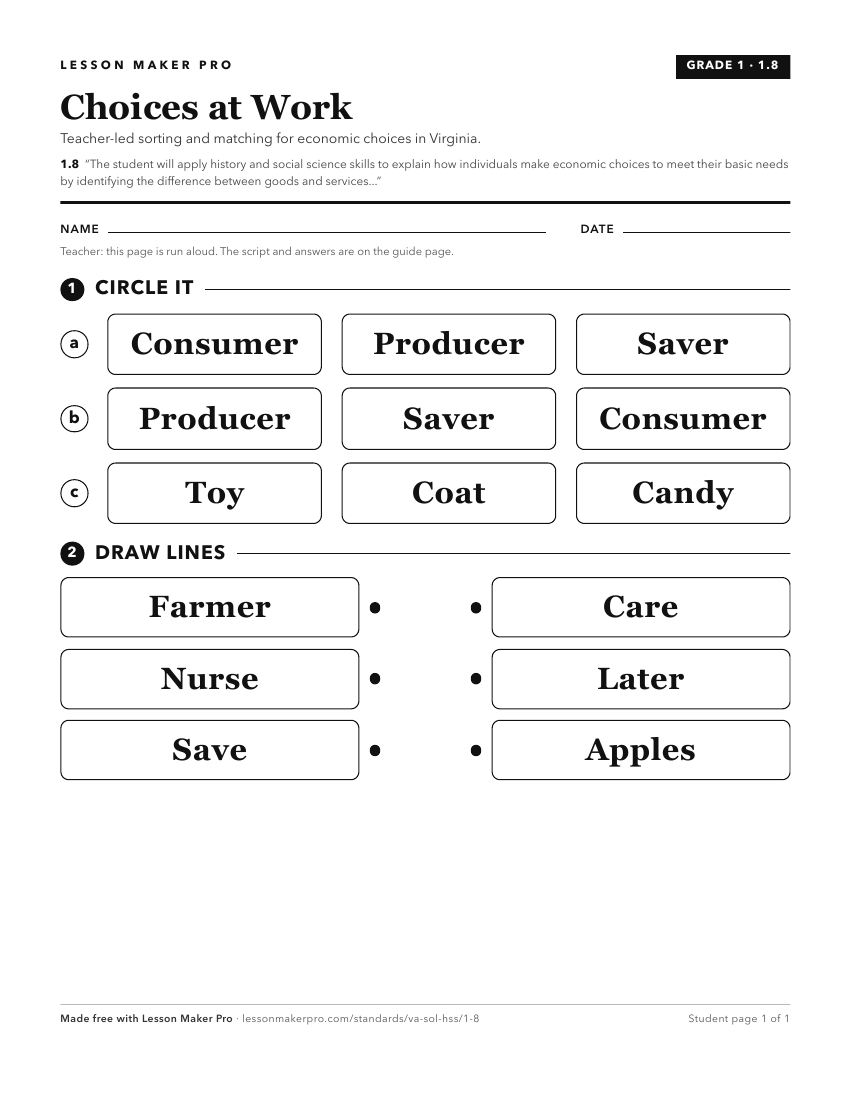
A ready-to-print activity worksheet aligned to 1.8, with an answer key for the teacher on its own page. No account needed.
PDF, US Letter, prints cleanly in black and white.
Download the worksheetKeep exploring
Related Standards
- 3.10
The student will apply history and social science skills to explain basic economic principles by
- K.8
The student will apply history and social science skills to demonstrate an understanding of primary economic principles by
- 2.13
The student will apply history and social science skills to understand basic economic principles by
- CE.11
The student will apply history and social science skills to analyze how economic decisions are made in the marketplace and in daily life by
Turn this cluster into a lesson
Grade, subject, topic, and the complete cluster are prefilled. Create one free, no account needed.
Also for this cluster:Make a WorksheetMake a QuizMake a Sub Lesson