Virginia SOL 2.13
SOL Standard (Skills Cluster)
The student will apply history and social science skills to understand basic economic principles by identifying natural resources (e.g., water, soil, wood, coal), human resources (i.e., people at work), and capital resources (e.g., machines, tools, computers, buildings); distinguishing between needs and wants; distinguishing between the use of barter and the use of money in the exchange for goods and services and describing how money makes trading easier than barter; and explaining that scarcity (having limited resources) requires people to make choices about producing and consuming goods and services.
Virginia Standards of Learning for History and Social Science
Cluster contents
Skills in This Standard
2.13 is a Standards of Learning history and social science standard. These are the skills expectations under it.
- 2.13.a
identifying natural resources (e.g., water, soil, wood, coal), human resources (i.e., people at work), and capital resources (e.g., machines, tools, computers, ...
- 2.13.b
distinguishing between needs and wants
- 2.13.c
distinguishing between the use of barter and the use of money in the exchange for goods and services and describing how money makes trading easier than barter
- 2.13.d
explaining that scarcity (having limited resources) requires people to make choices about producing and consuming goods and services.
Teacher's field guide
What This Cluster Means
What Students Need to Do
- Students sort examples into natural, human, and capital resources and tell how each helps produce a good or service. They separate needs from wants and compare barter with paying money. They also explain how limited time, money, or materials force choices about what to make or buy.
What Mastery Looks Like
- A student correctly classifies familiar examples, such as soil, a cashier, and a cash register, and explains each choice. Given a trade, the student tells why money is easier to use than finding a matching barter partner. In a limited-budget scenario, the student chooses one option and names what must be given up.
Common Misconceptions
- Students may call every object a natural resource, even when people changed it into a tool. They may label any desired item as a need, or think barter means buying with money. They may think scarcity means nothing is available, rather than not enough for every possible use.
How to Assess It
- Exit ticket: Label a tree, a carpenter, and a hammer as natural, human, or capital resources. Circle the need, bread or a toy, then explain why money helps trading and choose one of two $5 items when you have only $5.
Lesson moves
Ways to Teach It
Set out picture cards of water, lumber, workers, tools, computers, and buildings, then have students sort and defend each placement.
Ask, “You have $6 for lunch or a small toy. Which is a need, which is a want, and why?”
Run a barter game with mismatched item cards, then repeat with play coins and compare how quickly trades happen.
Study a local bakery photo and identify its ingredients, workers, equipment, customer needs, and choices when flour is limited.
Free download
Printable 2.13 Worksheet
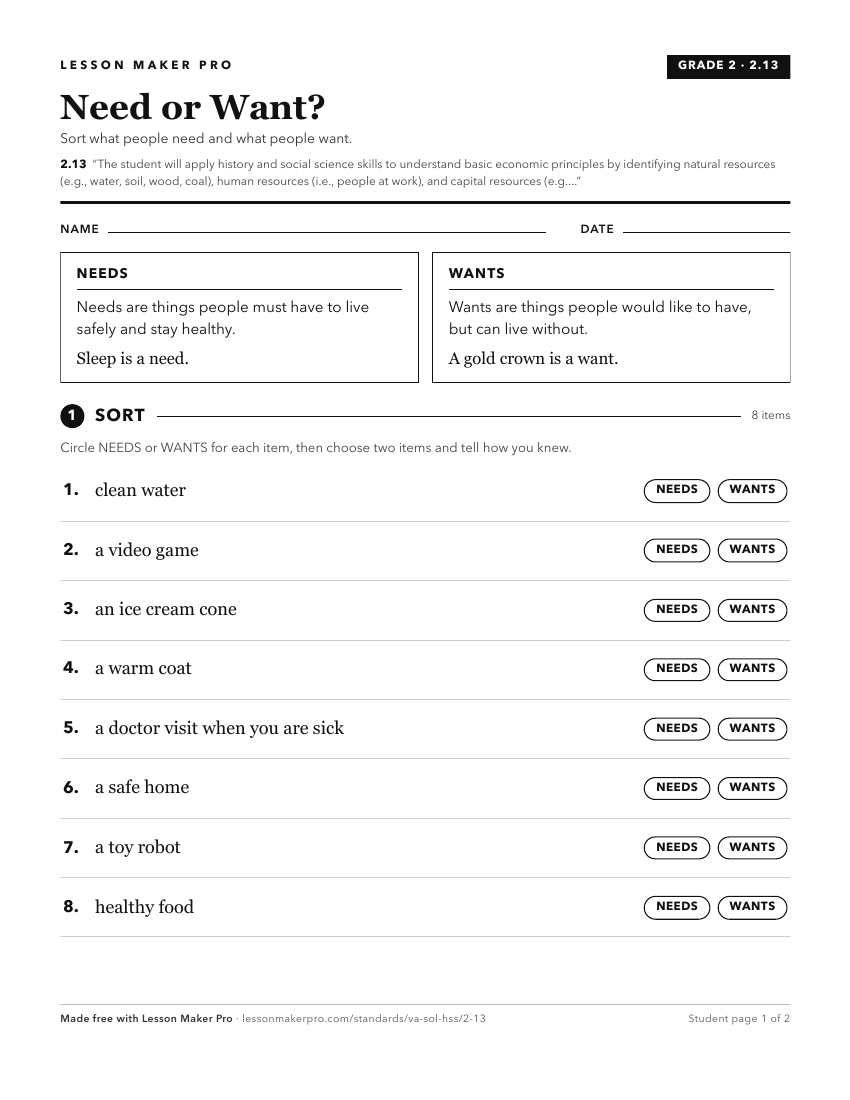
A ready-to-print activity worksheet aligned to 2.13, with an answer key for the teacher on its own page. No account needed.
PDF, US Letter, prints cleanly in black and white.
Download the worksheetKeep exploring
Related Standards
- 3.10
The student will apply history and social science skills to explain basic economic principles by
- 1.8
The student will apply history and social science skills to explain how individuals make economic choices to meet their basic needs by
- K.8
The student will apply history and social science skills to demonstrate an understanding of primary economic principles by
- CE.11
The student will apply history and social science skills to analyze how economic decisions are made in the marketplace and in daily life by
Turn this cluster into a lesson
Grade, subject, topic, and the complete cluster are prefilled. Create one free, no account needed.
Also for this cluster:Make a WorksheetMake a QuizMake a Sub Lesson