Virginia SOL 3.10
SOL Standard (Skills Cluster)
The student will apply history and social science skills to explain basic economic principles by defining production, distribution, and consumption of goods and services; understanding different cultures and the natural, human, and capital resources they use in the production of goods and services; recognizing that because people and regions cannot produce everything they want, they specialize in what they do best and trade for the rest; and identifying examples of making an economic choice and explaining the idea of opportunity cost.
Virginia Standards of Learning for History and Social Science
Cluster contents
Skills in This Standard
3.10 is a Standards of Learning history and social science standard. These are the skills expectations under it.
- 3.10.a
defining production, distribution, and consumption of goods and services
- 3.10.b
understanding different cultures and the natural, human, and capital resources they use in the production of goods and services
- 3.10.c
recognizing that because people and regions cannot produce everything they want, they specialize in what they do best and trade for the rest
- 3.10.d
identifying examples of making an economic choice and explaining the idea of opportunity cost
Teacher's field guide
What This Cluster Means
What Students Need to Do
- Students trace how goods and services are produced, distributed, and consumed. They sort natural, human, and capital resources used by different cultures. They explain specialization, trade, economic choices, and opportunity cost.
What Mastery Looks Like
- Students correctly label each stage in a product’s path from maker to buyer. They identify the resources involved and explain why regions specialize and trade. Given two choices, they name the option given up as the opportunity cost.
Common Misconceptions
- Students may confuse distribution with selling or think consumption means using only food. They may call money a capital resource or treat workers as natural resources. They may name the chosen item, rather than the item given up, as the opportunity cost.
How to Assess It
- Give students this exit ticket: “A farmer can grow apples or pumpkins, but chooses apples. Name the opportunity cost and one resource needed to produce apples.”
Lesson moves
Ways to Teach It
Give groups bread, truck, worker, wheat, and store cards to sort by production, distribution, consumption, and resource type.
Ask students to write why a fishing community and a farming community might produce different goods and trade with each other.
Play a specialization game where groups make paper products using different tools, then trade to complete a required set.
Trace a school lunch item from its natural resources and workers to transportation, purchase, and consumption.
Free download
Printable 3.10 Worksheet
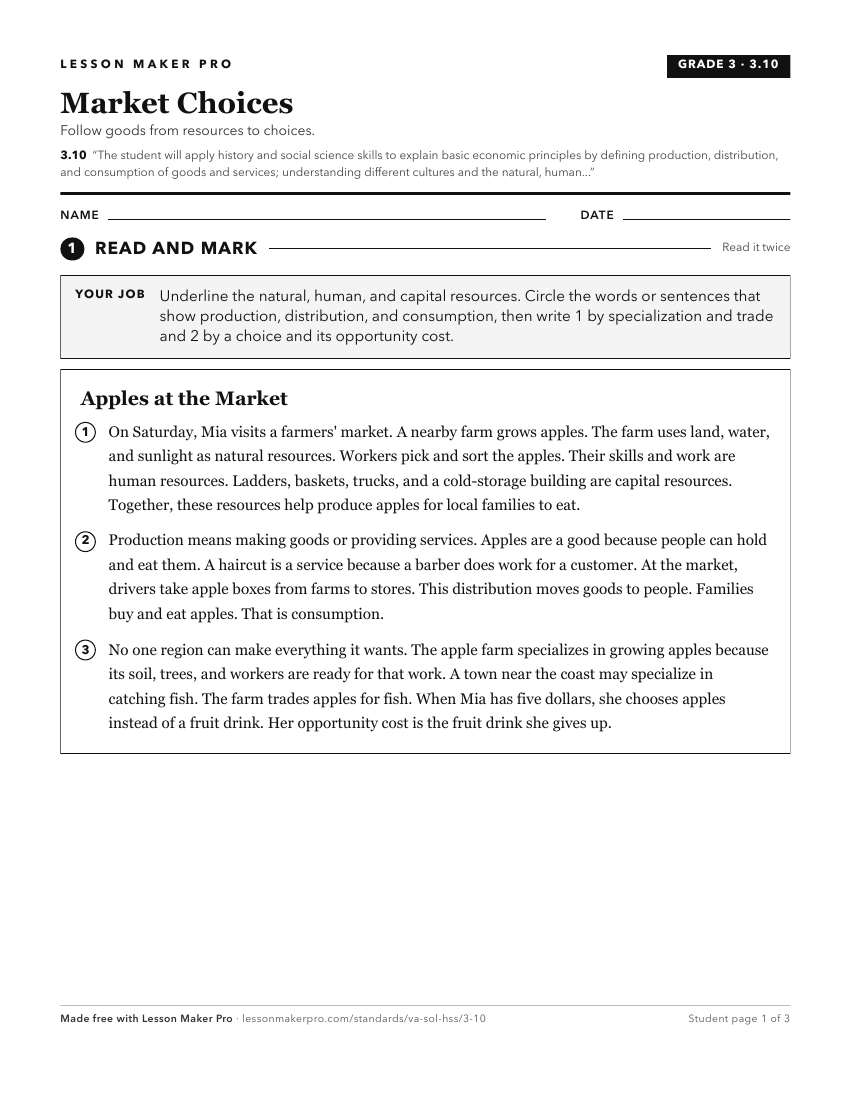
A ready-to-print activity worksheet aligned to 3.10, with an answer key for the teacher on its own page. No account needed.
PDF, US Letter, prints cleanly in black and white.
Download the worksheetKeep exploring
Related Standards
- 1.8
The student will apply history and social science skills to explain how individuals make economic choices to meet their basic needs by
- K.8
The student will apply history and social science skills to demonstrate an understanding of primary economic principles by
- 2.13
The student will apply history and social science skills to understand basic economic principles by
- CE.11
The student will apply history and social science skills to analyze how economic decisions are made in the marketplace and in daily life by
Turn this cluster into a lesson
Grade, subject, topic, and the complete cluster are prefilled. Create one free, no account needed.
Also for this cluster:Make a WorksheetMake a QuizMake a Sub Lesson