Virginia SOL 3.10.b
The Standard
- 3.10
- The student will apply history and social science skills to explain basic economic principles by
understanding different cultures and the natural, human, and capital resources they use in the production of goods and services
Virginia Standards of Learning for History and Social Science
Teacher's field guide
What This Standard Means
What Students Need to Do
- Students identify the natural materials, worker skills, and tools or buildings used to make a good or provide a service. They compare how traditions and available resources shape production choices.
What Mastery Looks Like
- Given a farming, cooking, building, or service example, students correctly label natural, human, and capital resources. They explain one way culture influences what is made or how it is made.
Common Misconceptions
- Students often call money a capital resource instead of identifying tools, machines, or buildings. They may classify a finished product as natural or overlook workers’ knowledge as a human resource. Some assume every culture produces goods in the same way.
How to Assess It
- Exit ticket: A family uses a traditional recipe, corn, a cook’s skill, and a griddle to make tortillas. Label each resource and explain how culture affects production.
Lesson moves
Ways to Teach It
Give groups picture cards for bread, cloth, and pottery, then have them sort each product’s materials, workers, and tools into three labeled hoops.
Ask students to compare two ways families make bread and write how traditions, local materials, and tools change the process.
Play Resource Relay: teams match product cards with one natural resource, one worker skill, and one tool card.
Study a local restaurant menu, choose one dish, and trace its ingredients, workers, equipment, and cultural tradition.
Free download
Printable 3.10.b Worksheet
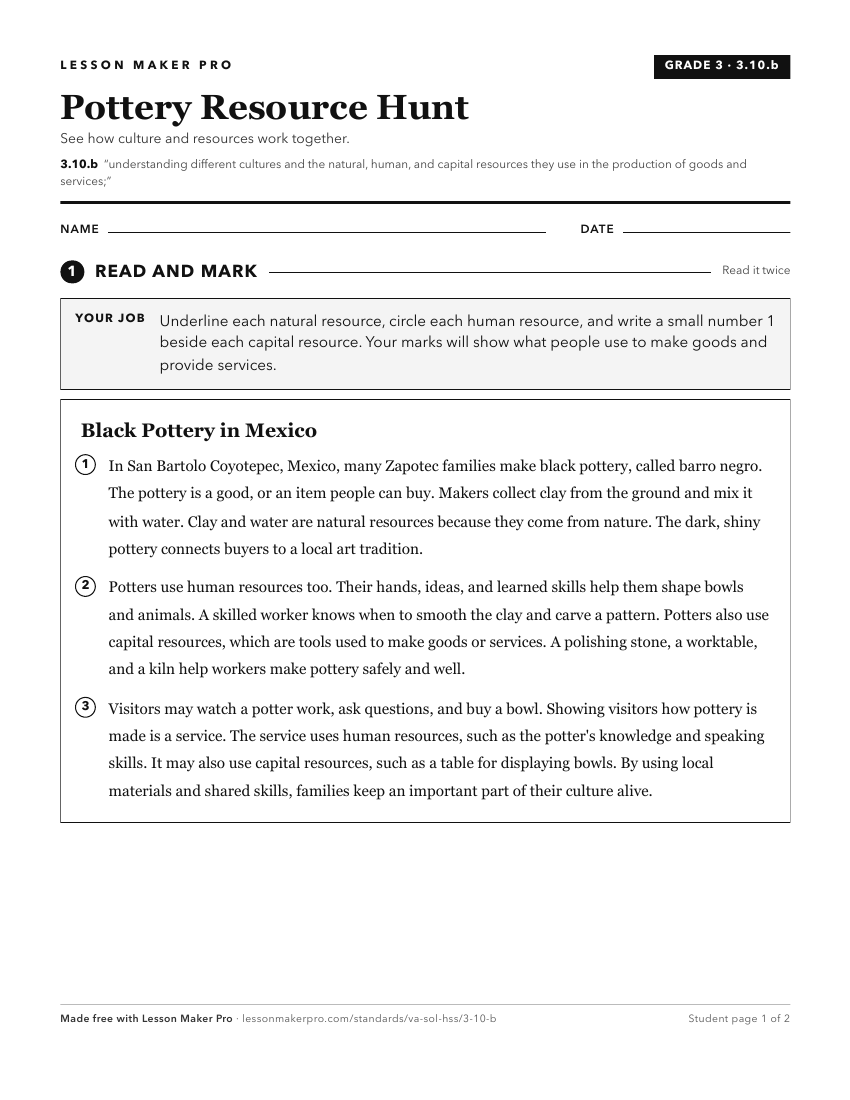
A ready-to-print activity worksheet aligned to 3.10.b, with an answer key for the teacher on its own page. No account needed.
PDF, US Letter, prints cleanly in black and white.
Download the worksheetKeep exploring
Related Standards
- 3.10.c
recognizing that because people and regions cannot produce everything they want, they specialize in what they do best and trade for the rest
- WG.2
The student will apply history and social science skills to evaluate the significance of natural, human, and capital resources by
- 2.13.a
identifying natural resources (e.g., water, soil, wood, coal), human resources (i.e., people at work), and capital resources (e.g., machines, tools, computers, ...
- 3.10.a
defining production, distribution, and consumption of goods and services
Turn this exact standard into a lesson
Grade, subject, topic, and the complete standard are prefilled. Create one free, no account needed.
Also for this standard:Make a WorksheetMake a QuizMake a Sub Lesson