Virginia SOL 7.LU
SOL Standard (Knowledge and Skills Cluster)
The student will use the conventions of Standard English when speaking and writing, differentiating between contexts that call for formal English and situations where informal discourse is more appropriate. Grammar Construct simple, compound, complex, and compound-complex sentences to communicate ideas clearly and add variety to writing. Recognize and use pronoun-antecedent agreement, including indefinite, reflexive, and relative pronouns, when speaking and writing. Use specific adjectives and adverbs to enhance speech and writing. Arrange phrases and clauses within a sentence and apply appropriate subject-verb agreement to improve meaning, reader/listener interest, and style in writing. Maintain consistent verb tense across paragraphs in writing. Mechanics Construct complete sentence with appropriate punctuation, avoiding comma splices and run-ons in writing. Use and punctuate dialogue and direct quotations appropriately in writing. Recognize and consistently spell frequently used words accurately. Consult reference materials to check and correct spelling.
Virginia Standards of Learning for English
Cluster contents
Knowledge and Skills in This Standard
7.LU is a Standards of Learning standard. These are the knowledge and skills expectations under it.
- 7.LU.1.A
Construct simple, compound, complex, and compound-complex sentences to communicate ideas clearly and add variety to writing.
- 7.LU.1.B
Recognize and use pronoun-antecedent agreement, including indefinite, reflexive, and relative pronouns, when speaking and writing.
- 7.LU.1.C
Use specific adjectives and adverbs to enhance speech and writing.
- 7.LU.1.D
Arrange phrases and clauses within a sentence and apply appropriate subject-verb agreement to improve meaning, reader/listener interest, and style in writing.
- 7.LU.1.E
Maintain consistent verb tense across paragraphs in writing.
- 7.LU.2.A
Construct complete sentence with appropriate punctuation, avoiding comma splices and run-ons in writing.
- 7.LU.2.B
Use and punctuate dialogue and direct quotations appropriately in writing.
- 7.LU.2.C
Recognize and consistently spell frequently used words accurately
- 7.LU.2.D
Consult reference materials to check and correct spelling.
Teacher's field guide
What This Cluster Means
What Students Need to Do
- Students choose formal or conversational language to fit the audience and purpose. They build and revise varied sentences while keeping pronouns, subjects, verbs, modifiers, and tense clear and consistent. They punctuate sentences and quoted speech correctly, then check spelling with reliable references.
What Mastery Looks Like
- Given a rough paragraph, a student can vary sentence structures, fix agreement and tense shifts, and replace vague modifiers. The student can remove fragments, run-ons, and comma splices, punctuate quoted speech, correct spelling, and adjust word choice for the audience.
Common Misconceptions
- Students often think any long sentence is a run-on, or that a comma alone can join two complete thoughts. They may match a verb or pronoun to the nearest noun instead of the actual subject or antecedent. They also shift tense without reason and use texting language in formal work.
How to Assess It
- Exit ticket: Rewrite this for a principal's report: "The robotics students brings there robot yesterday, they say its super cool." Label each change as agreement, tense, spelling, sentence boundary, quotation, or register.
Lesson moves
Ways to Teach It
Give pairs sentence strips with clauses and punctuation cards, then have them build four sentence types and explain each punctuation choice.
Ask students to rewrite the same school announcement for a friend and the principal, then explain three language changes.
Run a proofreading relay where teams correct agreement, tense, modifiers, run-ons, quotations, and spelling in one flawed paragraph.
Have students edit a sample job inquiry email, choosing a suitable tone and checking every sentence with a dictionary or spell-check tool.
Free download
Printable 7.LU Worksheet
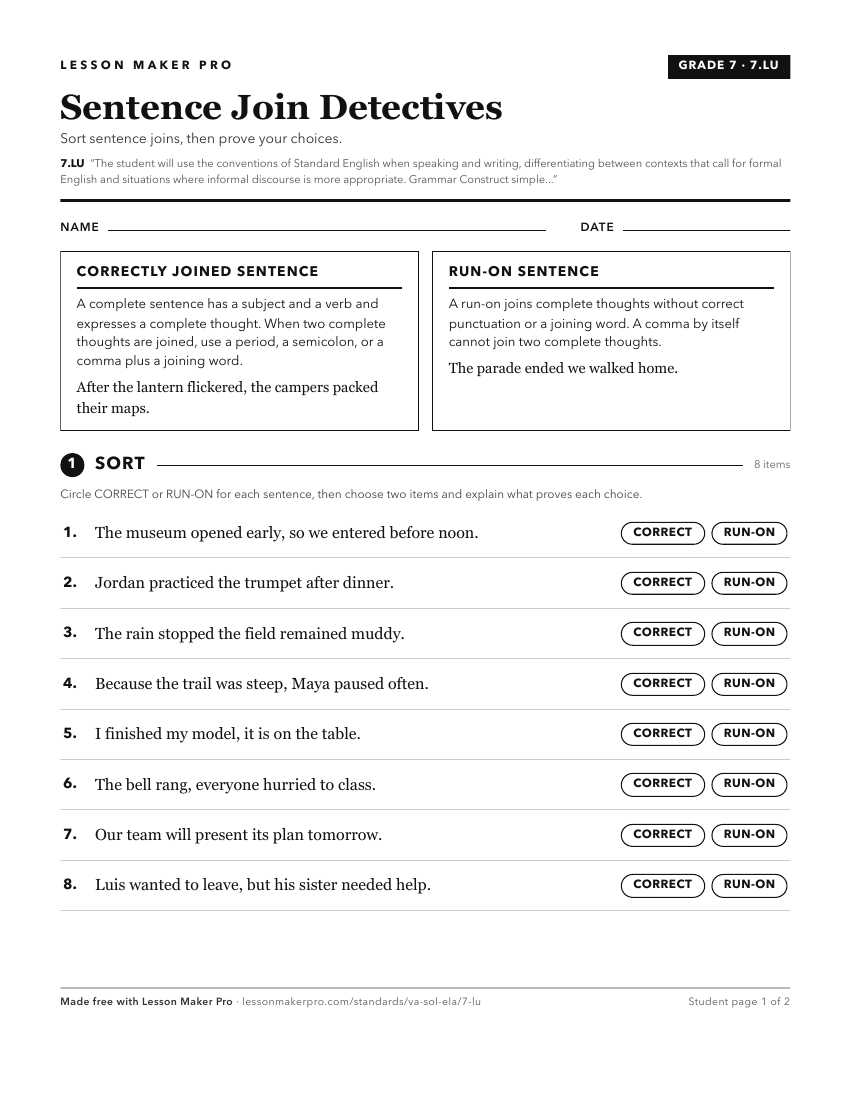
A ready-to-print activity worksheet aligned to 7.LU, with an answer key for the teacher on its own page. No account needed.
PDF, US Letter, prints cleanly in black and white.
Download the worksheetKeep exploring
Related Standards
Turn this cluster into a lesson
Grade, subject, topic, and the complete cluster are prefilled. Create one free, no account needed.
Also for this cluster:Make a WorksheetMake a QuizMake a Sub Lesson