Virginia SOL 7.LU.1.B
The Standard
Recognize and use pronoun-antecedent agreement, including indefinite, reflexive, and relative pronouns, when speaking and writing.
Virginia Standards of Learning for English · Grammar
Teacher's field guide
What This Standard Means
What Students Need to Do
- Students identify the noun or pronoun that each pronoun refers to. They choose forms that match in number and person when speaking and writing.
What Mastery Looks Like
- Students choose pronouns that match their antecedents in number and person. They use indefinite, reflexive, and relative pronouns correctly and can explain each choice.
Common Misconceptions
- Students may match a pronoun with the nearest noun instead of its actual antecedent. They may use reflexive forms such as "myself" as subjects or confuse "who," "which," and "that." They may also treat indefinite pronouns such as "everyone" or "several" as having the same number.
How to Assess It
- Exit ticket: Correct these sentences: "The players packed his uniform. Ana and Bea congratulated herself. The book who won the award is new."
Lesson moves
Ways to Teach It
Sort antecedent and pronoun cards, then pair them and explain matches in number, person, and type.
Write three sentences about a class event using one indefinite, one reflexive, and one relative pronoun, then underline each antecedent.
Play Pronoun Repair Relay: teams correct mismatched sentences on the board and earn a point only when they name the rule.
Edit a school announcement for pronoun agreement, then read it aloud to check whether every reference is clear.
Free download
Printable 7.LU.1.B Worksheet
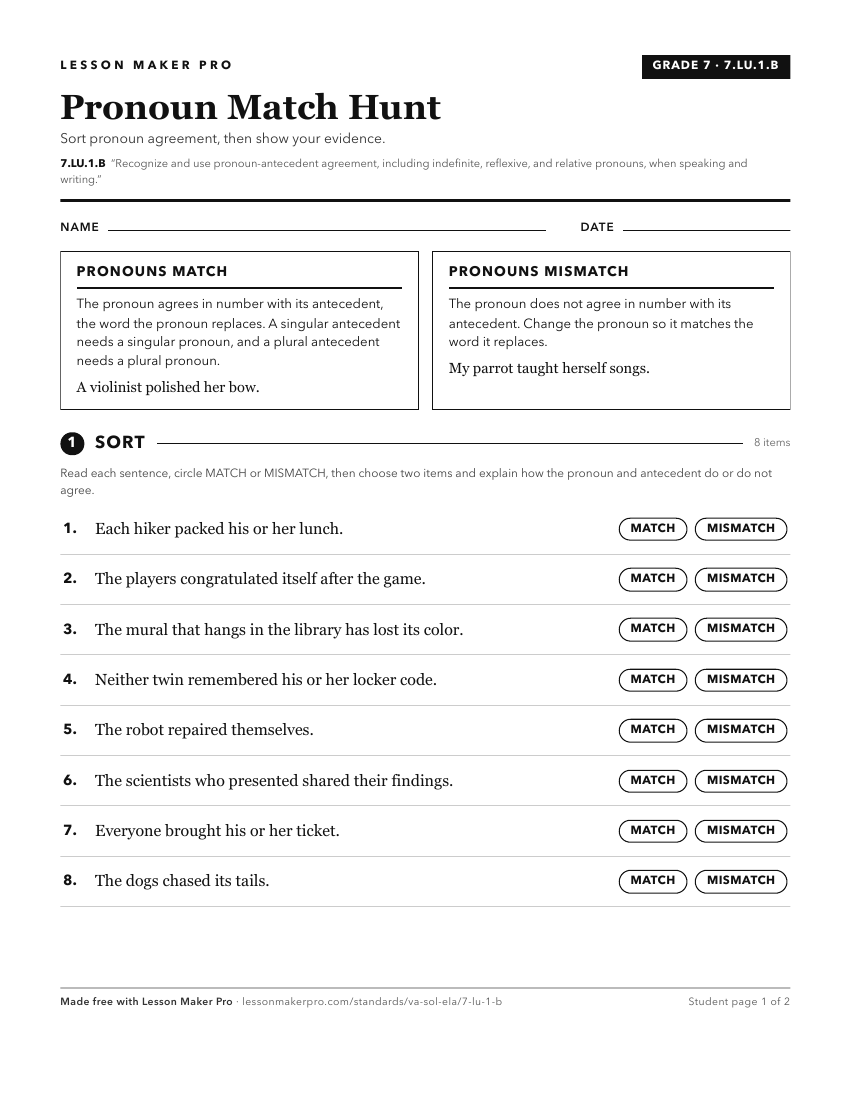
A ready-to-print activity worksheet aligned to 7.LU.1.B, with an answer key for the teacher on its own page. No account needed.
PDF, US Letter, prints cleanly in black and white.
Download the worksheetKeep exploring
Related Standards
Turn this exact standard into a lesson
Grade, subject, topic, and the complete standard are prefilled. Create one free, no account needed.
Also for this standard:Make a WorksheetMake a QuizMake a Sub Lesson