Virginia SOL 4.LU
SOL Standard (Knowledge and Skills Cluster)
The student will use the conventions of Standard English when speaking and writing, differentiating between contexts that call for formal English and situations where informal discourse is more appropriate.
Virginia Standards of Learning for English
Cluster contents
Knowledge and Skills in This Standard
4.LU is a Standards of Learning standard. These are the knowledge and skills expectations under it.
- 4.LU.1.A
Produce, expand, and rearrange simple and compound sentences, including prepositional phrases, when speaking and writing.
- 4.LU.1.B
Use coordinating (e.g., and, but), subordinating (e.g., although, because) conjunctions to join words and phrases in a sentence.
- 4.LU.1.C
Use adjectives to compare and describe noun or noun phrases with specificity when speaking and writing.
- 4.LU.1.D
Use modal words (e.g., can, may, must) to convey various conditions when speaking and writing.
- 4.LU.1.E
Use standard subject-verb agreement when speaking and writing.
- 4.LU.1.F
Use standard noun-pronoun agreement when speaking and writing.
- 4.LU.2.A
Use commas in series, dates, addresses, and letters in writing.
- 4.LU.2.B
Use commas and quotation marks to indicate dialogue in writing.
- 4.LU.2.C
Use apostrophes to form contractions and to show possession in writing.
- 4.LU.2.D
Use conventional spelling for high-frequency and other studied words and grade level word analysis knowledge.
- 4.LU.2.E
Consult reference materials to check and correct spelling.
Teacher's field guide
What This Cluster Means
What Students Need to Do
- Students build and revise sentences so ideas connect clearly and details are specific. They match subjects with verbs and nouns with pronouns. They choose formal or informal language, punctuate correctly, and check spelling with reference tools.
What Mastery Looks Like
- Students write clear simple and compound sentences, adding specific adjectives, prepositional phrases, conjunctions, and modal words when useful. Subjects, verbs, nouns, and pronouns agree. Their punctuation and spelling are accurate, and their language fits the audience and setting.
Common Misconceptions
- Students may join clauses with a comma alone or choose a conjunction that does not show the intended relationship. They may mix formal and casual language, use pronouns that do not agree with nouns, or miss subject-verb errors. Commas, quotation marks, possessive apostrophes, and contraction apostrophes are often confused or omitted.
How to Assess It
- Give students a four-sentence exit ticket with an informal phrase, an agreement error, missing dialogue punctuation, and a misspelled studied word. Ask them to correct each issue and explain one change.
Lesson moves
Ways to Teach It
Give pairs color-coded word cards to build, expand, and rearrange sentences with prepositional phrases, adjectives, modal words, and conjunctions.
Ask students to explain why “Can you help me?” fits a friend, then rewrite it as a formal request to the principal.
Run an editing relay with agreement, apostrophe, comma, quotation mark, and spelling errors; teams correct one error per turn.
Have students write the same field-trip update as a text to a friend and a letter to a family member.
Free download
Printable 4.LU Worksheet
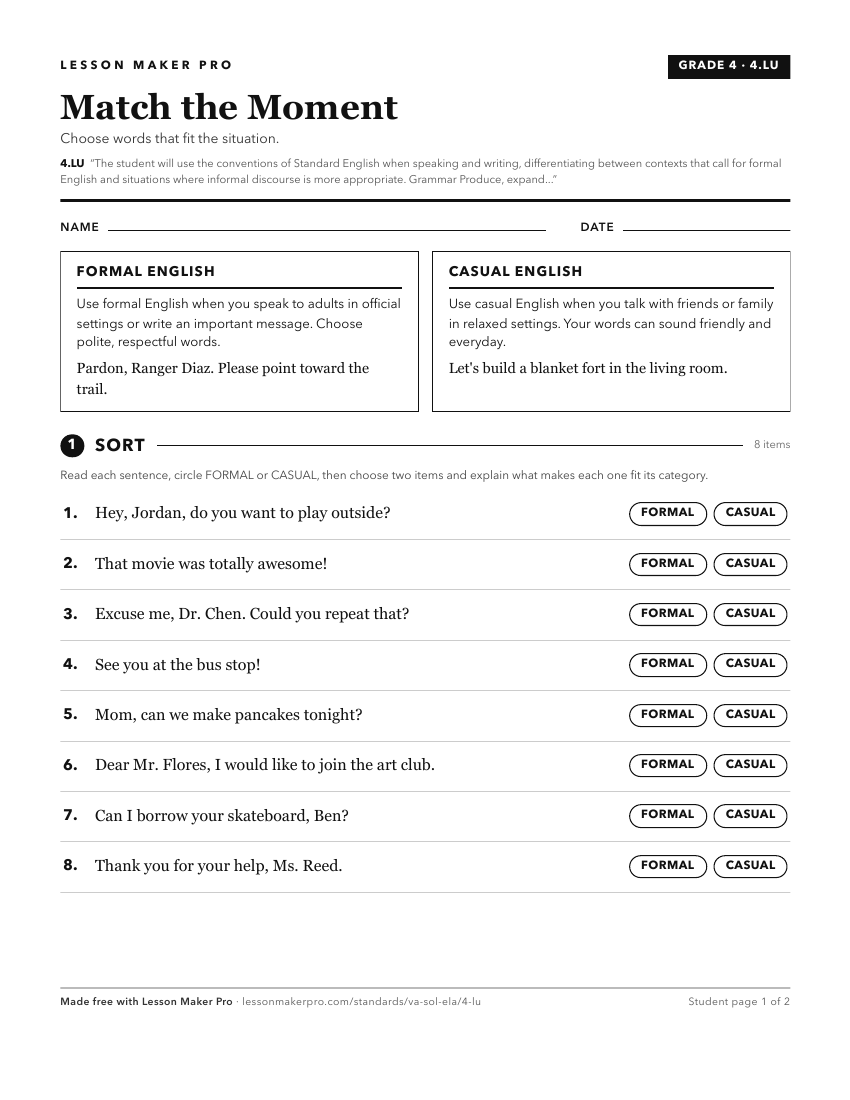
A ready-to-print activity worksheet aligned to 4.LU, with an answer key for the teacher on its own page. No account needed.
PDF, US Letter, prints cleanly in black and white.
Download the worksheetKeep exploring
Related Standards
Turn this cluster into a lesson
Grade, subject, topic, and the complete cluster are prefilled. Create one free, no account needed.
Also for this cluster:Make a WorksheetMake a QuizMake a Sub Lesson