Virginia SOL 5.LU
SOL Standard (Knowledge and Skills Cluster)
The student will use the conventions of Standard English when speaking and writing, differentiating between contexts that call for formal English and situations where informal discourse is more appropriate.
Virginia Standards of Learning for English
Cluster contents
Knowledge and Skills in This Standard
5.LU is a Standards of Learning standard. These are the knowledge and skills expectations under it.
- 5.LU.1.A
Expand, combine, and reduce sentences for meaning, reader/listener interest, and style.
- 5.LU.1.B
Use adverbs to express time, frequency, degree, and level of certainty when speaking and writing.
- 5.LU.1.C
Use interjections, prepositional phrases, and coordinating and subordinating conjunctions in writing to join words and phrases in a sentence.
- 5.LU.1.D
Recognize and correct inappropriate shifts in verb tense and number in writing.
- 5.LU.1.E
Use standard subject-verb agreement when speaking and writing.
- 5.LU.2.A
Use commas correctly in compound sentences.
- 5.LU.2.B
Use colons to separate hours and minutes and to introduce a list.
- 5.LU.2.C
Use a hyphen to divide words at the end of a line in writing.
- 5.LU.2.D
Use spelling patterns and generalizations (e.g., word families, syllable patterns, ending rules) when pronouncing and writing words.
- 5.LU.2.E
Consult reference materials to check and correct spelling.
Teacher's field guide
What This Cluster Means
What Students Need to Do
- Students choose formal or informal English to fit the audience and purpose. They reshape sentences and use adverbs, interjections, phrases, and conjunctions to make meaning clear and varied. They keep verbs consistent and subjects matched, then apply commas, colons, line-ending hyphens, spelling patterns, and reference tools.
What Mastery Looks Like
- A student can combine choppy ideas, shorten wordy sentences, and explain why each version fits the audience. They keep verb tense and agreement consistent, place commas and colons correctly, and check unfamiliar spellings. They select adverbs that show when, how often, how much, or how certain.
Common Misconceptions
- Students often shift tense within a paragraph or make a verb agree with the nearest noun instead of the subject. They may create run-ons, place a colon directly after a verb, or assume every adverb ends in ly. Informal language may appear in school writing, while spelling guesses go unchecked even when a dictionary is available.
How to Assess It
- Give this exit ticket: “Yesterday Maya walks to rehearsal. Her friends were waiting but the coach are late. Practice begins at 3 30.” Ask students to correct it, add an adverb, and rewrite the last sentence for a friend.
Lesson moves
Ways to Teach It
Build sentences with color-coded word and phrase cards, then combine or shorten them using conjunctions, adverbs, prepositional phrases, and interjections.
Write the same request as a principal email and a friend’s message, then discuss which language choices fit each audience.
Run an editing relay where teams correct tense shifts, agreement, commas, colons, line-ending hyphens, and misspellings with dictionaries.
Create a club announcement with a meeting time, a materials list, varied sentences, and spelling checked in a print or online dictionary.
Free download
Printable 5.LU Worksheet
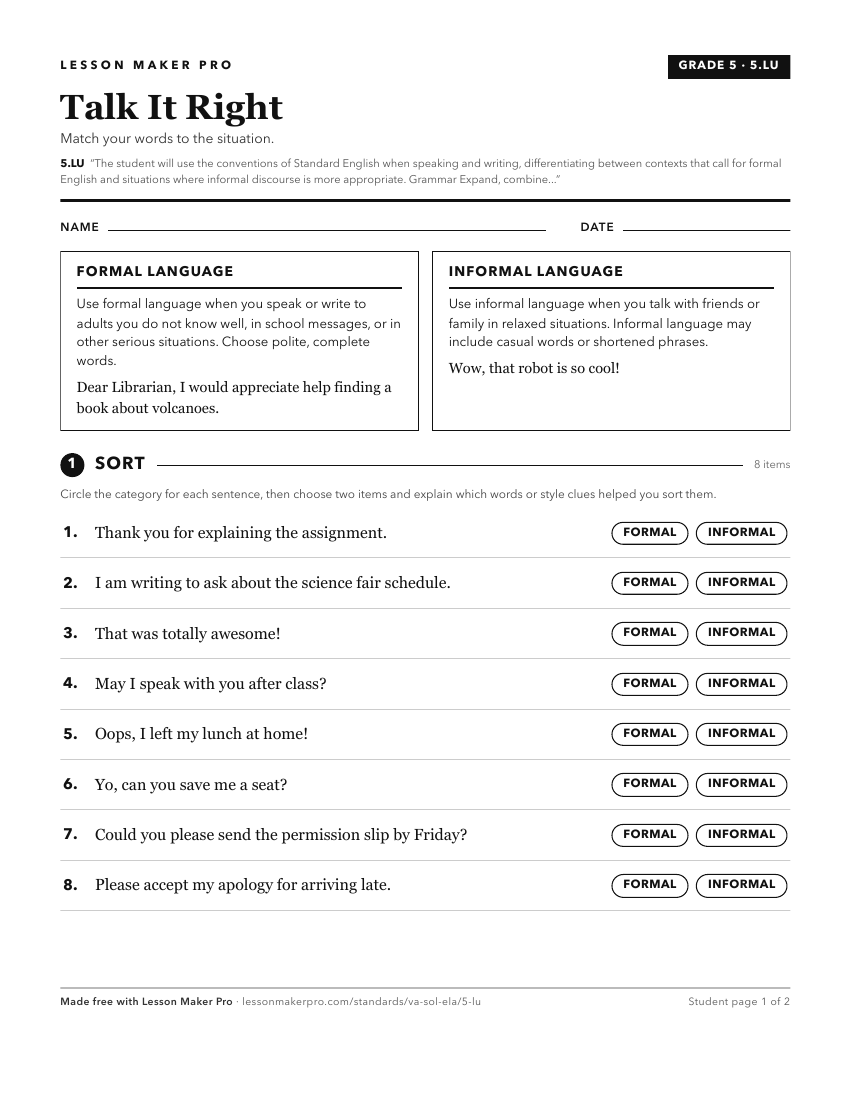
A ready-to-print activity worksheet aligned to 5.LU, with an answer key for the teacher on its own page. No account needed.
PDF, US Letter, prints cleanly in black and white.
Download the worksheetKeep exploring
Related Standards
Turn this cluster into a lesson
Grade, subject, topic, and the complete cluster are prefilled. Create one free, no account needed.
Also for this cluster:Make a WorksheetMake a QuizMake a Sub Lesson