Texas TEKS 7.20
TEKS Knowledge Statement (Expectation Cluster)
Social studies skills. The student applies critical-thinking skills to organize and use information acquired through established research methodologies from a variety of valid sources, including technology. The student is expected to: differentiate between, locate, and use valid primary and secondary sources such as media and news services, biographies, interviews, and artifacts to acquire information about Texas; analyze information by applying absolute and relative chronology through sequencing, categorizing, identifying cause-and-effect relationships, comparing, contrasting, finding the main idea, summarizing, making generalizations and predictions, and drawing inferences and conclusions; organize and interpret information from outlines, reports, databases, and visuals, including graphs, charts, timelines, and maps; identify bias and points of view from the historical context surrounding an event that influenced the participants; formulate and communicate visually, orally, or in writing a claim supported by evidence and reasoning related to a social studies topic; and evaluate a variety of historical and contemporary sources for validity, credibility, bias, and accuracy.
Texas Essential Knowledge and Skills for Social Studies
Cluster contents
Student Expectations in This Statement
7.20 is a TEKS knowledge and skills statement. These are the student expectations under it.
- 7.20.A
differentiate between, locate, and use valid primary and secondary sources such as media and news services, biographies, interviews, and artifacts to acquire in...
- 7.20.B
analyze information by applying absolute and relative chronology through sequencing, categorizing, identifying cause-and-effect relationships, comparing, contra...
- 7.20.C
organize and interpret information from outlines, reports, databases, and visuals, including graphs, charts, timelines, and maps
- 7.20.D
identify bias and points of view from the historical context surrounding an event that influenced the participants
- 7.20.E
formulate and communicate visually, orally, or in writing a claim supported by evidence and reasoning related to a social studies topic
- 7.20.F
evaluate a variety of historical and contemporary sources for validity, credibility, bias, and accuracy.
Teacher's field guide
What This Cluster Means
What Students Need to Do
- Students find and distinguish trustworthy primary and secondary sources about Texas. They organize information using timelines, maps, charts, and categories. They identify bias, explain cause and effect, and support a claim with evidence and reasoning.
What Mastery Looks Like
- Students can select credible sources and explain why each source is useful or limited. They can sequence events with exact dates and relative terms, then compare accounts from different viewpoints. Their claims use accurate evidence and clear reasoning.
Common Misconceptions
- Students may think every old source is primary or every recent source is secondary. They often treat bias as proof that a source is useless. They may confuse correlation with cause or make claims without linking evidence to reasoning.
How to Assess It
- Give students a short Texas history source, timeline, and chart. Ask them to classify the source, identify one bias, and write a claim supported by two details.
Lesson moves
Ways to Teach It
Give pairs six printed Texas source cards to sort as primary or secondary, then rank by credibility and annotate one reason.
Ask students to write: How did historical context shape two accounts of the same Texas event?
Run a chronology relay where teams sequence event cards, label dates as absolute or relative, and match causes to effects.
Compare a local news report with a government data chart, then decide which claim each source can support.
Free download
Printable 7.20 Worksheet
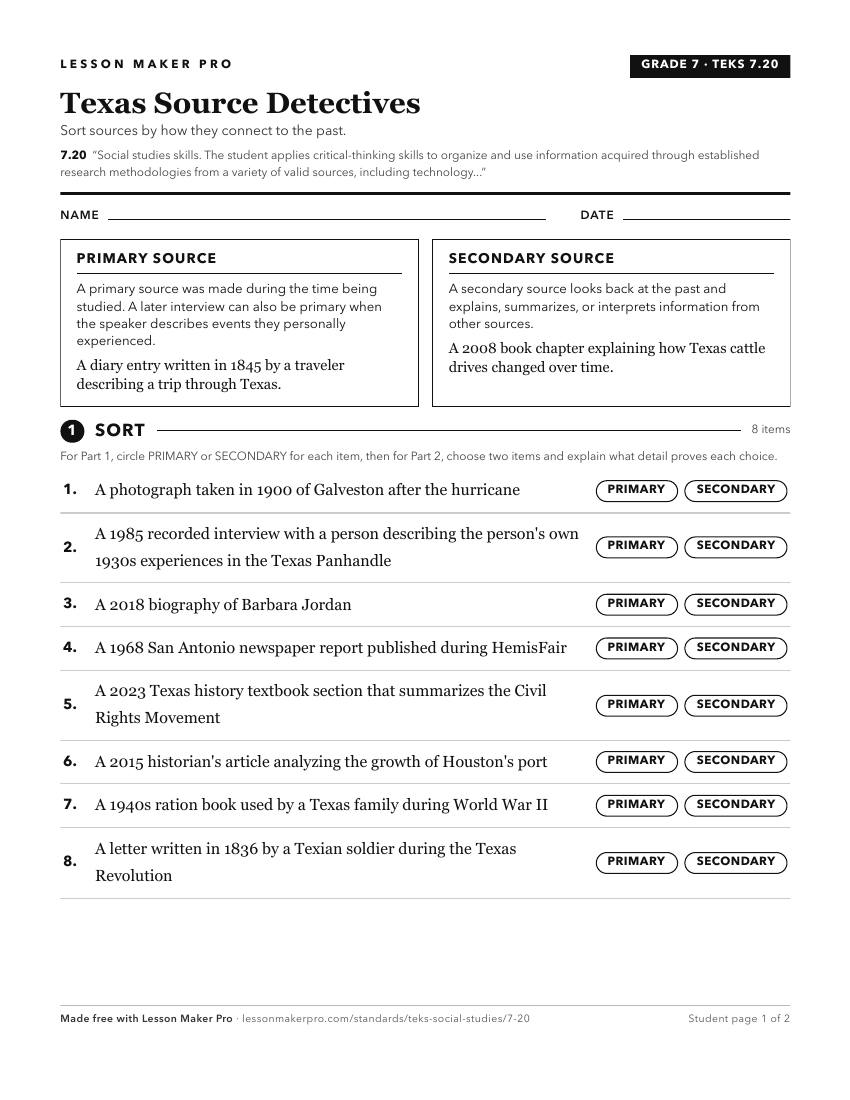
A ready-to-print activity worksheet aligned to 7.20, with an answer key for the teacher on its own page. No account needed.
PDF, US Letter, prints cleanly in black and white.
Download the worksheetKeep exploring
Related Standards
- 4.19
Social studies skills. The student applies critical-thinking skills to organize and use information acquired from a variety of valid sources, including technolo...
- 8.29
Social studies skills. The student applies critical-thinking skills to organize and use information acquired through established research methodologies from a v...
- 2.15
Social studies skills. The student applies critical-thinking skills to organize and use information acquired from a variety of valid sources, including technolo...
- K.13
Social studies skills. The student applies critical-thinking skills to organize and use information acquired from a variety of valid sources, including technolo...
Turn this cluster into a lesson
Grade, subject, topic, and the complete cluster are prefilled. Create one free, no account needed.
Also for this cluster:Make a WorksheetMake a QuizMake a Sub Lesson