Texas TEKS 7.20.F
The Standard
- 7.20
- Social studies skills. The student applies critical-thinking skills to organize and use information acquired through established research methodologies from a variety of valid sources, including technology. The student is expected to:
evaluate a variety of historical and contemporary sources for validity, credibility, bias, and accuracy.
Texas Essential Knowledge and Skills for Social Studies
Teacher's field guide
What This Standard Means
What Students Need to Do
- Students examine who created a source, when it was created, its purpose, and the evidence it uses. They compare sources to identify unsupported claims, factual errors, and biased language.
What Mastery Looks Like
- Students can judge whether a source is trustworthy and support that judgment with specific details. They confirm key claims by comparing them with reliable sources.
Common Misconceptions
- Students may assume that printed, official-looking, or popular sources are automatically trustworthy. They may treat bias as proof that a source is useless. They also confuse opinion with factual error.
How to Assess It
- Give students a museum article and an anonymous social media post about the same Texas event. Ask which is more credible and require two specific reasons.
Lesson moves
Ways to Teach It
Give groups four source cards about one Texas event, then have them highlight author, date, evidence, bias, and questionable claims.
Ask students to write: When can a biased source still provide useful historical evidence? Support your answer with an example.
Run a Source Detective game where teams earn points for finding missing authors, weak evidence, loaded words, and claims needing verification.
Compare an online claim about a local issue with city records and newspaper coverage, then list agreements, conflicts, and unanswered questions.
Free download
Printable 7.20.F Worksheet
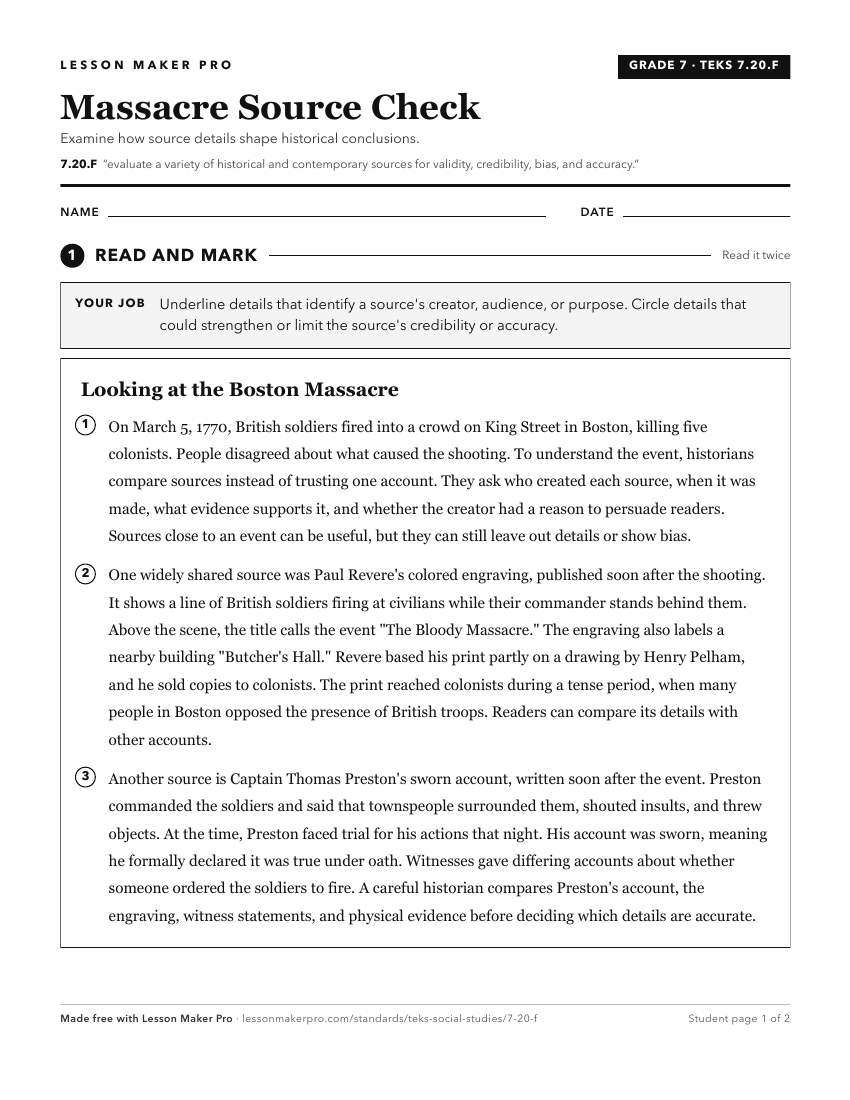
A ready-to-print activity worksheet aligned to 7.20.F, with an answer key for the teacher on its own page. No account needed.
PDF, US Letter, prints cleanly in black and white.
Download the worksheetKeep exploring
Related Standards
- 5.23.B
identify and ask questions about the credibility of different kinds of primary and secondary sources
- 6.19.F
evaluate a variety of historical and contemporary sources for validity, credibility, bias, and accuracy
- 6.19.A
differentiate between, locate, and use valid primary and secondary sources such as oral, print, and visual material and artifacts to acquire information about v...
- 8.29.F
evaluate a variety of historical and contemporary sources for validity, credibility, bias, and accuracy
Turn this exact standard into a lesson
Grade, subject, topic, and the complete standard are prefilled. Create one free, no account needed.
Also for this standard:Make a WorksheetMake a QuizMake a Sub Lesson