Texas TEKS 8.29.F
The Standard
- 8.29
- Social studies skills. The student applies critical-thinking skills to organize and use information acquired through established research methodologies from a variety of valid sources, including technology. The student is expected to:
evaluate a variety of historical and contemporary sources for validity, credibility, bias, and accuracy
Texas Essential Knowledge and Skills for Social Studies
Teacher's field guide
What This Standard Means
What Students Need to Do
- Students examine who created a source, why it was created, and what evidence supports its claims. They compare sources to spot bias, errors, missing context, and unsupported statements.
What Mastery Looks Like
- Students judge how trustworthy a source is and support that judgment with specific details. They verify claims across multiple sources and explain how bias or limited evidence affects usefulness.
Common Misconceptions
- Students may think a biased source is always useless or that a primary source is always accurate. They may also trust polished websites, photographs, or eyewitness accounts without checking origin, context, or supporting evidence.
How to Assess It
- Give students two short accounts of the same event with source information. Ask which is more credible and require two details that support their judgment.
Lesson moves
Ways to Teach It
Set up source stations with a replica newspaper, diary, photograph, and textbook excerpt; students label author, purpose, evidence, and missing context.
Ask, “When does bias make a source less useful?” Students write a claim, cite one example, then discuss exceptions.
Play a credibility ranking game: teams order source cards from most to least trustworthy and earn points for each evidence-based defense.
Compare a viral social media claim with a local news report and government record; students trace the original source and list verified facts.
Free download
Printable 8.29.F Worksheet
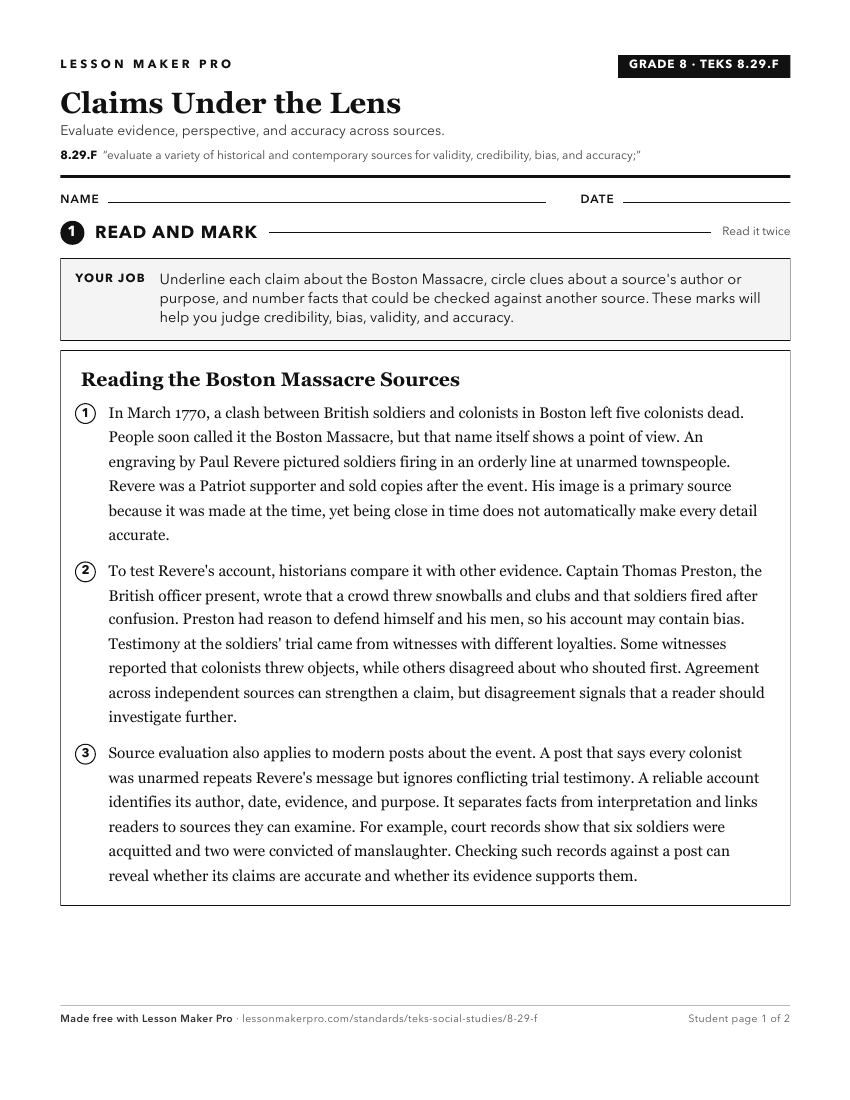
A ready-to-print activity worksheet aligned to 8.29.F, with an answer key for the teacher on its own page. No account needed.
PDF, US Letter, prints cleanly in black and white.
Download the worksheetKeep exploring
Related Standards
- 5.23.B
identify and ask questions about the credibility of different kinds of primary and secondary sources
- 8.29.A
differentiate between, locate, and use valid primary and secondary sources such as media and news services, biographies, interviews, and artifacts to acquire in...
- 7.20.F
evaluate a variety of historical and contemporary sources for validity, credibility, bias, and accuracy.
- 6.19.F
evaluate a variety of historical and contemporary sources for validity, credibility, bias, and accuracy
Turn this exact standard into a lesson
Grade, subject, topic, and the complete standard are prefilled. Create one free, no account needed.
Also for this standard:Make a WorksheetMake a QuizMake a Sub Lesson