Texas TEKS 7.20.A
The Standard
- 7.20
- Social studies skills. The student applies critical-thinking skills to organize and use information acquired through established research methodologies from a variety of valid sources, including technology. The student is expected to:
differentiate between, locate, and use valid primary and secondary sources such as media and news services, biographies, interviews, and artifacts to acquire information about Texas
Texas Essential Knowledge and Skills for Social Studies
Teacher's field guide
What This Standard Means
What Students Need to Do
- Students sort Texas history evidence by who created it, when it was created, and why. They find trustworthy sources and record facts, authors, dates, evidence, and points of view.
What Mastery Looks Like
- Given an interview, biography, news report, and artifact, students correctly identify each as primary or secondary and explain their reasoning. They select credible sources for a Texas history question and cite details that support an answer.
Common Misconceptions
- Students may think any old item is a primary source or that every interview is automatically reliable. They may treat the first search result as credible, or reject a useful source simply because it shows bias.
How to Assess It
- Show a 1900 Galveston diary excerpt and a modern textbook paragraph about the hurricane. Ask students to classify each, name one credibility check, and record one useful fact.
Lesson moves
Ways to Teach It
Set up a source lab with a Texas letter, photograph, artifact replica, and textbook page for students to classify and annotate.
Ask students to write which source, an eyewitness interview or encyclopedia entry, better explains Dust Bowl experiences and why.
Play Source Sort Relay using cards with creators, dates, and formats, then require teams to defend one disputed classification.
Compare a local drought report with a Texas Water Development Board map, then list agreements, differences, and supporting evidence.
Free download
Printable 7.20.A Worksheet
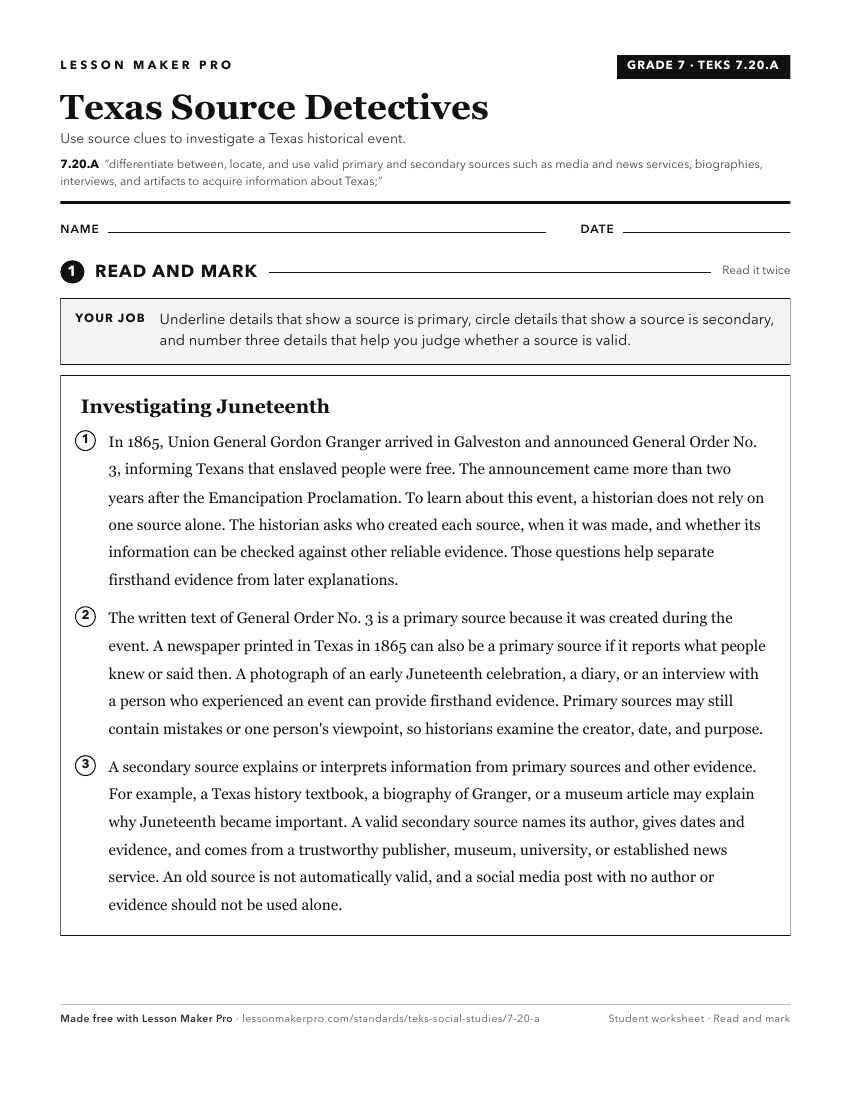
A ready-to-print activity worksheet aligned to 7.20.A, with an answer key for the teacher on its own page. No account needed.
PDF, US Letter, prints cleanly in black and white.
Download the worksheetKeep exploring
Related Standards
- 8.29.A
differentiate between, locate, and use valid primary and secondary sources such as media and news services, biographies, interviews, and artifacts to acquire in...
- 5.23.A
differentiate between, locate, and use valid primary and secondary sources such as technology; interviews; biographies; oral, print, and visual material; docume...
- 4.19.A
differentiate between, locate, and use valid primary and secondary sources such as technology; interviews; biographies; oral, print, and visual material; docume...
- 6.19.A
differentiate between, locate, and use valid primary and secondary sources such as oral, print, and visual material and artifacts to acquire information about v...
Turn this exact standard into a lesson
Grade, subject, topic, and the complete standard are prefilled. Create one free, no account needed.
Also for this standard:Make a WorksheetMake a QuizMake a Sub Lesson