Texas TEKS 8.6
TEKS Knowledge Statement (Expectation Cluster)
Matter and energy. The student understands that matter can be classified according to its properties and matter is conserved in chemical changes that occur within closed systems. The student is expected to: explain by modeling how matter is classified as elements, compounds, homogeneous mixtures, or heterogeneous mixtures; use the periodic table to identify the atoms involved in chemical reactions; describe the properties of cohesion, adhesion, and surface tension in water and relate to observable phenomena such as the formation of droplets, transport in plants, and insects walking on water; compare and contrast the properties of acids and bases, including pH relative to water; and investigate how mass is conserved in chemical reactions and relate conservation of mass to the rearrangement of atoms using chemical equations, including photosynthesis.
Texas Essential Knowledge and Skills for Science
Cluster contents
Student Expectations in This Statement
8.6 is a TEKS knowledge and skills statement. These are the student expectations under it.
- 8.6.A
explain by modeling how matter is classified as elements, compounds, homogeneous mixtures, or heterogeneous mixtures
- 8.6.B
use the periodic table to identify the atoms involved in chemical reactions
- 8.6.C
describe the properties of cohesion, adhesion, and surface tension in water and relate to observable phenomena such as the formation of droplets, transport in p...
- 8.6.D
compare and contrast the properties of acids and bases, including pH relative to water
- 8.6.E
investigate how mass is conserved in chemical reactions and relate conservation of mass to the rearrangement of atoms using chemical equations, including photos...
Teacher's field guide
What This Cluster Means
What Students Need to Do
- Students sort matter using particle models and observable properties. They use periodic table symbols and chemical equations to identify atoms and show that atoms rearrange while total mass stays constant. They also explain water behavior and compare acids and bases by pH.
What Mastery Looks Like
- A student can classify an unfamiliar sample and defend the choice with evidence. They can count each type of atom in an equation and explain equal mass in a closed reaction. They can predict water behavior and place acids, water, and bases correctly on a pH scale.
Common Misconceptions
- Students may call every clear liquid a pure substance or confuse compounds with homogeneous mixtures. They may think atoms disappear during reactions, or that equal mass requires equal numbers of molecules. They often reverse cohesion and adhesion, or assume all acids are dangerous and all bases are safe.
How to Assess It
- Give an exit ticket with a particle diagram, a pH value, a capillary tube sketch, and an unbalanced reaction. Ask students to classify the matter, label acid or base, name the water property, and count each atom before and after.
Lesson moves
Ways to Teach It
Measure a sealed bag of baking soda and vinegar before and after mixing, then draw particle models to explain the unchanged mass.
Show a water strider, a leaf droplet, and colored water rising in celery, then ask which water property explains each observation.
Run a card sort with element symbols, particle diagrams, mixture samples, pH values, and equations, requiring a reason for every match.
Test vinegar, water, soap solution, and sports drink with pH paper, then connect each result to safe household use.
Free download
Printable 8.6 Worksheet
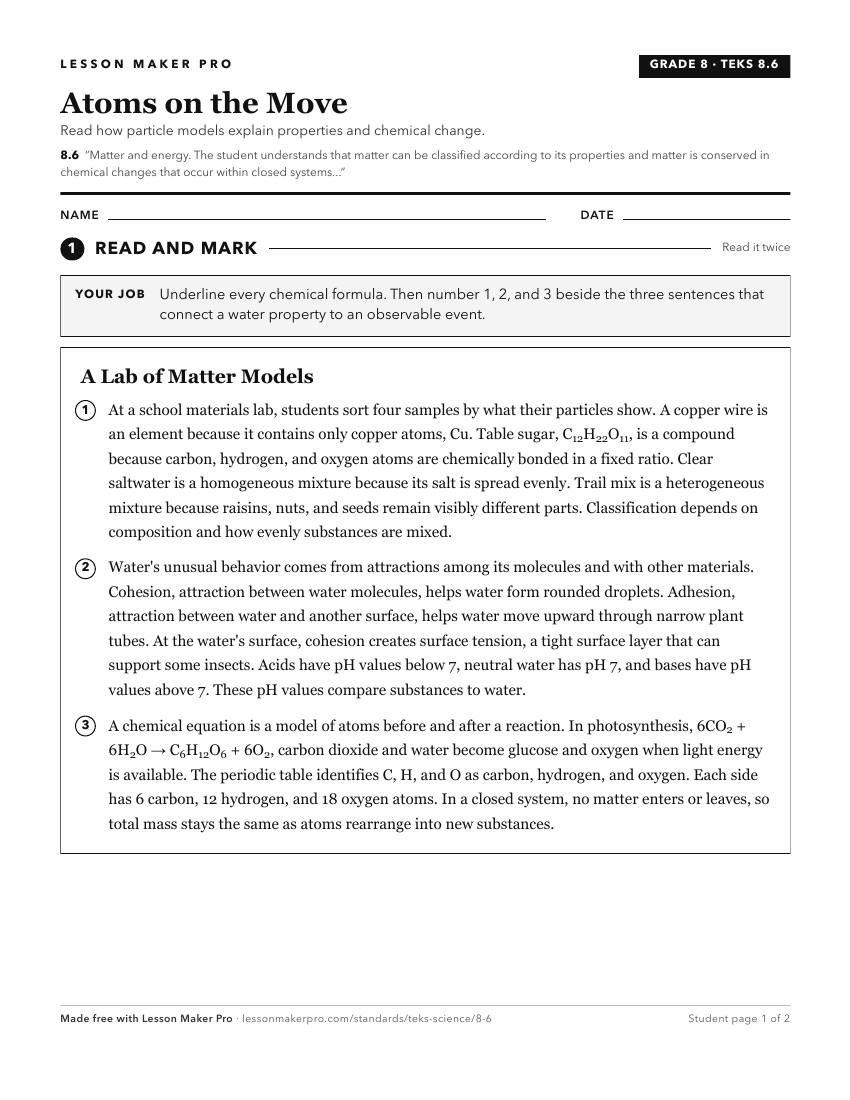
A ready-to-print activity worksheet aligned to 8.6, with an answer key for the teacher on its own page. No account needed.
PDF, US Letter, prints cleanly in black and white.
Download the worksheetKeep exploring
Related Standards
- 7.6
Matter and energy. The student distinguishes between elements and compounds, classifies changes in matter, and understands the properties of solutions. The stud...
- 3.6
Matter and energy. The student knows that matter has measurable physical properties that determine how matter is identified, classified, changed, and used. The ...
- 4.6
Matter and energy. The student knows that matter has measurable physical properties that determine how matter is identified, classified, changed, and used. The ...
- 6.6
Matter and energy. The student knows that matter is made of atoms, can be classified according to its properties, and can undergo changes. The student is expect...
Turn this cluster into a lesson
Grade, subject, topic, and the complete cluster are prefilled. Create one free, no account needed.
Also for this cluster:Make a WorksheetMake a QuizMake a Sub Lesson