Texas TEKS 8.6.A
The Standard
- 8.6
- The student understands that matter can be classified according to its properties and matter is conserved in chemical changes that occur within closed systems
explain by modeling how matter is classified as elements, compounds, homogeneous mixtures, or heterogeneous mixtures
Texas Essential Knowledge and Skills for Science
Teacher's field guide
What This Standard Means
What Students Need to Do
- Students classify matter as an element, compound, homogeneous mixture, or heterogeneous mixture. They use particle models to show how composition and particle distribution support each classification.
What Mastery Looks Like
- Students correctly classify a sample from its description, appearance, or particle model. They draw models with one atom type, bonded atom types, evenly mixed particles, or unevenly mixed particles.
Common Misconceptions
- Students often call compounds mixtures because compounds contain more than one element. They may think every uniform substance is an element or compound, and every mixture has visible parts.
How to Assess It
- Give students particle diagrams of copper, water, saltwater, and soil. Ask them to classify each and explain one choice using particle arrangement.
Lesson moves
Ways to Teach It
Sort sealed samples of copper wire, salt, saltwater, and soil, then build bead particle models and label each classification.
Write a claim explaining why saltwater is a mixture even though it looks like one substance.
Play a four-corner game where students move to the classification matching each sample card and defend their choice.
Examine a cereal bowl and a sports drink, then explain why one is heterogeneous and the other is homogeneous.
Free download
Printable 8.6.A Worksheet
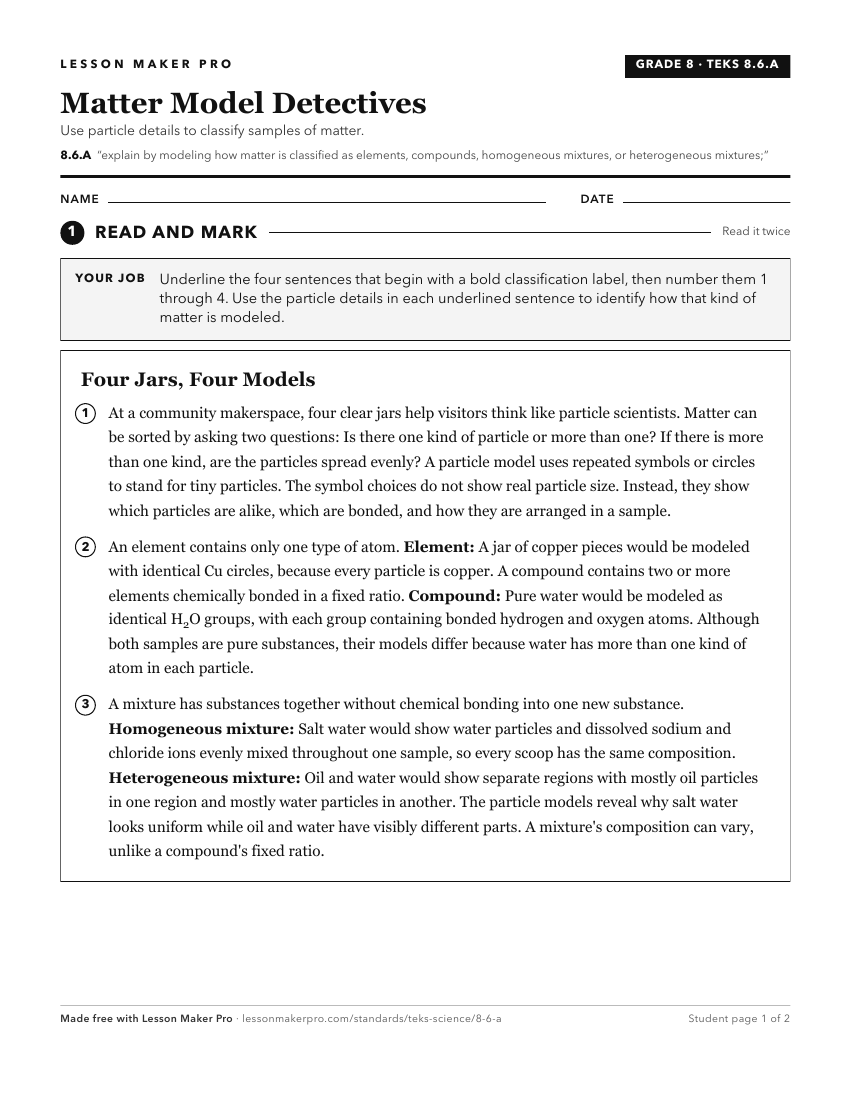
A ready-to-print activity worksheet aligned to 8.6.A, with an answer key for the teacher on its own page. No account needed.
PDF, US Letter, prints cleanly in black and white.
Download the worksheetKeep exploring
Related Standards
- 5.6.B
demonstrate and explain that some mixtures maintain physical properties of their substances such as iron filings and sand or sand and water
- 7.6
Matter and energy. The student distinguishes between elements and compounds, classifies changes in matter, and understands the properties of solutions. The stud...
- 4.6.A
classify and describe matter using observable physical properties, including temperature, mass, magnetism, relative density (the ability to sink or float in wat...
- 6.6.B
investigate the physical properties of matter to distinguish between pure substances, homogeneous mixtures (solutions), and heterogeneous mixtures
Turn this exact standard into a lesson
Grade, subject, topic, and the complete standard are prefilled. Create one free, no account needed.
Also for this standard:Make a WorksheetMake a QuizMake a Sub Lesson