Texas TEKS 6.6.B
The Standard
- 6.6
- Matter and energy. The student knows that matter is made of atoms, can be classified according to its properties, and can undergo changes. The student is expected to:
investigate the physical properties of matter to distinguish between pure substances, homogeneous mixtures (solutions), and heterogeneous mixtures
Texas Essential Knowledge and Skills for Science
Teacher's field guide
What This Standard Means
What Students Need to Do
- Students observe and measure properties such as clarity, solubility, magnetism, and uniformity. They use the evidence to classify a sample as a pure substance, a solution, or a nonuniform mixture.
What Mastery Looks Like
- A student can classify unfamiliar samples and support each choice with physical property evidence. They know uniform appearance alone cannot separate a pure substance from a solution, so more property data may be needed.
Common Misconceptions
- Students often call any clear or uniform sample a pure substance. They may think a dissolved solid has vanished, or that every mixture must have visible pieces. Some classify matter only by state, such as treating all liquids as solutions.
How to Assess It
- Give students a table: Sample A is uniform and boils at 100°C, Sample B is uniform and boils from 102°C to 105°C, and Sample C forms two layers. Ask them to classify each sample and cite the deciding evidence.
Lesson moves
Ways to Teach It
Give groups salt, saltwater, and sand-water; have them test uniformity, filtration, and evaporation, then classify each sample.
Ask students to write why clear saltwater and clear distilled water may belong in different groups despite looking alike.
Run a card sort with property descriptions for saltwater, granite, distilled water, air, and muddy water, requiring evidence for every classification.
Compare distilled water, vinegar, and Italian dressing, then explain how product appearance and label information support each classification.
Free download
Printable 6.6.B Worksheet
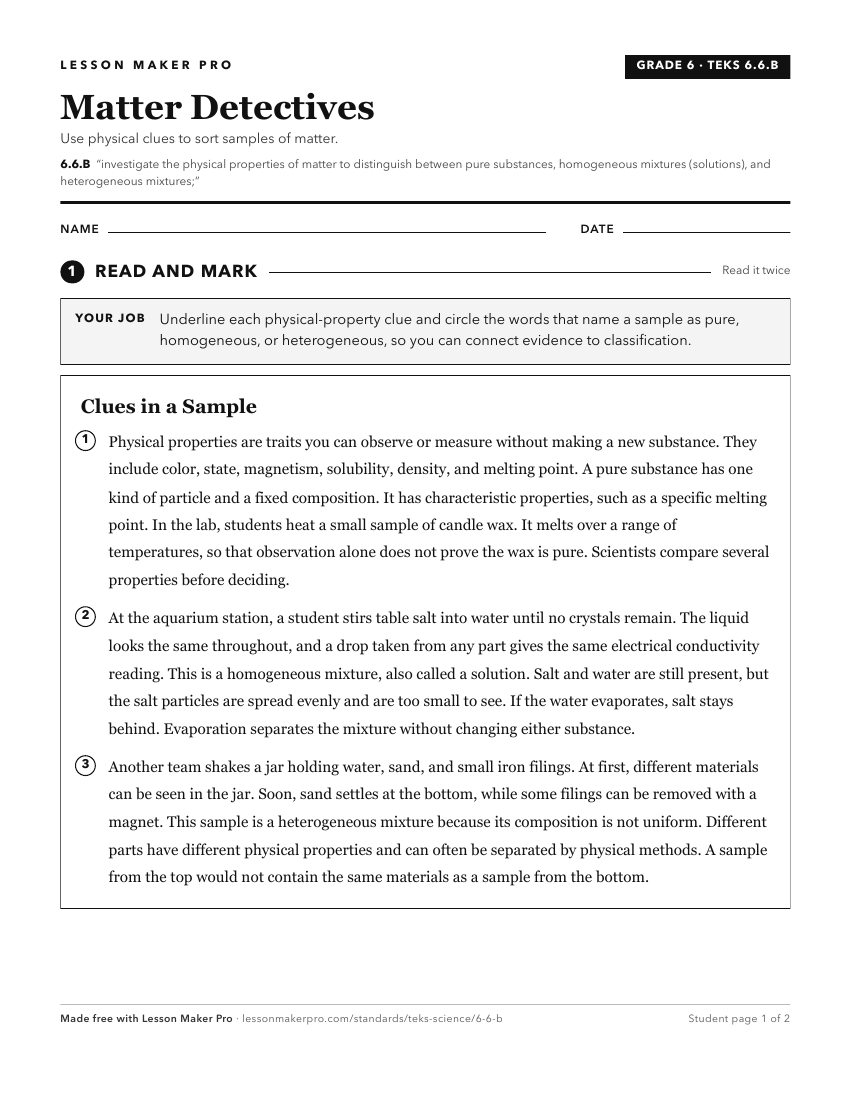
A ready-to-print activity worksheet aligned to 6.6.B, with an answer key for the teacher on its own page. No account needed.
PDF, US Letter, prints cleanly in black and white.
Download the worksheetKeep exploring
Related Standards
- 2.6.A
classify matter by observable physical properties, including texture, flexibility, and relative temperature, and identify whether a material is a solid or liqui...
- 5.6.C
compare the properties of substances before and after they are combined into a solution and demonstrate that matter is conserved in solutions
- 4.6.B
investigate and compare a variety of mixtures, including solutions that are composed of liquids in liquids and solids in liquids
- 4.6.A
classify and describe matter using observable physical properties, including temperature, mass, magnetism, relative density (the ability to sink or float in wat...
Turn this exact standard into a lesson
Grade, subject, topic, and the complete standard are prefilled. Create one free, no account needed.
Also for this standard:Make a WorksheetMake a QuizMake a Sub Lesson