Texas TEKS 2.6.A
The Standard
- 2.6
- Matter and its properties. The student knows that matter has physical properties that determine how it is described, classified, and used. The student is expected to:
classify matter by observable physical properties, including texture, flexibility, and relative temperature, and identify whether a material is a solid or liquid
Texas Essential Knowledge and Skills for Science
Teacher's field guide
What This Standard Means
What Students Need to Do
- Students examine everyday materials and sort them using features they can see, feel, or compare safely. They describe texture, bendability, warmth or coolness, and decide whether each sample keeps its shape or flows.
What Mastery Looks Like
- A student can sort several samples, name the property used, and explain why each belongs in its group. The student correctly labels solids and liquids even when their colors, containers, or textures differ.
Common Misconceptions
- Students may think every solid is hard or rigid, so they misclassify cloth, foam, or rubber. They may call sand or rice a liquid because it pours, even though each grain is solid. They may describe temperature without comparing one sample to another.
How to Assess It
- Place a sponge, craft stick, sealed cup of cool water, and sealed cup of room-temperature oil at each table. Ask students to label each solid or liquid and write two property comparisons.
Lesson moves
Ways to Teach It
Set out foil, felt, rubber bands, craft sticks, water, and oil for students to inspect and sort on labeled mats.
Ask whether something can be soft and still be solid, then have students defend an answer with one observed example.
Play Property Riddles by describing one sample by texture, flexibility, temperature, and state while partners identify it from a set.
Compare an apple slice, juice in a clear cup, a napkin, and a spoon by state, texture, and flexibility.
Free download
Printable 2.6.A Worksheet
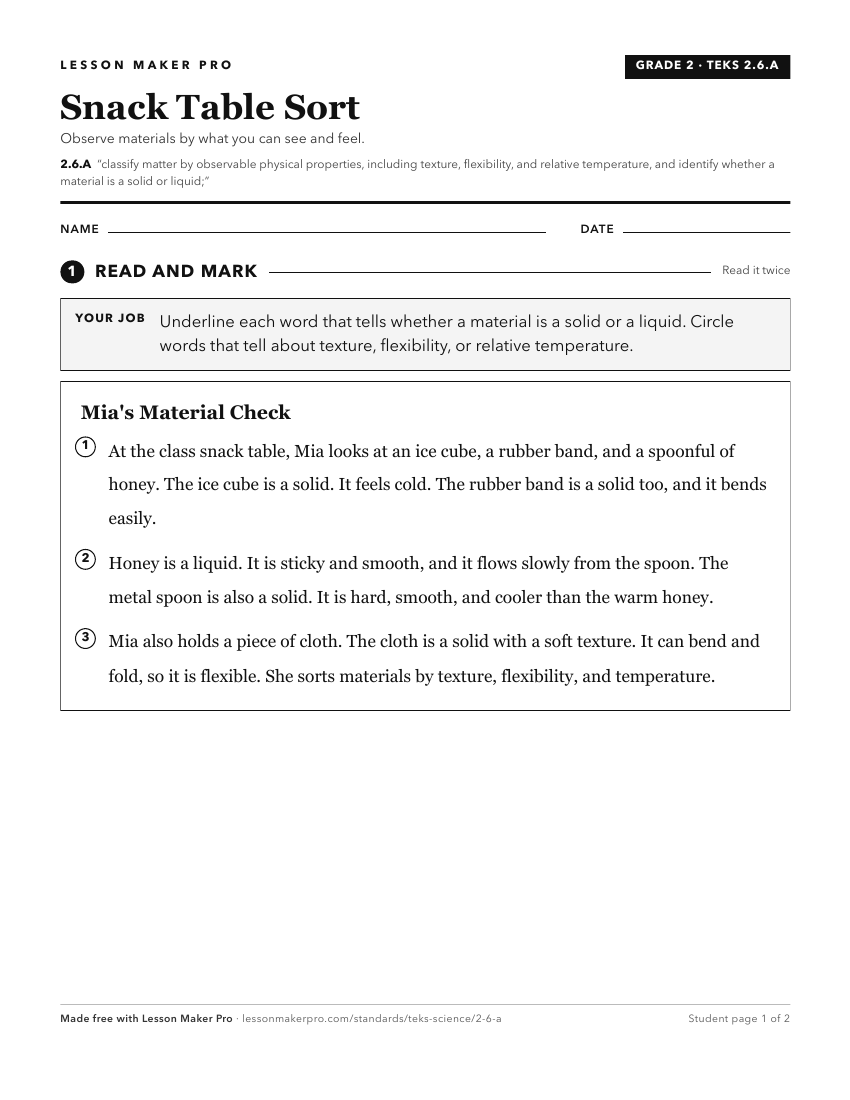
A ready-to-print activity worksheet aligned to 2.6.A, with an answer key for the teacher on its own page. No account needed.
PDF, US Letter, prints cleanly in black and white.
Download the worksheetKeep exploring
Related Standards
- 4.6.A
classify and describe matter using observable physical properties, including temperature, mass, magnetism, relative density (the ability to sink or float in wat...
- 6.6.B
investigate the physical properties of matter to distinguish between pure substances, homogeneous mixtures (solutions), and heterogeneous mixtures
- 5.6.A
compare and contrast matter based on measurable, testable, or observable physical properties, including mass, magnetism, relative density (sinking and floating ...
- 1.6.A
classify objects by observable physical properties, including, shape, color, and texture, and attributes such as larger and smaller and heavier and lighter
Turn this exact standard into a lesson
Grade, subject, topic, and the complete standard are prefilled. Create one free, no account needed.
Also for this standard:Make a WorksheetMake a QuizMake a Sub Lesson