Texas TEKS 4.6.B
The Standard
- 4.6
- Matter and energy. The student knows that matter has measurable physical properties that determine how matter is identified, classified, changed, and used. The student is expected to:
investigate and compare a variety of mixtures, including solutions that are composed of liquids in liquids and solids in liquids
Texas Essential Knowledge and Skills for Science
Teacher's field guide
What This Standard Means
What Students Need to Do
- Students combine common solids and liquids with water and record what happens. They compare whether each sample looks uniform, forms layers, settles, or can be filtered.
What Mastery Looks Like
- Students can explain why salt water is different from sand water and why oil behaves differently from food coloring in water. They use observations as evidence.
Common Misconceptions
- Students may think every mixture dissolves or that stirring always creates a solution. They may also think clear samples are pure substances and layered samples are not mixtures.
How to Assess It
- Give students pictures of salt water, sand water, oil and water, and food coloring in water. Ask them to group the samples and justify each group with one observable property.
Lesson moves
Ways to Teach It
Mix salt, sand, oil, and food coloring separately with water, then record dissolving, settling, layers, and filter results in a table.
Write a claim comparing salt water and sand water, then support it with observations about visibility, settling, and filtration.
Play Mixture Match by pairing sample cards with property cards such as uniform, layered, settles, dissolves, or filters out.
Examine a bottle of salad dressing before and after shaking, then explain why layers return after it sits.
Free download
Printable 4.6.B Worksheet
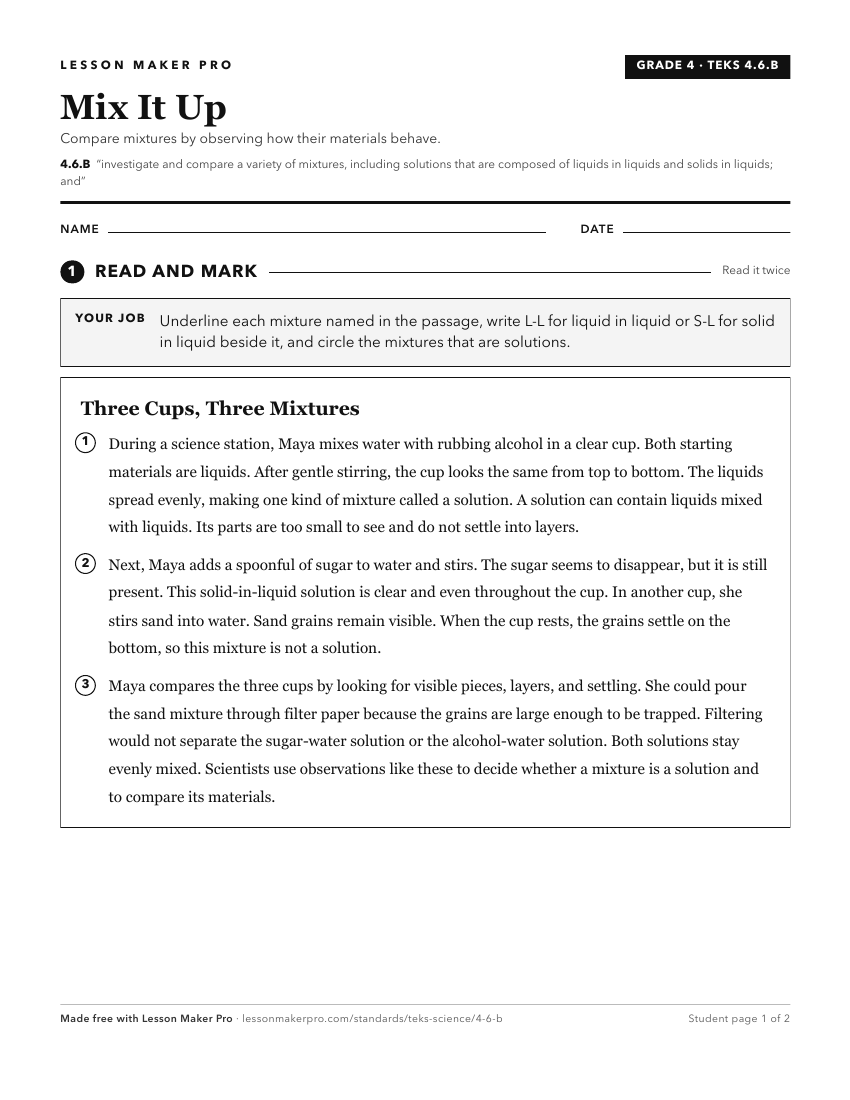
A ready-to-print activity worksheet aligned to 4.6.B, with an answer key for the teacher on its own page. No account needed.
PDF, US Letter, prints cleanly in black and white.
Download the worksheetKeep exploring
Related Standards
- 5.6.C
compare the properties of substances before and after they are combined into a solution and demonstrate that matter is conserved in solutions
- 5.6.B
demonstrate and explain that some mixtures maintain physical properties of their substances such as iron filings and sand or sand and water
- 6.6.B
investigate the physical properties of matter to distinguish between pure substances, homogeneous mixtures (solutions), and heterogeneous mixtures
- 6.6.D
compare the density of substances relative to various fluids
Turn this exact standard into a lesson
Grade, subject, topic, and the complete standard are prefilled. Create one free, no account needed.
Also for this standard:Make a WorksheetMake a QuizMake a Sub Lesson