Texas TEKS 6.6.D
The Standard
- 6.6
- Matter and energy. The student knows that matter is made of atoms, can be classified according to its properties, and can undergo changes. The student is expected to:
compare the density of substances relative to various fluids
Texas Essential Knowledge and Skills for Science
Teacher's field guide
What This Standard Means
What Students Need to Do
- Students predict and test whether a solid will sink, float, or remain suspended in different liquids. They use the results to compare the solid’s density with each liquid’s density.
What Mastery Looks Like
- A student can explain that a sinking object is denser than the liquid and a floating object is less dense. They can use several test results to place materials in density order.
Common Misconceptions
- Students may think heavy objects always sink and light objects always float. They may assume an object behaves the same way in every liquid or confuse density with size, mass, or thickness.
How to Assess It
- Exit ticket: A plastic bead sinks in vegetable oil but floats in water. Rank water, the bead, and oil from greatest to least density, then explain.
Lesson moves
Ways to Teach It
Test the same four objects in cups of water, vegetable oil, and corn syrup, then record sink, float, or suspended.
Write a claim explaining why the same object might float in saltwater but sink in fresh water, using density as evidence.
Play Density Detective by matching sink-and-float result cards to density-order cards, then explain each match to a partner.
Read a cargo ship scenario and decide how moving from ocean water to river water changes how low the ship rides.
Free download
Printable 6.6.D Worksheet
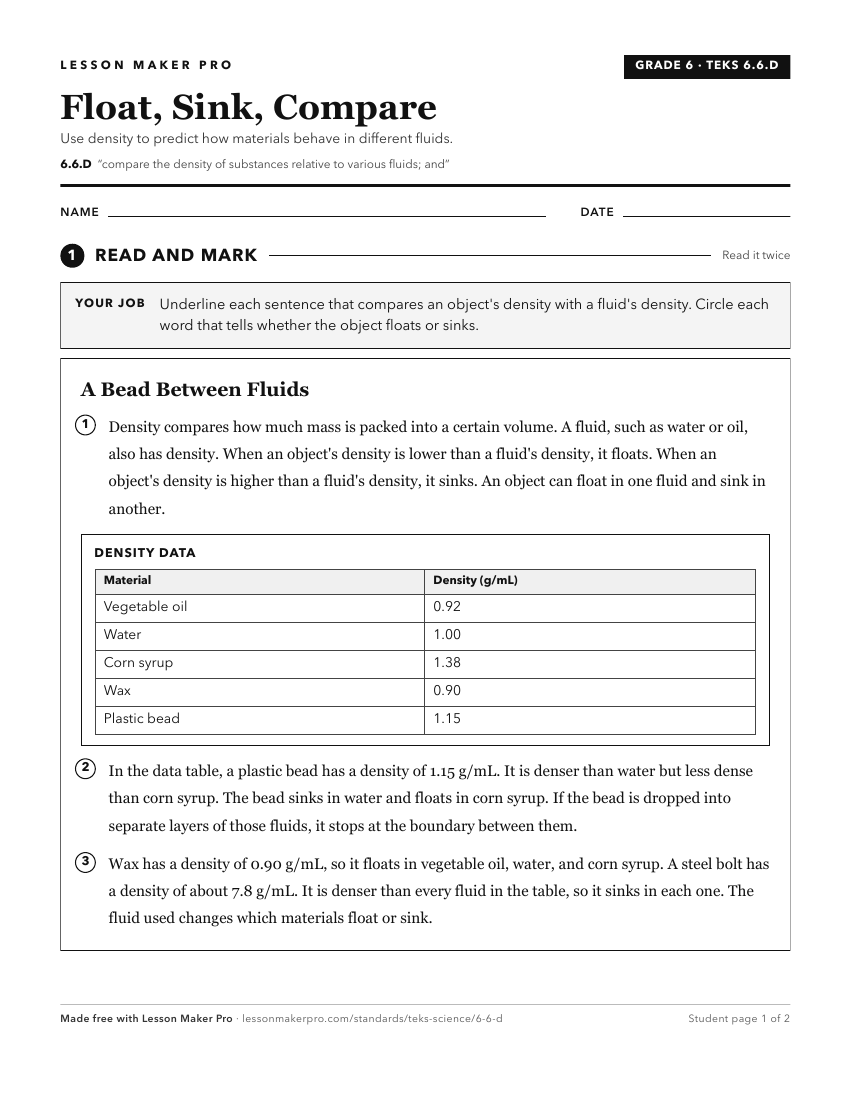
A ready-to-print activity worksheet aligned to 6.6.D, with an answer key for the teacher on its own page. No account needed.
PDF, US Letter, prints cleanly in black and white.
Download the worksheetKeep exploring
Related Standards
- 5.6.C
compare the properties of substances before and after they are combined into a solution and demonstrate that matter is conserved in solutions
- 4.6.B
investigate and compare a variety of mixtures, including solutions that are composed of liquids in liquids and solids in liquids
- 6.6.A
compare solids, liquids, and gases in terms of their structure, shape, volume, and kinetic energy of atoms and molecules
- 5.6.A
compare and contrast matter based on measurable, testable, or observable physical properties, including mass, magnetism, relative density (sinking and floating ...
Turn this exact standard into a lesson
Grade, subject, topic, and the complete standard are prefilled. Create one free, no account needed.
Also for this standard:Make a WorksheetMake a QuizMake a Sub Lesson