Texas TEKS 6.6.A
The Standard
- 6.6
- Matter and energy. The student knows that matter is made of atoms, can be classified according to its properties, and can undergo changes. The student is expected to:
compare solids, liquids, and gases in terms of their structure, shape, volume, and kinetic energy of atoms and molecules
Texas Essential Knowledge and Skills for Science
Teacher's field guide
What This Standard Means
What Students Need to Do
- Students identify how particles are arranged and move in each state of matter. They connect particle behavior to whether a sample keeps its shape and volume. They also compare relative kinetic energy, from lower in solids to higher in gases.
What Mastery Looks Like
- Students can label particle diagrams and explain why solids hold shape, liquids flow, and gases fill a container. They can compare particle spacing, movement, volume, and kinetic energy using evidence from a model.
Common Misconceptions
- Students may think gas particles have no volume or that liquid particles are widely separated. They may also confuse kinetic energy with stored energy or assume particles stop moving in solids.
How to Assess It
- Give students three particle diagrams and ask them to identify each state, then describe its shape, volume, particle arrangement, and relative kinetic energy.
Lesson moves
Ways to Teach It
Build three particle models in clear boxes using taped beads, loose packed beads, and a few loose beads, then compare movement.
Ask, “Why does water keep its volume in a new cup while air fills the whole cup?” and require particle evidence.
Run a card sort matching particle diagrams, shape, volume, and relative kinetic energy to solid, liquid, or gas.
Have students explain why a sealed syringe of air compresses more than a sealed syringe of water using particle spacing.
Free download
Printable 6.6.A Worksheet
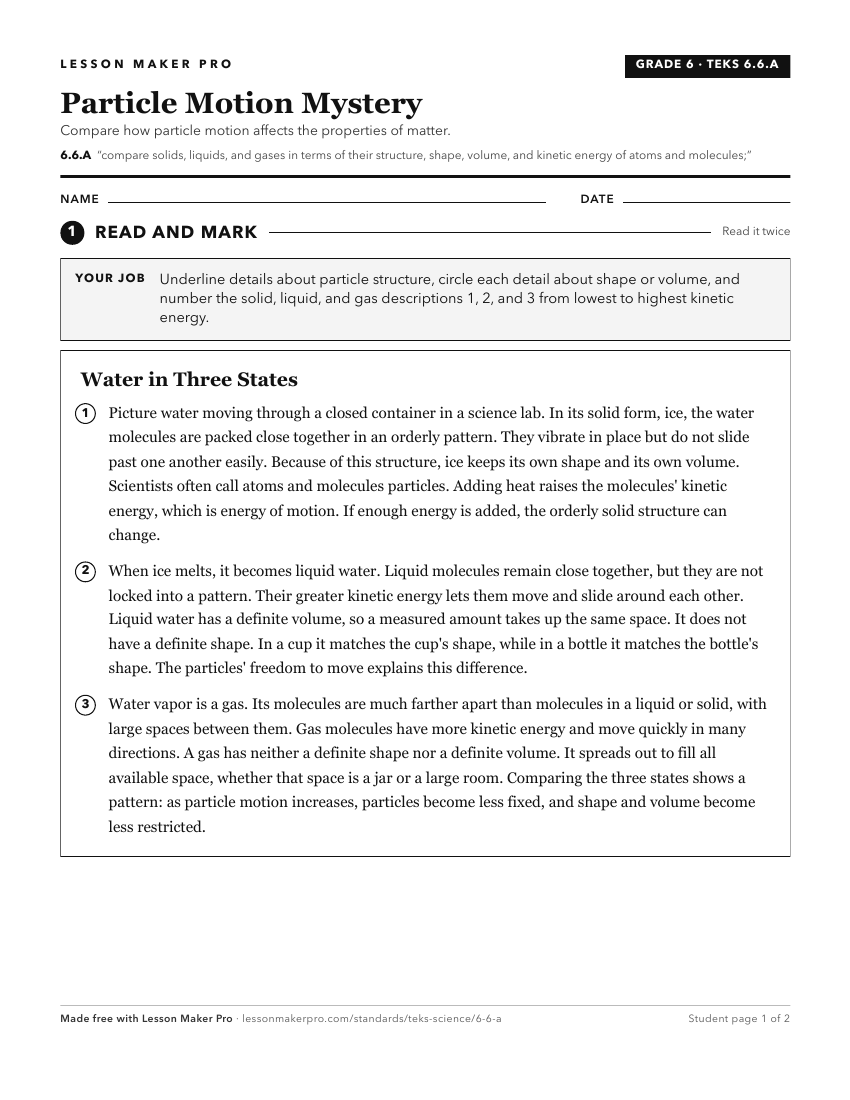
A ready-to-print activity worksheet aligned to 6.6.A, with an answer key for the teacher on its own page. No account needed.
PDF, US Letter, prints cleanly in black and white.
Download the worksheetKeep exploring
Related Standards
- 1.5.E
identify forms of energy and properties of matter
- 3.6.B
describe and classify samples of matter as solids, liquids, and gases and demonstrate that solids have a definite shape and that liquids and gases take the shap...
- 4.6.A
classify and describe matter using observable physical properties, including temperature, mass, magnetism, relative density (the ability to sink or float in wat...
- 7.6.A
compare and contrast elements and compounds in terms of atoms and molecules, chemical symbols, and chemical formulas
Turn this exact standard into a lesson
Grade, subject, topic, and the complete standard are prefilled. Create one free, no account needed.
Also for this standard:Make a WorksheetMake a QuizMake a Sub Lesson