Texas TEKS 7.6.A
The Standard
- 7.6
- Matter and energy. The student distinguishes between elements and compounds, classifies changes in matter, and understands the properties of solutions. The student is expected to:
compare and contrast elements and compounds in terms of atoms and molecules, chemical symbols, and chemical formulas
Texas Essential Knowledge and Skills for Science
Teacher's field guide
What This Standard Means
What Students Need to Do
- Students classify substances from particle models, symbols, and formulas. They explain that an element contains one type of atom, while a compound contains different atom types chemically joined.
What Mastery Looks Like
- Students correctly classify examples such as Fe, O2, H2O, and NaCl and explain each choice. They identify the elements in a formula and count the atoms shown by subscripts.
Common Misconceptions
- Students may call O2 a compound because it has two atoms, or call any two substances together a compound. They may ignore capitalization or think a subscript applies to every symbol in a formula.
How to Assess It
- Exit ticket: Classify O2, CO2, and NaCl as elements or compounds, then list each atom type and its count. Explain why O2 and CO2 differ.
Lesson moves
Ways to Teach It
Use colored beads and connectors to build models of He, O2, H2O, and CO2, then label each model as an element or compound.
Ask students to write: Why is O2 an element while CO is a compound? Use atom types, symbols, and formulas.
Run a card sort matching substance names, particle diagrams, symbols, and formulas, then have partners explain one match.
Create a materials chart for aluminum foil, distilled water, and table salt, listing notation, atom types, and classification.
Free download
Printable 7.6.A Worksheet
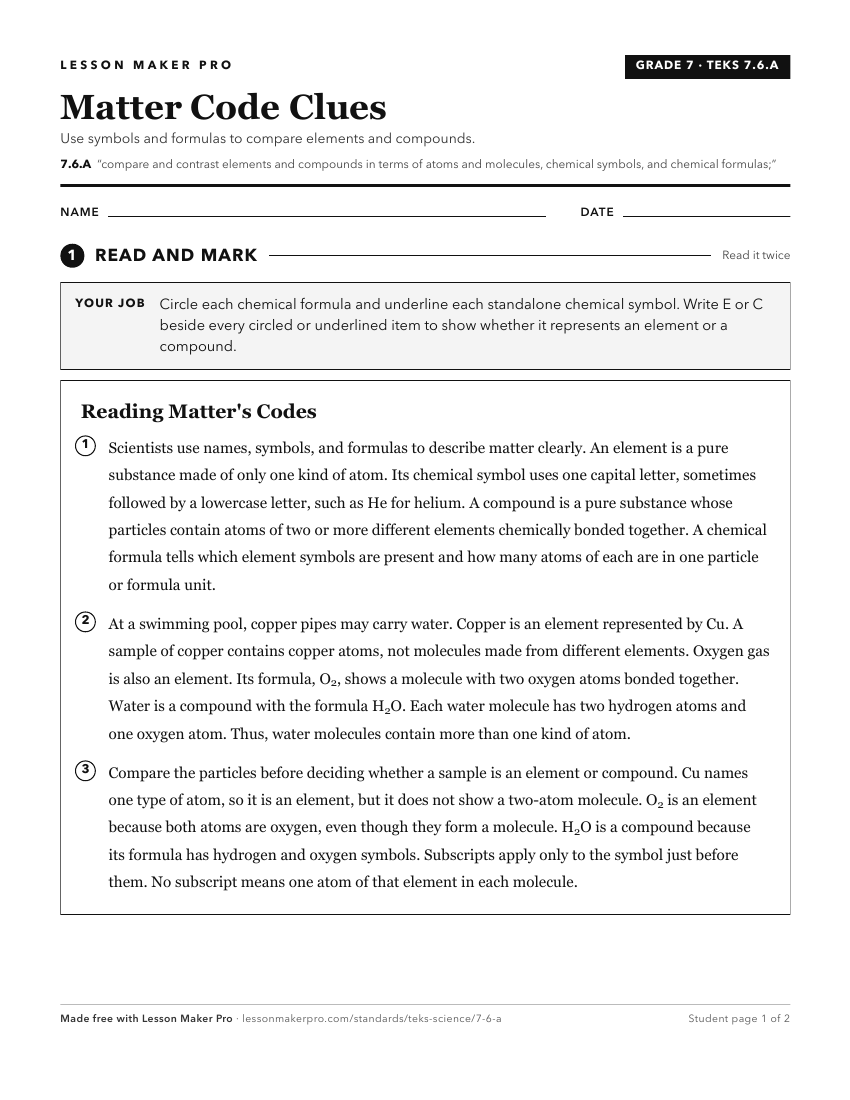
A ready-to-print activity worksheet aligned to 7.6.A, with an answer key for the teacher on its own page. No account needed.
PDF, US Letter, prints cleanly in black and white.
Download the worksheetKeep exploring
Related Standards
- 8.6.B
use the periodic table to identify the atoms involved in chemical reactions
- 6.6.A
compare solids, liquids, and gases in terms of their structure, shape, volume, and kinetic energy of atoms and molecules
- 7.6.B
use the periodic table to identify the atoms and the number of each kind within a chemical formula
- 5.6.A
compare and contrast matter based on measurable, testable, or observable physical properties, including mass, magnetism, relative density (sinking and floating ...
Turn this exact standard into a lesson
Grade, subject, topic, and the complete standard are prefilled. Create one free, no account needed.
Also for this standard:Make a WorksheetMake a QuizMake a Sub Lesson