Texas TEKS 3.6.B
The Standard
- 3.6
- Matter and energy. The student knows that matter has measurable physical properties that determine how matter is identified, classified, changed, and used. The student is expected to:
describe and classify samples of matter as solids, liquids, and gases and demonstrate that solids have a definite shape and that liquids and gases take the shape of their container
Texas Essential Knowledge and Skills for Science
Teacher's field guide
What This Standard Means
What Students Need to Do
- Students identify matter as solid, liquid, or gas by observing its properties. They explain how each sample behaves when placed in different containers.
What Mastery Looks Like
- Students correctly classify objects such as a rock, water, and air. They show that a solid keeps its own shape, while water and air match the containers holding them.
Common Misconceptions
- Students may think all solids are hard or that powders are liquids because they can be poured. They may also think gas is not matter because it cannot usually be seen.
How to Assess It
- Show students a wooden block, water in a cup, and an inflated balloon. Ask them to classify each sample and describe what happens in a new container.
Lesson moves
Ways to Teach It
Move a block, water, and air in sealed bags between containers, then record which samples change shape.
Ask students to write: How can you prove that invisible air is matter and takes the shape of its container?
Play a card sort using pictures of matter, with students placing each card under solid, liquid, or gas and defending one choice.
Compare ice, liquid water, and water vapor during cooking, then identify how each form behaves in its container.
Free download
Printable 3.6.B Worksheet
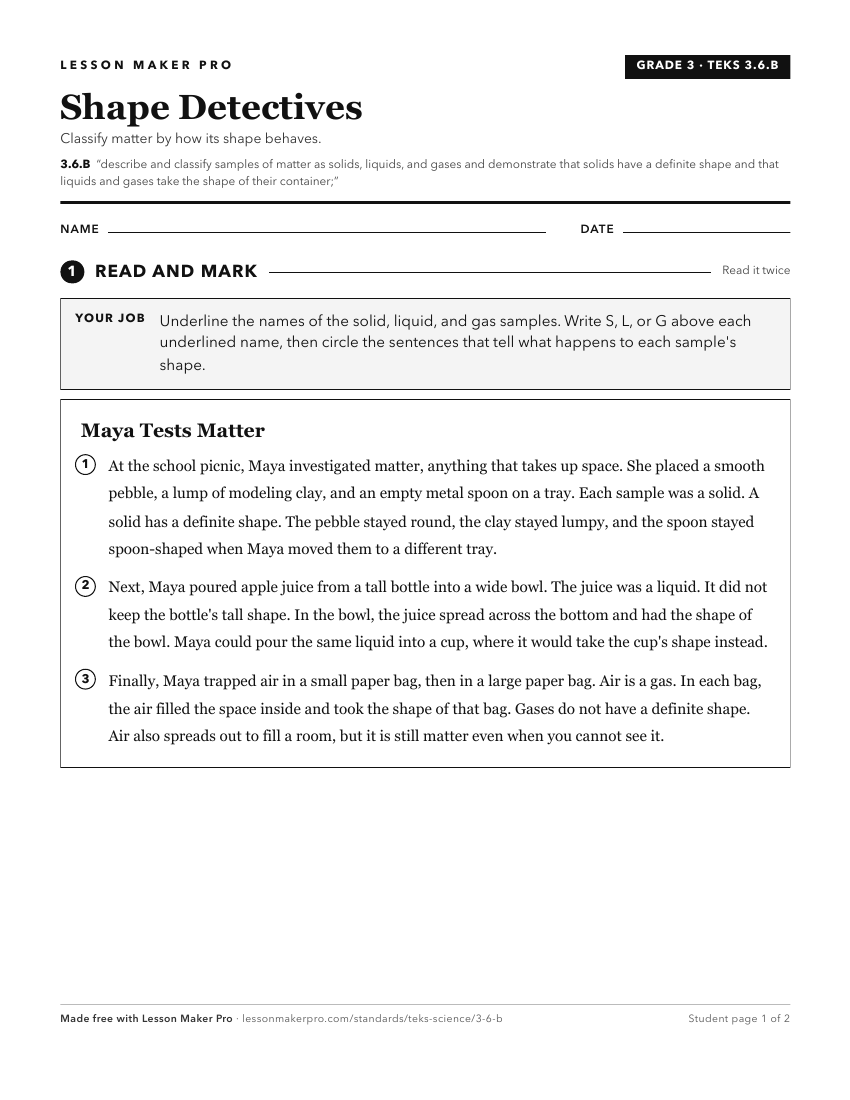
A ready-to-print activity worksheet aligned to 3.6.B, with an answer key for the teacher on its own page. No account needed.
PDF, US Letter, prints cleanly in black and white.
Download the worksheetKeep exploring
Related Standards
- 2.6.A
classify matter by observable physical properties, including texture, flexibility, and relative temperature, and identify whether a material is a solid or liqui...
- 6.6.A
compare solids, liquids, and gases in terms of their structure, shape, volume, and kinetic energy of atoms and molecules
- 5.6.B
demonstrate and explain that some mixtures maintain physical properties of their substances such as iron filings and sand or sand and water
- 4.6.A
classify and describe matter using observable physical properties, including temperature, mass, magnetism, relative density (the ability to sink or float in wat...
Turn this exact standard into a lesson
Grade, subject, topic, and the complete standard are prefilled. Create one free, no account needed.
Also for this standard:Make a WorksheetMake a QuizMake a Sub Lesson