Texas TEKS 7.6
TEKS Knowledge Statement (Expectation Cluster)
Matter and energy. The student distinguishes between elements and compounds, classifies changes in matter, and understands the properties of solutions. The student is expected to: compare and contrast elements and compounds in terms of atoms and molecules, chemical symbols, and chemical formulas; use the periodic table to identify the atoms and the number of each kind within a chemical formula; distinguish between physical and chemical changes in matter; describe aqueous solutions in terms of solute and solvent, concentration, and dilution; and investigate and model how temperature, surface area, and agitation affect the rate of dissolution of solid solutes in aqueous solutions.
Texas Essential Knowledge and Skills for Science
Cluster contents
Student Expectations in This Statement
7.6 is a TEKS knowledge and skills statement. These are the student expectations under it.
- 7.6.A
compare and contrast elements and compounds in terms of atoms and molecules, chemical symbols, and chemical formulas
- 7.6.B
use the periodic table to identify the atoms and the number of each kind within a chemical formula
- 7.6.C
distinguish between physical and chemical changes in matter
- 7.6.D
describe aqueous solutions in terms of solute and solvent, concentration, and dilution
- 7.6.E
investigate and model how temperature, surface area, and agitation affect the rate of dissolution of solid solutes in aqueous solutions.
Teacher's field guide
What This Cluster Means
What Students Need to Do
- Students tell elements from compounds by reading particle models, symbols, and formulas. They use the periodic table and subscripts to identify the atoms in a formula and count each kind. They classify changes, describe concentration and dilution, and test factors that change dissolution rate.
What Mastery Looks Like
- Given CaCl2, a student identifies the elements and counts one calcium atom and two chlorine atoms. The student classifies observed changes and cites evidence such as gas formation or a new color. The student labels solute and solvent, compares concentrations, and predicts dissolution rates when temperature, particle size, or stirring changes.
Common Misconceptions
- Students often treat subscripts as coefficients, count element symbols incorrectly, or assume every molecule is a compound. They may call dissolving a chemical change because the solid disappears, or confuse melting with dissolving. They also confuse faster dissolution with greater solubility and think stirring increases the final amount that can dissolve.
How to Assess It
- Give students an exit ticket showing Na2CO3, melting wax, rusting iron, two saltwater mixtures, and sugar stirred in hot or cold water. Ask them to count atoms, classify changes, label solution parts, compare concentration, and predict faster dissolution.
Lesson moves
Ways to Teach It
At three stations, time equal sugar samples dissolving while changing only water temperature, crystal size, or stirring.
Ask students why O2 is an element but H2O is a compound, using atoms, molecules, symbols, and formulas.
Run a card sort with element samples, compound samples, physical changes, and chemical changes, then require evidence for each placement.
Mix two sports drink concentrations, calculate each recipe's solute-to-water ratio, and connect dilution to label directions.
Free download
Printable 7.6 Worksheet
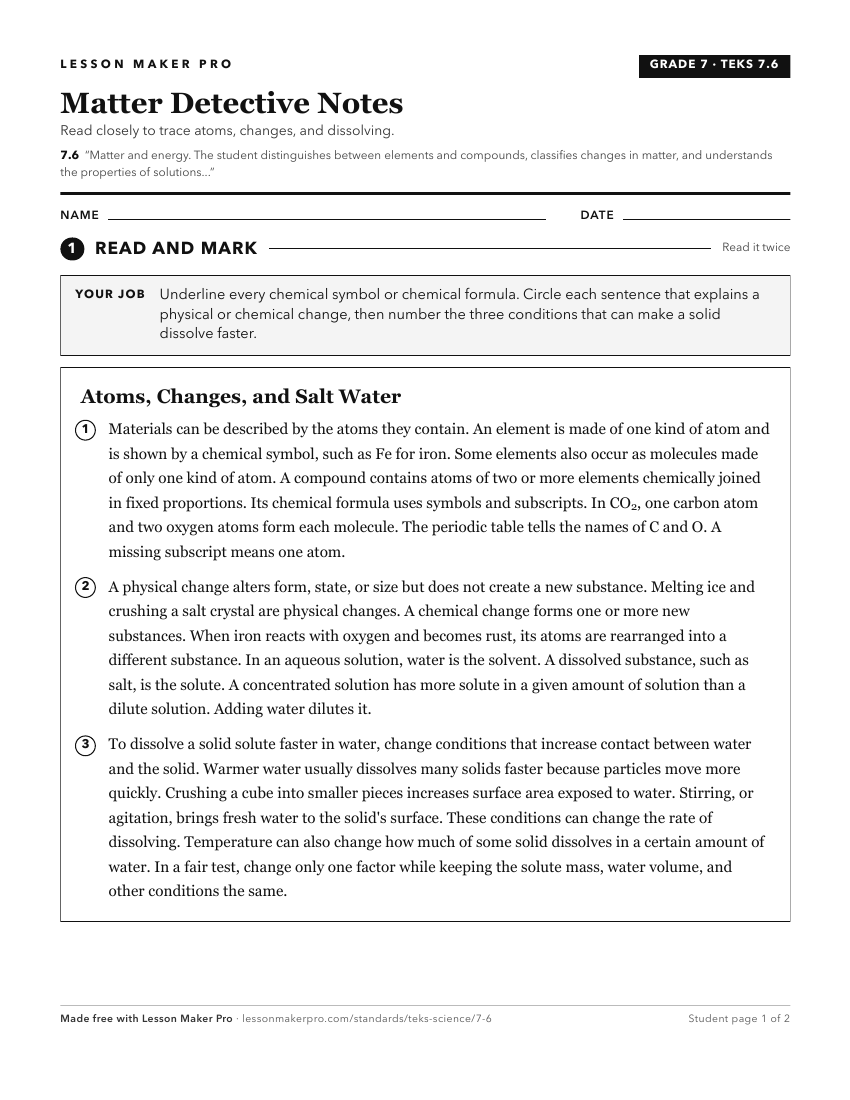
A ready-to-print activity worksheet aligned to 7.6, with an answer key for the teacher on its own page. No account needed.
PDF, US Letter, prints cleanly in black and white.
Download the worksheetKeep exploring
Related Standards
- 5.6
Matter and energy. The student knows that matter has measurable physical properties that determine how matter is identified, classified, changed, and used. The ...
- 3.6
Matter and energy. The student knows that matter has measurable physical properties that determine how matter is identified, classified, changed, and used. The ...
- 4.6
Matter and energy. The student knows that matter has measurable physical properties that determine how matter is identified, classified, changed, and used. The ...
- 6.6
Matter and energy. The student knows that matter is made of atoms, can be classified according to its properties, and can undergo changes. The student is expect...
Turn this cluster into a lesson
Grade, subject, topic, and the complete cluster are prefilled. Create one free, no account needed.
Also for this cluster:Make a WorksheetMake a QuizMake a Sub Lesson