Texas TEKS 7.6.C
The Standard
- 7.6
- Matter and energy. The student distinguishes between elements and compounds, classifies changes in matter, and understands the properties of solutions. The student is expected to:
distinguish between physical and chemical changes in matter
Texas Essential Knowledge and Skills for Science
Teacher's field guide
What This Standard Means
What Students Need to Do
- Students decide whether a change creates a new substance or only changes form, size, or state. They support each decision with observations such as gas production, temperature change, or a new solid.
What Mastery Looks Like
- Students correctly classify melting, freezing, cutting, dissolving, burning, rusting, and cooking. They explain that evidence of a new substance matters more than whether the change can be reversed.
Common Misconceptions
- Students often label every color change, bubble, or temperature change as chemical. They may also think dissolving is always chemical or that every reversible change is physical.
How to Assess It
- Give students three cases: melting ice, rusting a nail, and dissolving salt in water. Ask them to classify each and justify one answer with evidence.
Lesson moves
Ways to Teach It
Have groups melt ice, dissolve salt, and mix baking soda with vinegar, then record observations and classify each change.
Ask students to write: Is dissolving salt a physical or chemical change, and what evidence supports your claim?
Play a card sort with examples such as tearing foil, burning wood, cooking eggs, freezing juice, and tarnishing silver.
Students photograph or list five changes at home, then label each one and explain whether a new substance formed.
Free download
Printable 7.6.C Worksheet
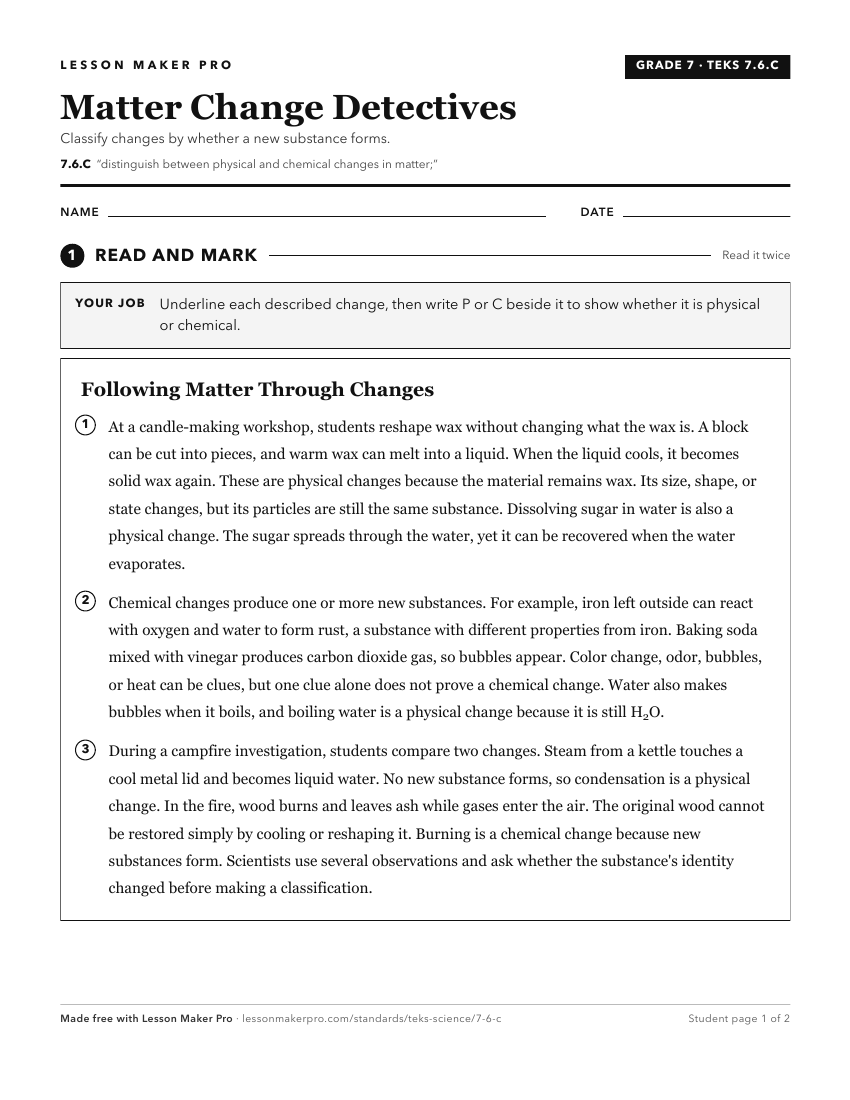
A ready-to-print activity worksheet aligned to 7.6.C, with an answer key for the teacher on its own page. No account needed.
PDF, US Letter, prints cleanly in black and white.
Download the worksheetKeep exploring
Related Standards
- 7.6
Matter and energy. The student distinguishes between elements and compounds, classifies changes in matter, and understands the properties of solutions. The stud...
- 4.6.A
classify and describe matter using observable physical properties, including temperature, mass, magnetism, relative density (the ability to sink or float in wat...
- 6.6.B
investigate the physical properties of matter to distinguish between pure substances, homogeneous mixtures (solutions), and heterogeneous mixtures
- 5.6.A
compare and contrast matter based on measurable, testable, or observable physical properties, including mass, magnetism, relative density (sinking and floating ...
Turn this exact standard into a lesson
Grade, subject, topic, and the complete standard are prefilled. Create one free, no account needed.
Also for this standard:Make a WorksheetMake a QuizMake a Sub Lesson